
The Hidden Cost of Running Your Business Without ERPNext
Many small and mid-sized businesses think they are saving money by delaying ERP adoption. The reality is very different. Every month, inefficiencies, duplicated work, delayed approvals, and fragmented data quietly drain ₹50,000 or more from your business.
These losses aren’t always obvious. They hide in repeated data entry errors, late reports, inventory discrepancies, missed deadlines, and slow customer responses. On the surface, operations may seem “under control,” but the cumulative impact erodes profitability, slows growth, and creates stress for your team.
If your business still relies on spreadsheets, WhatsApp messages, or disconnected software, it’s likely bleeding time and money without even realising it. This guide will show exactly how these hidden costs accumulate, and how ERPNext can help eliminate them.
Manual Work & Wasted Time
Many SMEs spend hours each day repeating the same work across multiple spreadsheets, email threads, and disconnected tools. Sales orders, purchase details, inventory updates, and payment information are often entered numerous times, doubling the workload and increasing the risk of errors.
Manual reporting adds further delays. Teams spend days consolidating data from different files, verifying numbers, and reconciling inconsistencies. Reports that should take minutes often stretch into hours, or even days, slowing decision-making and reducing agility.
On top of this, employees constantly check WhatsApp messages, emails, and phone calls to confirm the latest updates. Without an automated workflow, every follow-up consumes valuable time that could be spent on higher-value tasks.
Estimated monthly financial impact: ₹15,000–₹20,000 lost in wasted hours and reduced productivity.
Operational Errors
When businesses rely on manual processes, mistakes become inevitable, and even small errors can have a big impact. Incorrect billing, duplicate entries, or mismatched stock levels can disrupt sales, finance, and inventory management, creating a ripple effect that affects cash flow, customer trust, and operational efficiency.
Common operational errors include:
- Wrong billing amounts or duplicate invoices: Lead to undercharging, overcharging, and extra time spent correcting mistakes.
- Mismatched stock and inventory data: Causes stockouts, overstocking, or missed orders, frustrating customers and impacting revenue.
- GST or compliance errors: Increases the risk of penalties and requires time-consuming corrections.
Because these errors often go unnoticed until they accumulate, they drain resources silently and slow business growth.
Estimated monthly financial impact: ₹10,000–₹15,000 lost each month due to rework, delays, and reduced customer satisfaction.
Inventory Mismanagement
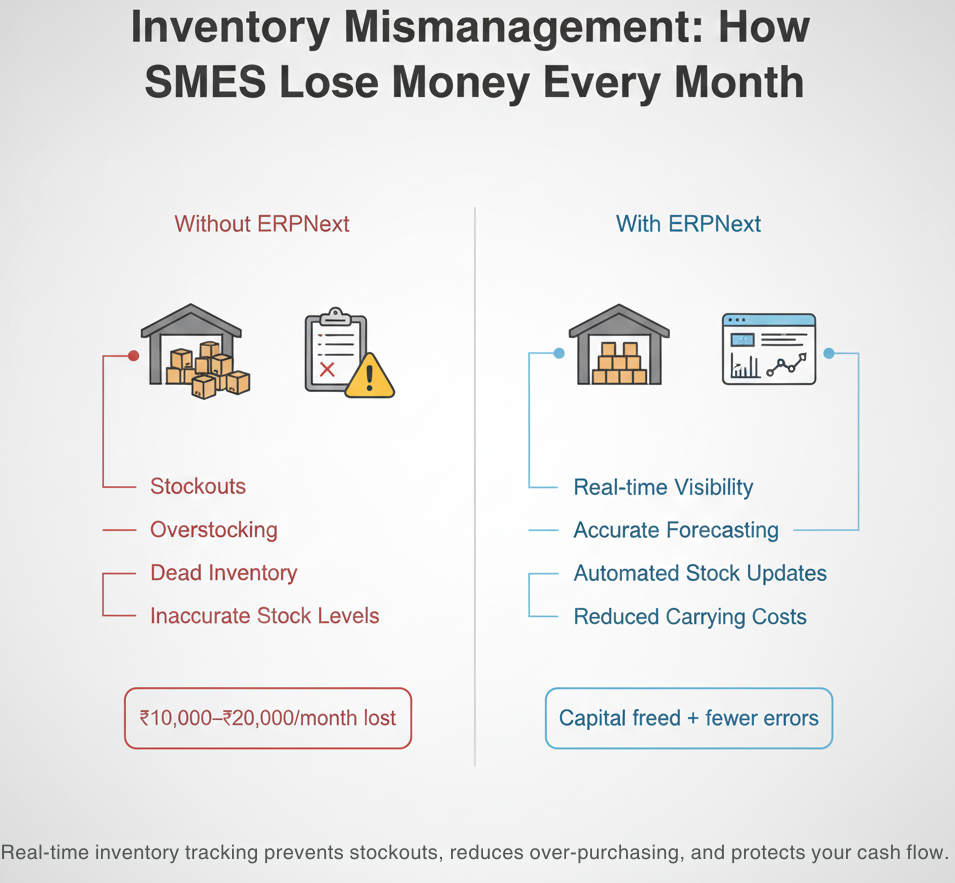
For many SMEs, inventory is one of the most expensive assets, yet it is often managed using spreadsheets, scattered tools, or manual records. Without real-time visibility, businesses struggle to maintain the right stock levels. Over time, this leads to over-purchasing, which ties up working capital in slow-moving or excess inventory, and stockouts, which result in lost sales and unhappy customers. Items that are not tracked properly may also get damaged, expire, or become unsellable, forcing businesses to write them off. These inefficiencies not only increase operational costs but also disrupt cash flow and customer satisfaction.
Estimated monthly financial impact: ₹10,000–₹20,000 lost each month due to poor inventory management.
Delayed Decision-Making
One of the highest hidden costs for SMEs without a proper ERP system is slow and inaccurate decision-making. When reporting relies on spreadsheets, emails, and disconnected tools, teams spend hours or even days gathering and reconciling data from multiple sources. By the time the report reaches management, the information is often outdated, making it difficult to respond quickly to operational challenges or market changes.
This delay affects forecasting and cash flow management. Inaccurate or inconsistent data makes it hard to predict demand, plan purchases, or track actual cash positions. Managers struggle to identify risks or make timely adjustments, which can result in overstocking, missed sales, or inefficient allocation of resources.
The impact goes beyond numbers. Missed opportunities, such as delayed deals, untapped promotions, or slow responses to customer needs, slow growth and erode competitiveness. Decisions made on incomplete information increase operational costs, frustrate teams, and create stress for leadership, ultimately affecting both profitability and long-term business success.
Estimated monthly financial impact: ₹5,000–₹10,000 lost each month due to slow, inconsistent reporting and delayed decision-making.
Low Accountability & Workflow Issues
When SMEs rely on scattered tools and manual communication channels like emails, WhatsApp messages, or spreadsheets, it becomes difficult to maintain clear accountability. Employees are often unsure who is responsible for specific tasks, leading to confusion, duplication of effort, and missed deadlines. Without a centralised system to assign, track, and monitor tasks, critical work can easily slip through the cracks.
This lack of structure also affects workflow consistency. Teams handle similar tasks differently, creating inefficiencies and bottlenecks. Managers spend extra time following up, clarifying responsibilities, and checking on progress instead of focusing on strategy and growth. Over time, these inefficiencies slow overall productivity and increase operational stress.
The consequences extend to the customer experience. Missed deadlines, delayed responses, and inconsistent communication reduce client satisfaction and trust, directly impacting repeat business and revenue. Without a unified system, even simple follow-ups become time-consuming and error-prone, leaving both employees and customers frustrated.
Common issues include:
- Unclear task ownership leading to duplicated work
- Missed deadlines due to a lack of tracking
- Inconsistent communication across teams is affecting customers
Estimated monthly financial impact: ₹5,000–₹10,000 lost each month due to inefficiency, missed follow-ups, and duplicated work.
Missed Sales & Poor Customer Response
Inefficient sales processes and slow customer responses can cost SMEs significant revenue each month. Sales teams often take longer to prepare quotations because pricing, stock availability, and customer details are scattered across multiple tools. Support teams spend extra time manually checking order status, payment details, or service history, delaying responses and frustrating customers. These delays and inconsistencies directly impact repeat business, as clients who experience slow or unreliable service may turn to competitors instead. Over time, missed opportunities and slower sales cycles reduce revenue, erode trust, and harm the company’s reputation, making this a hidden but serious cost of operating without a centralised system like ERPNext.
Estimated monthly financial impact: ₹10,000 or more lost each month due to missed deals, delayed responses, and lower customer retention.
Total Cost of Not Having ERPNext
When you combine the losses from manual work, operational errors, poor inventory management, delayed decision-making, low accountability, and slow customer responses, the financial impact on a typical SME is staggering. On average, businesses lose ₹50,000 to ₹75,000 or more every month due to inefficiencies that are often invisible on the balance sheet.
These hidden costs silently erode profitability. Teams spend excessive time on repetitive tasks, errors go unnoticed until they accumulate, inventory mismanagement ties up capital, and delayed decisions lead to missed opportunities. Customers experience slower service, which affects retention and revenue. Without a centralised system like ERPNext, SMEs continue to operate in a reactive mode, constantly firefighting issues rather than focusing on growth and efficiency.
Implementing ERPNext addresses these challenges by streamlining workflows, automating repetitive tasks, centralising data, and giving management real-time visibility into operations. The result is a business that runs more efficiently, makes faster and more accurate decisions, and protects both revenue and customer trust.
How ERPNext Solves These Problems
ERPNext provides SMEs with a centralised, all-in-one platform that brings structure and efficiency to every part of the business. By consolidating data from sales, inventory, finance, HR, and customer interactions, it eliminates the need for multiple spreadsheets and scattered tools, reducing errors and saving valuable time. Automation of routine tasks, such as invoicing, stock updates, approvals, and reminders, ensures workflows continue smoothly without constant manual intervention.
With real-time dashboards and reporting, business owners and managers gain instant visibility into sales performance, inventory levels, cash flow, and team productivity. Accurate tracking of inventory, sales, and finances prevents overstocking, stockouts, and billing errors, while standardised workflows and clear task accountability ensure that responsibilities are well-defined and deadlines are met.
Unlike traditional ERP systems, ERPNext is open-source, affordable, and fully scalable. SMEs can implement it without high licensing costs, add users or modules as the business grows, and customise workflows to suit their unique processes. By adopting ERPNext, businesses streamline operations, improve accuracy, enhance customer satisfaction, and recover thousands of rupees each month that would otherwise be lost to inefficiency.
Take Action Today
If your business is still struggling with scattered tools, manual processes, and hidden inefficiencies, now is the time to act. ERPNext offers a practical, cost-effective solution that helps SMEs streamline operations, reduce errors, and improve productivity without the high costs of traditional ERP systems.
Scheduling a consultation or demo is the first step toward transforming your workflows and reclaiming the money and time lost each month. With ERPNext, you can see firsthand how centralised data, automation, and real-time reporting make daily operations smoother and more reliable, while giving you clear visibility into your business performance.
Don’t wait to improve your business. Book your free ERPNext implementation consultation today and discover how your SME can save ₹50,000+ every month while building a more efficient, scalable, and profitable business.
