

The one rule that prevents 90% of project failures.
Every development project balances three forces: time, cost, and quality. In practice, you can only prioritize two. Pushing one side always affects the others.
When these trade-offs are ignored, problems don’t disappear. They show up later as delays, rework, and missed expectations. When they’re understood early, planning becomes realistic, and outcomes become predictable.
This is the principle behind the Developer’s Triangle, and it explains why so many projects fail before they even begin.
Why You Can’t Have All Three
This limitation has nothing to do with developer capability. It has everything to do with how work actually gets done.
A digital project is far more than writing code. It includes discovery, design, development, testing, revisions, coordination, and quality assurance. Each stage requires time and focused effort. When one part of the equation is compressed, pressure shifts elsewhere, often in ways that are not immediately visible.
Most projects that struggle are not poorly built. They are poorly framed.
It’s common for a business to ask for a complex website to be delivered in a week, at a low cost, with zero tolerance for bugs. In reality, something in that request must change. Either the timeline needs to expand, the budget needs to increase, or the scope needs to become more realistic.
When none of these adjustments are made, the project starts under tension. That tension does not disappear. It surfaces later as delays, rework, frustration, or results that fall short of expectations.
Accepting that you cannot optimize everything at once is not a compromise. It is how you stay in control of the outcome.
The Triangle Explained Simply
Every development project balances three forces:
- Cost
- Time
- Quality
You can prioritize any two. The third will adjust automatically.
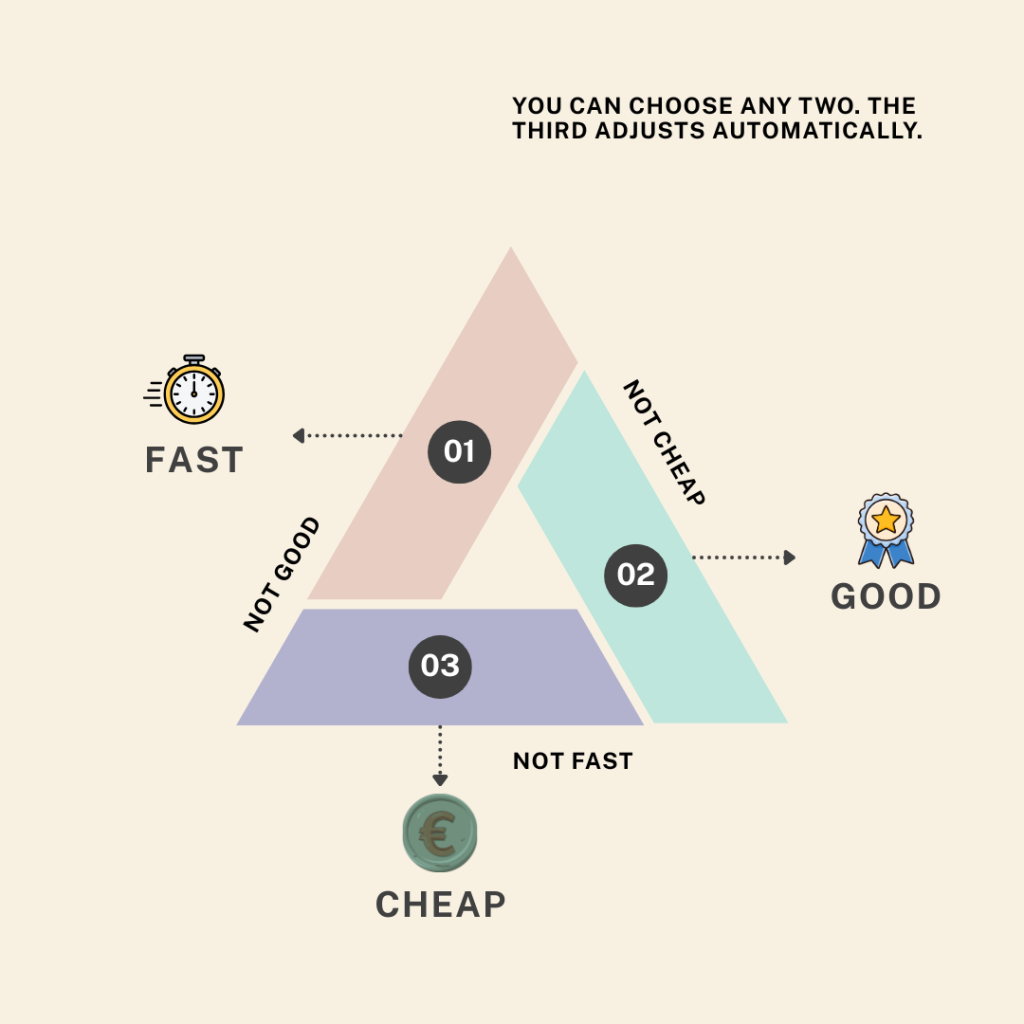
This isn’t theory. It’s a practical constraint that applies to every team, every budget, and every timeline.
Cheap and Fast
When speed and affordability are the priority, quality is limited by necessity.
The solution can still work well, but it will be simpler. Design remains minimal, and features focus only on what is essential. This approach is well-suited for MVPs, prototypes, and internal tools where learning and validation matter more than polish.
You get something usable quickly, without over-investing early.
Fast and Good
When speed and quality are both non-negotiable, cost increases.
Delivering high-quality work on a tight timeline requires clear prioritization, experienced developers, and often additional resources. This approach makes sense for fixed launch dates, marketing campaigns, or situations where technical compromises are unacceptable.
The result is strong, but the budget must support the urgency.
Good and Cheap
When quality and cost control matter most, time becomes the variable.
Good work requires planning, testing, and refinement. With limited budgets, the project needs to move at a realistic pace. This is often the right choice for long-term platforms and systems where stability and reliability matter more than speed.
The outcome is dependable and cost-effective, but it cannot be rushed.
A Practical Example
A startup once approached us with a straightforward request. They wanted a complete e-commerce website delivered in ten days, with a budget of ₹30,000. Their expectations included polished design, smooth performance, and room to scale.
On the surface, it sounded achievable. Just not all at once.
We walked them through the Developer’s Triangle and outlined two realistic paths.
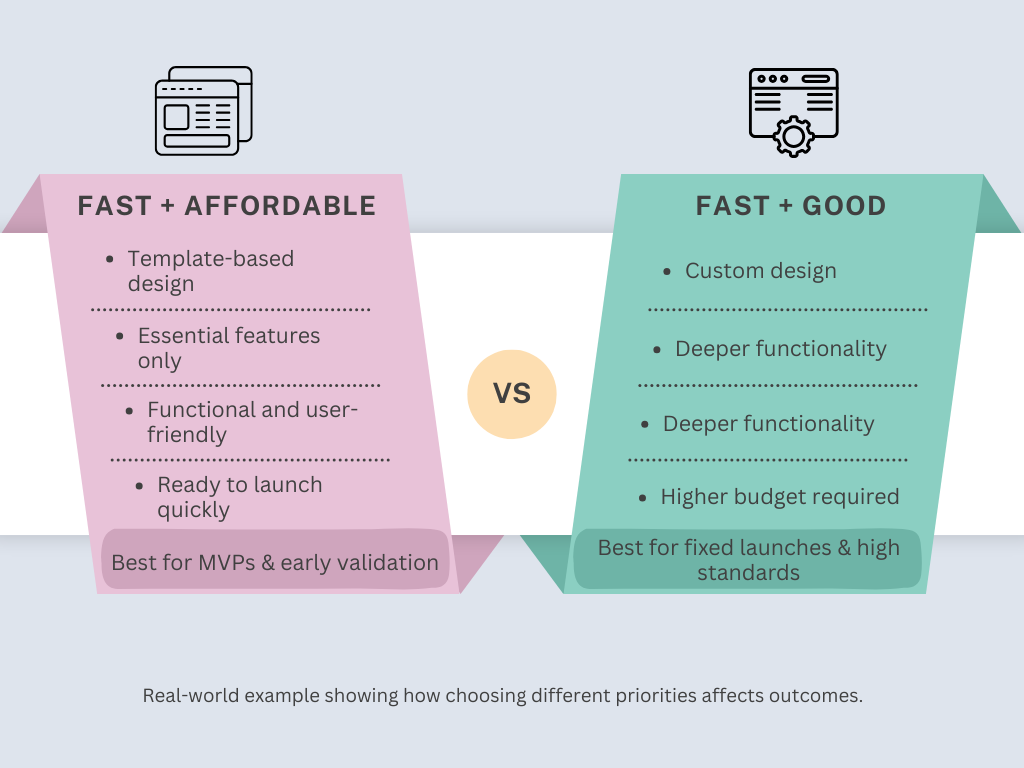
Option 1: Speed and Affordability
- A clean, template-based design with only the essential features
- Functional, user-friendly, ready to launch quickly
Option 2: Speed and Quality
- Custom design, deeper functionality, refined performance
- Supported by a higher budget to meet the tight timeline
They chose the fast and affordable route for their initial launch. The site went live on time, demand was validated, and early risk was minimized. A few months later, with real traction and user data, they returned to build the higher-quality version at a more deliberate pace.
Nothing went wrong because expectations were aligned from the start. The triangle didn’t block progress; it guided them to invest intelligently and move forward with clarity.
How to Decide What Matters Most
There is no universally correct choice. There is only one choice that fits your current goal.
- If you must launch by a fixed date, speed becomes non-negotiable. In that situation, either the budget increases or the scope tightens; there is no third option.
- If the budget is fixed, the timeline needs to be flexible. Rushing a project under cost constraints is the quickest way to erode quality and create future rework.
- If quality is critical, especially for systems designed to scale, time and realistic planning are essential. Stability cannot be rushed without consequences.
The only mistake is pretending the triangle doesn’t apply to you.
Clarity at the beginning removes friction later and keeps the project grounded in reality.
Where We Stand on This
At Gnosys Digital, we don’t promise everything. We promise realism.
Our default approach is what we call good and realistic. That means timelines and costs that genuinely reflect the work involved. It also means being willing to say no to rushed decisions that may look fine in the short term but create problems later.
Projects that appear fast often become expensive after launch. Fixes, performance issues, rebuilds, and lost opportunities cost far more than doing the work properly the first time.
By setting realistic expectations early, we help clients avoid those downstream costs. The result is work that lasts, scales with the business, and doesn’t require constant correction.
Verdict: The Real Advantage Is Clarity
The Developer’s Triangle is not about limitation. It is about decision-making.
Projects succeed when businesses understand trade-offs and choose deliberately. They struggle when everyone assumes reality will bend later.
You don’t need cheap, fast, and perfect. You need alignment between what you want, what you are willing to invest, and how quickly you need results.
When that alignment is clear, development stops being stressful and becomes predictable. That is where real value is created.
A Practical Next Step
If you’re planning a development project and want realistic answers before committing time or budget, we’ll help you map the right trade-offs and define a plan that actually makes sense.
