
Executive Summary
Governments and public sector units operate within highly regulated environments that demand transparency, accountability, and operational efficiency. This article presents how ERPNext, an open-source enterprise resource planning platform, supports public financial management, transparent procurement, asset lifecycle control, and digital citizen services. It also highlights how ERPNext contributes to cost reduction and reduced vendor dependency during digital transformation initiatives.
Introduction
Government entities and public sector units manage large-scale operations across multiple departments, agencies, and physical locations. These operations involve complex tendering processes, financial governance, infrastructure assets, and citizen-facing services that require structured workflows and compliant documentation.
Many agencies continue to rely on spreadsheets, legacy systems, or disconnected applications. This creates information silos, manual approvals, delayed reporting, and increased compliance risk. ERPNext offers a unified, modular, and auditable solution designed to address these systemic challenges and support modern e-governance and digitization mandates.
Challenges with Legacy Systems in the Public Sector
Public sector workflows encounter persistent administrative and governance challenges, including:
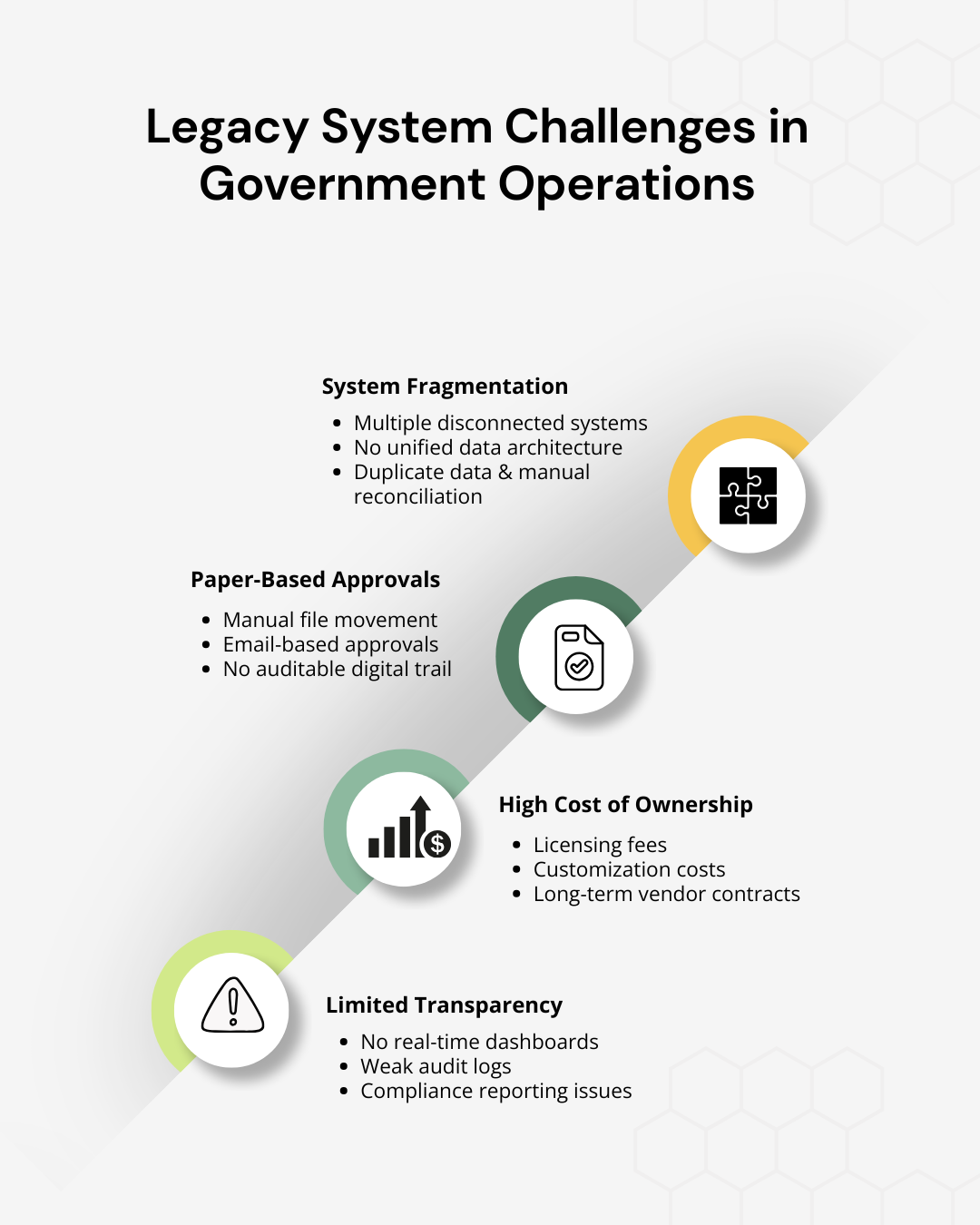
1. System Fragmentation
Separate systems for procurement, payroll, budgeting, and inventory reduce visibility and slow coordination.
2. Paper-Based Approvals
Manual or email-based approvals create delays and weak audit trails.
3. High Procurement and Maintenance Costs
Proprietary ERP solutions demand high licensing, customization, and long-term support.
4. Limited Transparency and Auditability
Disconnected systems make real-time reporting and compliance documentation difficult.
These issues hinder financial management, transparency, and digital transformation.
ERPNext as a Suitable Platform for Government and PSUs
ERPNext is designed for multi-department, compliance-driven organizations, offering modular, auditable, and workflow-driven capabilities. Key benefits for public sector use include:
1. Procurement and Tendering – Manages requisitions, vendor onboarding, competitive bids, approvals, and contract payments with complete documentation and audit trails for transparency and compliance.
2. Asset and Inventory Management – Tracks assets and inventory across multiple sites, manages depreciation, transfers, and maintenance, ensuring optimal utilization and audit readiness.
3. Public Financial Management – Supports budgeting, cost allocation, project accounting, statutory reporting, and vendor payments, enabling transparent financial governance.
4. Compliance and Audit Support – Enforces policy-based approvals, digital signatures, mandatory fields, and audit logs to simplify audits and regulatory compliance.
5. Human Resource Management – Centralizes recruitment, onboarding, attendance, payroll, training, and performance tracking, improving efficiency and workforce oversight.
6. Citizen and Stakeholder Portals – Facilitates vendor registration, citizen requests, grievance tracking, application status updates, and digital payments, enhancing service delivery and reducing counter-based workloads.
Enhancing Transparency and Accountability
Transparency is a core requirement in public sector governance, and ERPNext provides practical tools to support it:
Real-time dashboards and department reporting give leadership visibility across operations and help them make timely decisions.
Structured audit logs and policy-based approvals make every action traceable and compliant with oversight standards.
Procurement and budget tracking improve visibility into tenders, spending, and grants, reducing the risk of errors or misuse.
Project and grant performance metrics support evidence-based monitoring and public accountability.
These capabilities help agencies meet e-governance mandates while improving audit readiness, operational control, and stakeholder trust.
Typical Use Cases in Government and PSUs
Here is a more concise and stronger replacement:
ERPNext’s modular design makes it suitable for a broad range of public sector organizations:
Local and municipal bodies handling urban services, water and sanitation, and public works.
State and central PSUs in sectors such as energy, mining, transport, and logistics.
Healthcare and education boards manage budgets, assets, and citizen services.
Defense and large supply chains for procurement, inventory, and asset control.
Its flexible architecture supports phased or department-wise deployment, allowing gradual adoption without disrupting ongoing operations.
Advantages Compared to Proprietary ERP Solutions
Government agencies often evaluate ERPNext as an alternative to commercial ERP platforms. Key advantages include:
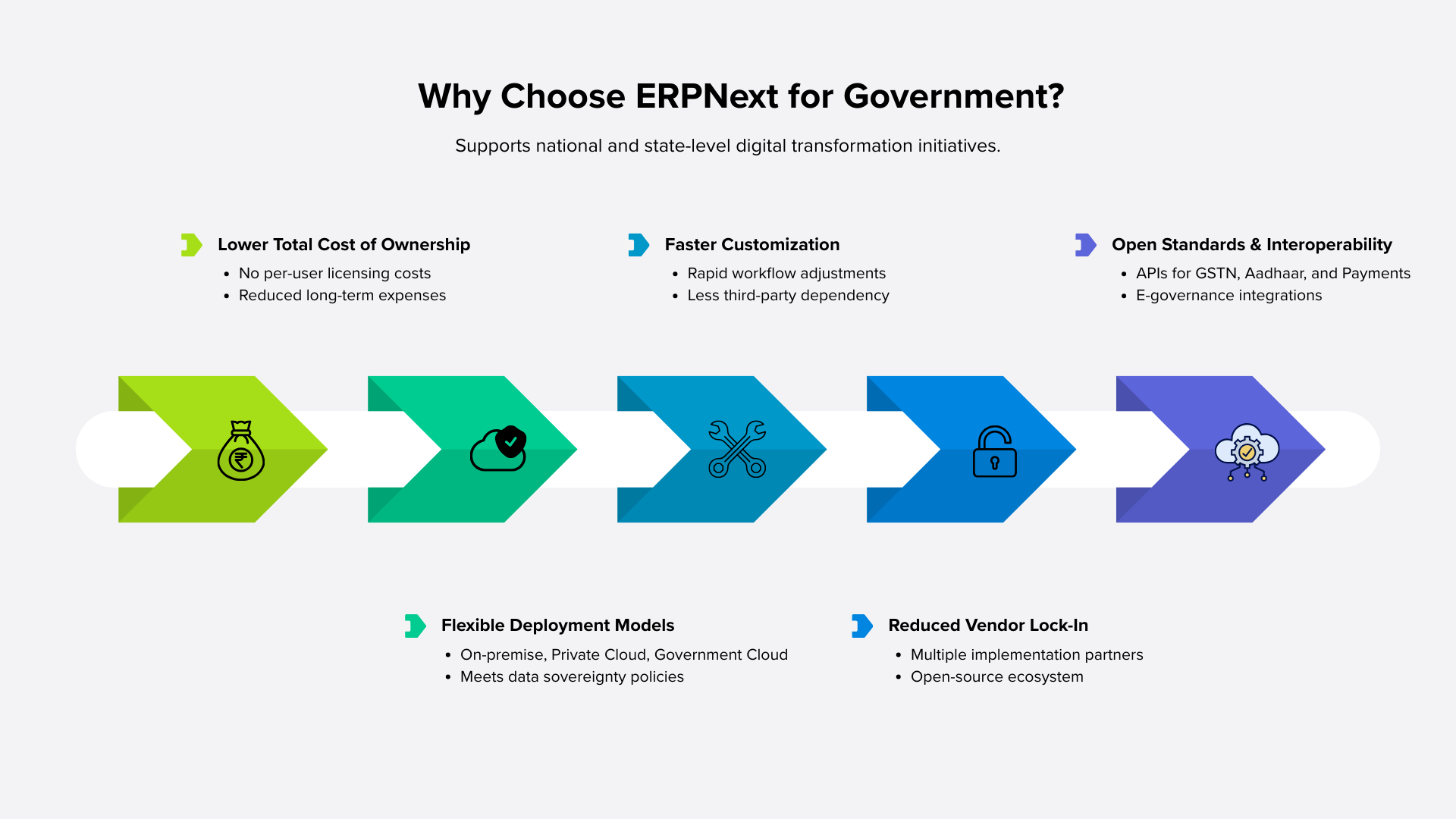
Lower Total Cost of Ownership
Open-source licensing reduces long-term expenditure on software and user seats.
Faster Customization
Workflows can be tailored with shorter customization cycles and reduced consultant dependency.
Interoperability and Open Standards
Integration with national systems (e.g., GSTN, Aadhaar, payment gateways) is supported through open APIs.
Flexible Deployment Models
Agencies can choose on-premise, private cloud, or government cloud hosting, addressing data sovereignty requirements.
Reduced Vendor Lock-In
Multiple partners can provide implementation and support, reducing dependency on a single vendor.
These characteristics align well with national and state-level digital transformation policies.
Implementation Considerations
Deploying ERPNext successfully in the public sector requires structured planning to ensure compliance, security, and continuity:
- Hosting and data residency policies
- Information security compliance
- User onboarding and training programs
- Inter-departmental change management
- Integration with existing systems
- Procurement and tender workflow customization
- Documentation and policy alignment
These measures help agencies achieve a compliant, auditable, and risk-managed ERP deployment.
Conclusion
Digital transformation in the public sector requires platforms that support transparency, internal controls, citizen services, and financial accountability. ERPNext provides a unified and configurable environment for managing procurement, assets, financial operations, and workforce administration. It enables agencies to modernize operations, adopt open standards, and reduce long-term technology dependency and licensing costs.
ERPNext demonstrates that government digitalization does not require prohibitively expensive proprietary solutions. Instead, sustainable transformation can be achieved through open, auditable, and customizable platforms that support e-governance objectives.
Consultation and Implementation Support
Government agencies and public sector organizations seeking to modernize operations can access expert support for:
Solution architecture and implementation strategy
Workflow customization to align with policies and regulations
Deployment planning and phased rollouts for minimal operational disruption
To explore how ERPNext can support your agency’s digital transformation, request a consultation at:
