
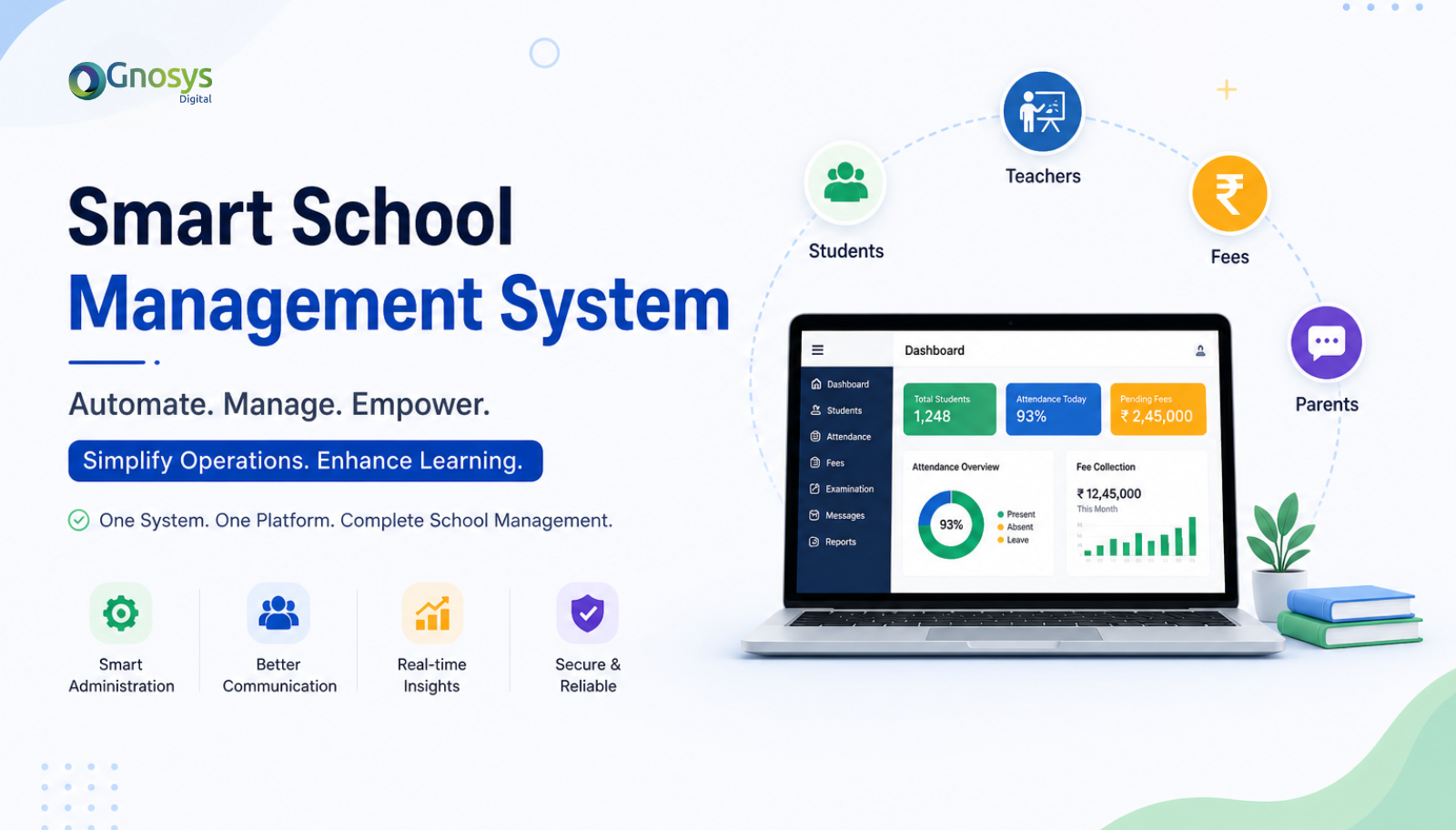
Running a school smoothly involves managing many daily responsibilities at the same time. Admissions, fee collection, attendance tracking, timetable planning, and parent communication all require constant attention. As the number of students grows, these tasks become more complex and time-consuming.
Many schools still rely on manual registers, spreadsheets, and disconnected processes to manage operations. This often leads to delays, errors, missing records, and unnecessary pressure on administrative staff. Valuable time that should go toward improving education gets consumed by repetitive operational work.
This is where a School Management System becomes the smart solution. It helps schools automate daily operations, centralize data, and create a more efficient environment for administrators, teachers, parents, and students.
Why Schools Need Digital Transformation in 2026
Schools today are operating in a more demanding environment than ever before. Growing student strength means higher workloads for administration teams, teachers, and support staff. Managing everything manually becomes increasingly difficult as the institution expands.
Parents also expect faster updates, transparent fee records, attendance notifications, and easy communication with the school. In a digital-first world, delays in communication or lack of transparency can negatively affect trust and satisfaction.
To remain competitive and future-ready, schools need systems that improve speed, efficiency, and service quality. Digital transformation is no longer optional for institutions that want sustainable growth.
Common Problems Schools Face Without Software
Schools without proper software often struggle with multiple operational issues that slow down progress. Manual attendance registers consume teacher time and can lead to inaccuracies, especially when managing large classrooms every day.
Fee collection is another common challenge. Pending dues, receipt confusion, and difficulty tracking payments create stress for both school management and parents. Without automation, financial visibility remains limited.
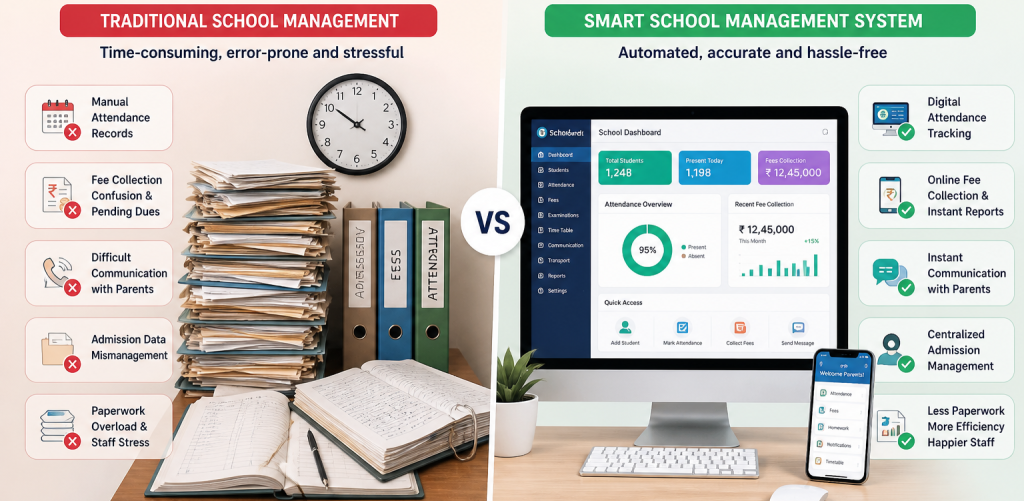
Common challenges include:
- Manual attendance records
- Fee collection confusion and pending dues
- Difficult communication with parents
- Admission data mismanagement
- Staff workload and paperwork overload
What Is a School Management System?
A School Management System is an all-in-one software solution designed to manage every major school operation from a single platform. Instead of using separate tools or manual methods, schools can control admissions, fees, attendance, communication, HR, and reporting in one place.
It acts as a centralized system for administrators, teachers, students, and parents. Each user gets access to relevant information, making communication and coordination faster and more organized.
With real-time data access and automation, schools can reduce delays, improve accuracy, and make smarter decisions based on up-to-date information.
Key Features Every School Needs
A modern school system should provide practical tools that simplify administration and improve the experience for teachers, parents, and students. The right features help schools save time while ensuring smooth daily operations.
From admissions to transport management, every department benefits when processes are connected inside one system. This removes duplication of work and keeps data accurate across the institution.
Essential features include student records management, attendance tracking, fee collection, admission CRM, timetable planning, parent communication portal or app, HR and payroll, and transport management.
Benefits for Schools
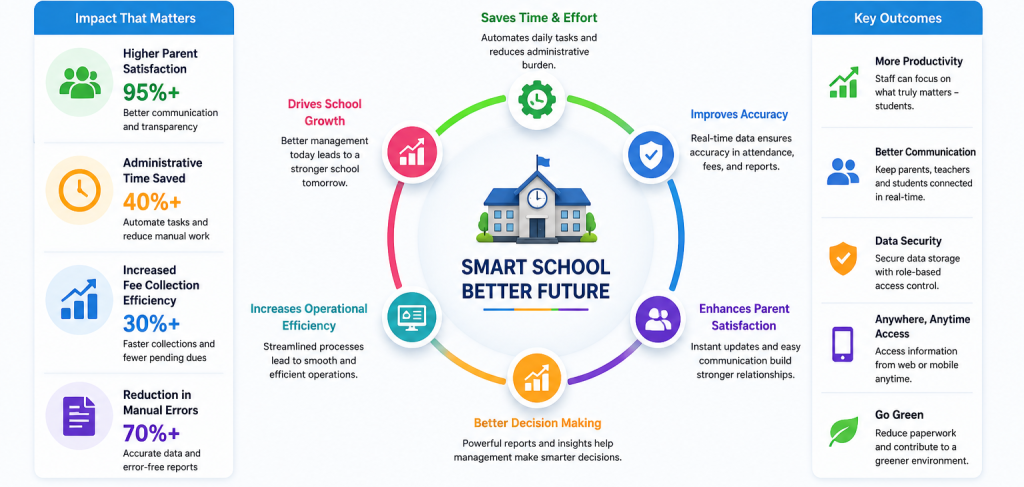
The biggest benefit of a School Management System is time savings. Administrative teams spend less time on repetitive tasks like fee tracking, attendance compilation, and paperwork, allowing them to focus on more valuable responsibilities.
Automation also reduces errors that commonly happen with manual entries and disconnected spreadsheets. Accurate data creates smoother operations and fewer complaints from staff or parents.
Schools also gain better decision-making through reports and dashboards. Management can track performance, finances, admissions, and attendance trends quickly, leading to stronger operational efficiency.
Why Choose a Custom School ERP
Every school has its own workflow, policies, fee structures, approval processes, and communication style. A custom School ERP is designed around your institution’s needs instead of forcing your team to adapt to generic software limitations.
As your school grows, a custom solution can scale with increasing student strength, branches, and new requirements. This ensures that the system remains useful for the long term rather than becoming outdated quickly.
| Feature | Standard Software | Custom School ERP |
| Workflow Fit | Limited | Fully tailored |
| Scalability | Basic | High |
| Integrations | Restricted | Website/App/Payment Ready |
| Support | Generic | Dedicated & Flexible |
Conclusion
The shift from manual processes to digital systems is now essential for schools that want to operate efficiently and grow confidently. Smart institutions understand that managing everything through registers and spreadsheets is no longer sustainable.
A complete School Management System helps schools save time, reduce errors, improve parent satisfaction, and build a stronger administrative foundation for the future.
If your school is ready to modernize operations and become future-ready, now is the right time to act. Upgrade your school with a complete management system in 2026 and transform the way your institution works. 🚀
