
Small and mid-sized businesses often depend on spreadsheets, WhatsApp messages, and scattered tools. These methods feel manageable at the start, but they eventually slow down operations. Orders get delayed, inventory becomes unreliable, and teams spend hours reconciling information.
ERPNext gives SMEs an affordable way to eliminate this chaos. It brings structure, real-time visibility, and automation without the high cost of traditional ERP systems. If your business still runs on manual workflows, ERPNext helps you modernize without stretching your budget. A guided implementation starting at ₹50,000 makes the transition simple and practical.
Why Manual Workflows Hold SMEs Back
Many SMEs build their daily operations around tools like Excel sheets, WhatsApp updates, and informal verbal instructions. These methods feel convenient in the early stages, but as the business grows, they start creating problems that are not immediately visible. Over time, these small inefficiencies turn into serious bottlenecks.
Information gets scattered across spreadsheets, chats, emails, and personal devices. Teams waste valuable time searching for the latest version of a file or waiting for someone to confirm an update. Decisions slow down because no one has access to real-time data. Work becomes dependent on individuals rather than a defined process, so even simple tasks can stall when someone is unavailable. Reports need to be created manually, which makes them late, inconsistent, and often unreliable.
The impact reaches customers as well. Sales, operations, and accounts do not share the same information, which results in mixed messages, delays, and poor service. Business owners, who should have a clear view of daily performance, end up relying on partial updates from different team members. This lack of visibility leads to decisions based on assumptions instead of accurate numbers.
These issues rarely appear suddenly. They develop slowly and quietly as the business expands. Errors become frequent. Delays become normal. Teams start spending more time updating spreadsheets than growing the business. At this point, relying on manual workflows becomes a major risk. A structured system becomes essential for improving control, accountability, and long-term scalability.
What ERPNext Changes
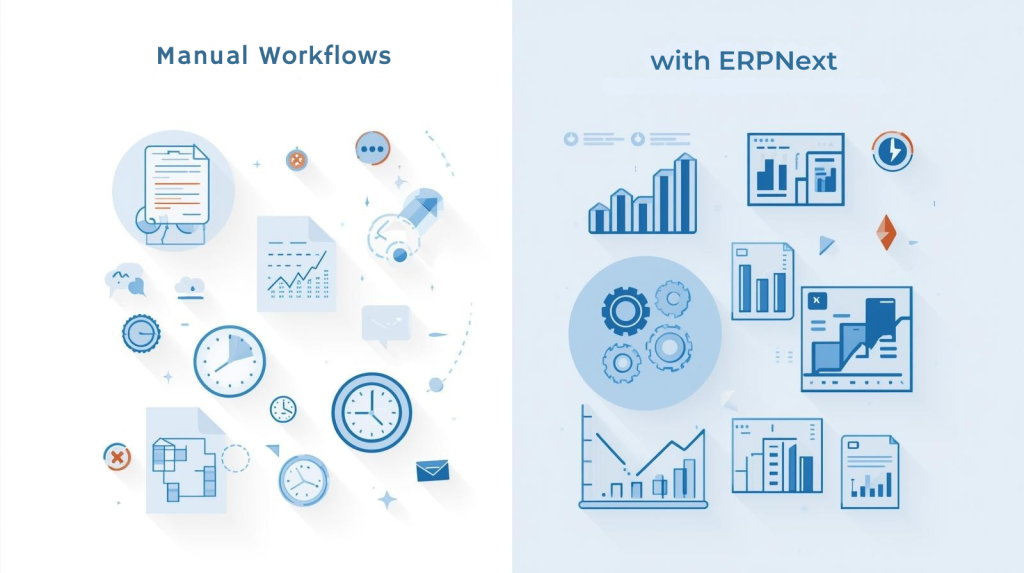
ERPNext replaces scattered tools with one organized system that connects every part of the business. Instead of juggling spreadsheets, messages, and manual follow-ups, your daily operations run through a unified workflow that the entire team can see and follow.
Data becomes centralized and updated in real time. Every department works with the same information, which removes confusion and eliminates the need for repeated entries. Routine work, such as invoicing, stock updates, approvals, reminders, and follow-ups, is automated. This cuts down manual effort and ensures tasks continue even when the team is busy.
Owners and managers gain immediate visibility through clear dashboards. Sales performance, inventory levels, collections, expenses, and work status can be checked at any moment without waiting for reports. As the business expands, ERPNext scales easily. You can add new users, locations, warehouses, and processes without worrying about licensing costs or complicated upgrades.
The shift from manual operations to automated workflows creates an instant improvement in accuracy, speed, and coordination. Teams work smoothly, information flows without interruption, and operational waste drops significantly. The result is a business that runs with structure and clarity instead of constant follow-ups and guesswork.
Workflows SMEs Can Replace Immediately
When ERPNext is configured correctly, daily operations become far more predictable. Tasks that once depended on calls, messages, and scattered entries shift into clean, trackable workflows that run the same way every time.
Purchasing becomes structured from purchase order creation to invoice entry and payment. Sales and dispatch move without confusion because each stage is visible to the entire team. Inventory updates automatically whenever stock is received, consumed, or delivered, which keeps quantities accurate without manual checks. Accounting stays in sync with sales and inventory, so invoices, expenses, and ledgers update in real time without the need to enter the same information twice.
HR and payroll gain proper structure, with attendance, leave, and salary calculations handled inside the system. CRM brings clarity to leads and follow-ups, while manufacturing and job work become easier to track with clear visibility into production, material use, and work-in-progress. Service teams also benefit from organized ticketing for complaints, installations, and maintenance tasks.
Once these workflows operate inside ERPNext, the usual manual problems fade quickly. Teams coordinate better, information moves without delays, and departments stop working in isolation. Operations feel smoother, faster, and far more reliable.
What You Get in a ₹50,000 ERPNext Implementation
A ₹50,000 ERPNext setup gives SMEs everything they need to move from manual work to structured operations. The focus is on a clean, practical implementation that supports daily workflows without unnecessary customization or complexity.
The process starts with understanding your current operations and mapping them to ERPNext. The core modules, Sales, Purchase, Inventory, Accounts, and CRM, are configured to match how your business works. Essential automation is added for approvals, reminders, alerts, and document flows so routine tasks run smoothly without constant follow-up.
User roles and permissions are defined clearly, allowing each team member to access only what they need. Dashboards are created for owners and managers so they can track sales, stock, collections, and performance at a glance.
Important data, such as items, customers, and suppliers, is imported to help you transition away from spreadsheets. Your staff receives straightforward training sessions so they can use the system confidently from day one. During the go-live phase, you get hands-on support to address questions and ensure the system settles well into your operations.
This implementation gives SMEs a complete, ready-to-use ERP that replaces manual processes quickly and provides a solid foundation for growth without adding complexity or cost.
Why This Approach Works for SMEs
Many small and mid-sized businesses stay away from ERP systems because they believe the setup will be expensive, complex, and difficult for their teams to adopt. ERPNext breaks this cycle. Its open-source foundation removes licensing costs, cuts recurring software fees, and allows businesses to scale without worrying about rising subscription charges.
The implementation relies on a clean configuration instead of heavy custom development. This keeps the system stable, easier to maintain, and far simpler for teams to use. Because there is no vendor lock-in, SMEs retain full flexibility as they grow or adjust their processes.
For most SMEs, this creates the right balance: an affordable ERP that is easy to adopt, powerful enough to support daily operations, and capable of growing with the business without adding financial pressure.
Real Operational Improvements
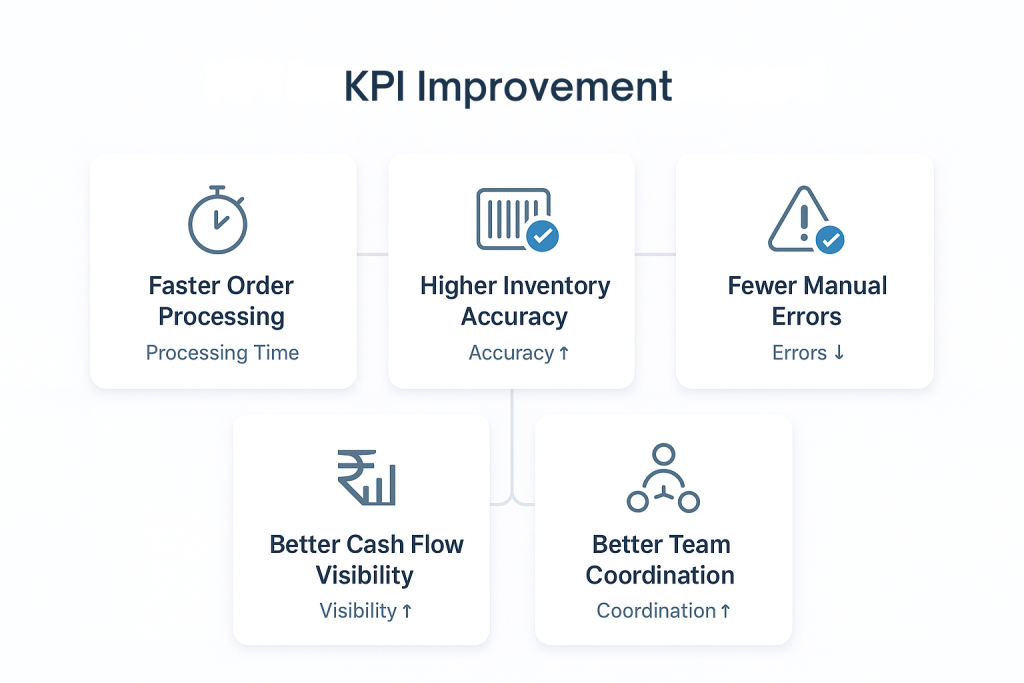
Businesses that move away from manual processes and adopt ERPNext begin to see results in a short time. Order processing speeds up because each stage is structured and automated. Manual errors reduce significantly as data is captured once and used across all modules. Inventory accuracy improves through real-time stock updates every time items move.
Cash flow becomes easier to monitor because invoices, payments, and expenses stay fully aligned. Teams collaborate better since everyone works from the same system instead of scattered tools. Business owners get clear visibility into daily operations through live dashboards, even when they are away from the office.
These improvements translate into higher efficiency, better profitability, and stronger customer satisfaction within just a few weeks.
When ERPNext Is the Right Choice
ERPNext is well-suited for SMEs that need structure but do not want the complexity or cost of traditional ERP systems. If your operations depend on spreadsheets, manual tracking, unclear stock levels, disconnected departments, or delayed reporting, ERPNext provides a practical and affordable shift toward organized workflows.
It delivers automation, transparency, and consistency without the financial pressure of platforms like SAP or Oracle. For growing businesses that need reliable daily visibility and smoother coordination, ERPNext becomes the operational backbone that keeps everything running in one place.
A Simple Way to Get Started
If you’re ready to step away from manual processes, the ₹50,000 ERPNext setup gives you a practical way to modernize without overcomplicating your operations. It helps SMEs shift to automation quickly and begin seeing measurable improvements within a few weeks.
Start with a consultation to understand how this setup aligns with your business needs:
https://gnosysdigital.com/free-digital-consultation/
