Small and mid-sized businesses are entering a phase where manual workflows are no longer sustainable. Rising labor costs, tighter competition, and growing customer expectations are pushing SMEs to adopt automation faster than ever. Companies that streamline operations in 2026 will grow faster, spend less, and deliver a better experience than their competitors.
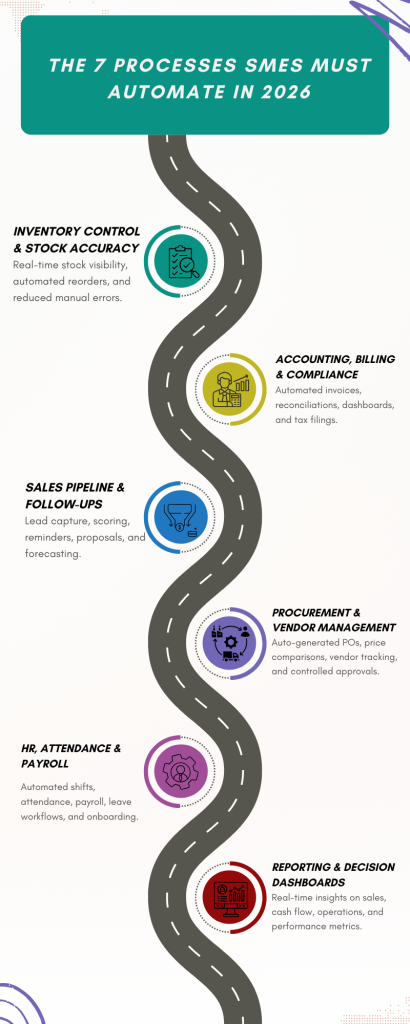
1. Inventory Control and Stock Accuracy
Inventory mismanagement is one of the most costly challenges for SMEs. Relying on manual stock counts often leads to errors, delays, stockouts, and overstocking. These inefficiencies directly impact cash flow, disrupt daily operations, and can negatively affect customer satisfaction. In industries like manufacturing, retail, and distribution, even minor discrepancies in inventory can result in lost revenue and missed business opportunities.
Automation addresses these challenges by providing accurate, real-time stock visibility across all channels. Live stock updates ensure that warehouses, retail stores, and online platforms remain perfectly synchronized, eliminating discrepancies and enabling smarter decision-making. Automatic reorder triggers prevent stockouts by generating purchase orders whenever inventory falls below predefined thresholds.
Additionally, batch and serial tracking maintain detailed histories for each item, simplifying warranty claims, product recalls, and quality control. Reducing manual adjustments saves hours previously spent reconciling stock discrepancies while minimizing human errors.
For SMEs, automating inventory management often delivers one of the fastest returns on investment. By improving stock visibility, reducing operational errors, and streamlining workflows, businesses can shift their focus from firefighting inventory issues to strategic growth and enhanced customer satisfaction.
2. Accounting, Billing, and Daily Financial Tasks
Financial management remains one of the biggest challenges for SMEs. Relying on spreadsheets or outdated accounting software increases the risk of errors, delays, and missed payments, all of which can disrupt cash flow and impede business growth. Manual processes also make it difficult for management to gain a real-time view of the company’s financial health, limiting their ability to make timely, informed decisions.
Automation streamlines accounting and billing processes efficiently. Automated invoice creation and reminders ensure timely billing and reduce late payments. Real-time financial dashboards provide instant insights into revenue, expenses, and overall financial performance, enabling faster, data-driven decisions. Auto-reconciliation of payments across multiple channels eliminates hours of manual bookkeeping, while scheduled GST, tax, and compliance reports ensure accuracy and regulatory compliance without added effort.
Manual vs Automated Accounting Tasks:
| Task | Manual Workflow | Automated Workflow | Key Benefit |
| Invoice Generation | Manually created, risk of errors | Auto-generated invoices | Saves time, reduces errors |
| Payment Reconciliation | Manual cross-checking of payments | Auto-reconciliation across channels | Faster, fewer mistakes |
| Financial Reporting | Delayed, labor-intensive | Real-time dashboards | Better visibility, informed decisions |
| Tax & Compliance | Manual tracking, risk of mistakes | Scheduled automated reports | Accurate, compliant |
By implementing these automation strategies, SMEs can reduce workloads, minimize errors, and free accounting teams to focus on strategic planning and growth initiatives. The result is improved operational efficiency, stronger financial control, and the ability to make smarter, faster business decisions.
3. Sales Pipeline and Lead Follow-ups
Leads are the lifeblood of any SME, yet they are easily lost when follow-ups rely on memory or manual tracking. Missing timely engagement can directly affect conversion rates and revenue growth, making an efficient sales process critical for business success.
Automation ensures that every lead is captured, scored, and engaged promptly. Systems can automatically capture and prioritize high-potential prospects, send follow-up reminders and sequences to maintain consistent engagement, streamline proposal creation and approvals, and provide sales forecasting dashboards for real-time insights into pipeline performance.
A structured, automated sales pipeline increases conversions without adding headcount. By reducing the risk of missed opportunities, SMEs can ensure their sales teams focus on closing deals rather than tracking prospects manually, driving both efficiency and revenue growth.
4. Procurement and Vendor Management
Manual procurement processes often result in delays, pricing inconsistencies, and unnecessary expenses. For SMEs, these inefficiencies can quickly escalate, impacting cash flow and overall operational performance. Automation streamlines procurement workflows, helping businesses keep costs under control while maintaining organized vendor relationships.
Automated systems can generate purchase orders automatically, accelerating purchasing cycles and reducing administrative effort. Real-time price comparisons enable better negotiation and cost savings, while vendor performance tracking provides valuable insights into quality, reliability, and timely delivery. Approval workflows maintain controlled spending, minimizing the risk of overspending or unauthorized purchases.
By adopting procurement automation, SMEs can reduce operational costs, strengthen supplier relationships, and ensure smoother operations, freeing teams to focus on strategic sourcing and business growth rather than repetitive administrative tasks.
5. HR, Attendance, and Payroll
As teams grow, manual HR management quickly becomes unsustainable. Relying on spreadsheets and paper-based processes increases the risk of errors, delays, and compliance issues. Digital, rule-based systems provide a structured approach to HR, ensuring smooth operations and regulatory adherence.
Automation covers attendance tracking and shift scheduling, payroll calculations and TDS, leave management, and employee onboarding and document management. These capabilities reduce disputes, ensure compliance, and save significant administrative time.
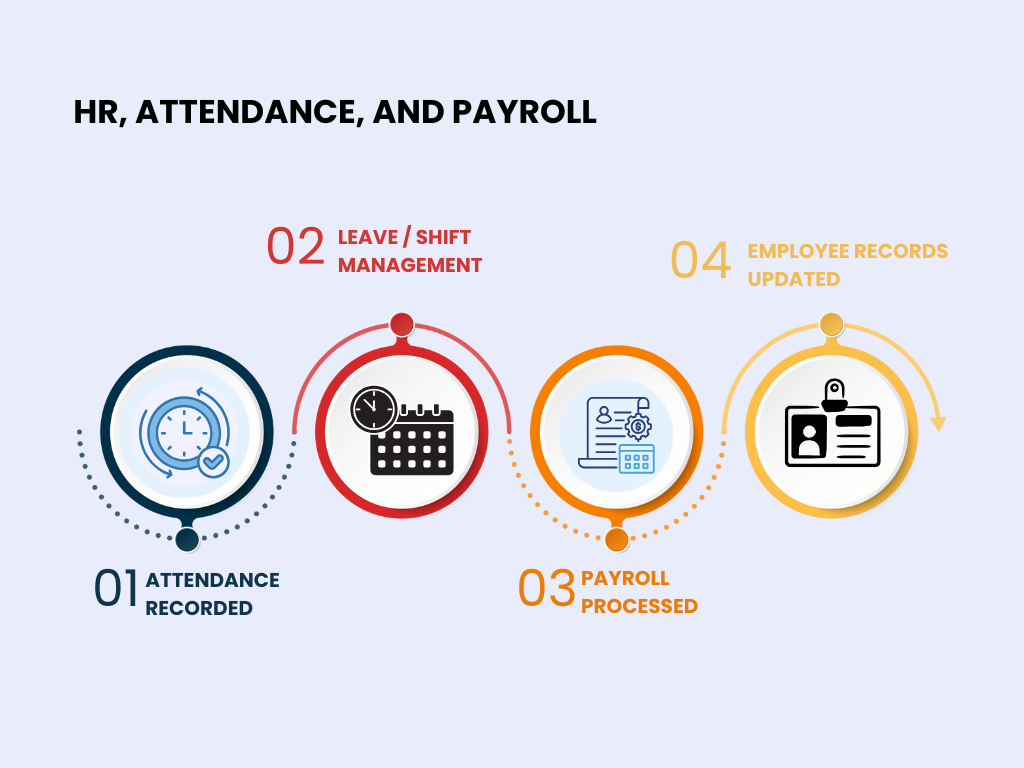
By automating HR processes, SMEs allow HR teams to focus on employee engagement, retention, and strategic initiatives instead of repetitive manual tasks, contributing directly to overall business growth and operational efficiency.
6. Customer Support and Ticket Handling
In today’s competitive market, customers expect fast, reliable, and consistent support. Manual handling of queries often leads to delays, missed messages, and dissatisfied clients, which can harm a business’s reputation. Automation ensures every customer interaction is tracked, organized, and resolved efficiently.
Automated systems can create and route tickets instantly, while pre-set replies speed up responses for common issues. Interaction history tracking allows support teams to provide contextual, personalized assistance, and service-level monitoring ensures timely resolution and accountability throughout the support process.
By automating customer support, SMEs can deliver a superior customer experience without increasing headcount, improving client satisfaction and loyalty. Teams are freed from repetitive tasks, enabling them to focus on complex, high-value issues that strengthen relationships and drive business growth.
7. Reporting and Decision-Making Dashboards
Many SMEs struggle with delayed decision-making because critical data is scattered across departments. Without a centralized system, leaders often rely on incomplete or outdated information, which can result in inefficiencies and missed opportunities. Automation solves this by creating a single source of truth for all business data, enabling faster, data-driven decisions.
Automated dashboards provide real-time insights into key areas, including sales, expenses, and cash flow, stock valuation, project and task status, and production and order fulfillment. By consolidating all critical information in one place, business leaders can monitor performance, identify trends, and make informed decisions quickly.
With accurate, real-time reporting, SMEs gain a competitive advantage, allowing them to act strategically in a fast-paced market while improving operational efficiency and overall business performance.
Conclusion
Automation is no longer a luxury for SMEs; it is a critical enabler of sustainable growth and operational efficiency. By automating these seven essential processes, businesses can cut costs, minimize manual errors, and scale effectively without expanding headcount. Whether you run a manufacturing unit, a wholesale business, or a service firm, adopting these automation strategies will shape your competitiveness in 2026.
For SMEs looking for a structured roadmap, implementing these processes through ERPNext or a full-stack business system can be achieved in as little as 21 days with the right guidance.
Explore the complete ERPNext implementation roadmap here:
👉 https://gnosysdigital.com/erpnext-implementation/
