
Choosing an ERP is one of the most costly and consequential decisions an Indian SME owner can make. Get it right, and you unlock efficiency and growth. Get it wrong, and you face soaring costs, stalled projects, and operational chaos.
This guide breaks down ERPNext, SAP, and Odoo with a clear, rupee-by-rupee view of total cost, ROI timelines, scalability, and real-world suitability for Indian SMEs.
1. Quick ERP Overview: Choosing the Right Fit for Your SME
Selecting the right ERP isn’t just about features; it’s about fit, flexibility, and total cost of ownership. Here’s a clear comparison of the top three ERP platforms for Indian SMEs:
| ERP System | Key Strengths | Ideal For | Deployment |
|---|---|---|---|
| ERPNext | Open-source, fully customizable, all-in-one modules | Cost-conscious SMEs that need fast ROI and strong accounting or manufacturing control | Cloud & On-premise |
| SAP | Enterprise-grade, highly scalable, advanced analytics & reporting | Large SMEs with complex, multi-department operations and internal IT capacity | Cloud & On-premise |
| Odoo | Modular, user-friendly, flexible, easy to scale | Growing or service-based SMEs that want to start small and scale gradually | Cloud & On-premise |
Key Takeaways for SMEs:
- ERPNext: The most practical choice for the majority of Indian SMEs, delivering essential ERP functionality without enterprise-level cost or complexity.
- SAP: Best suited only when operational complexity clearly justifies the higher expense and implementation effort.
- Odoo: Effective when flexibility and modularity matter more than deeply integrated, end-to-end control.
Why This Version Works Better:
It is concise, professional, and communicates clear decision guidance for SME owners, highlighting when each ERP makes strategic sense rather than just listing features.
2. Cost Analysis for Indian SMEs: Understanding True Investment
A deeper look at the total cost of ownership (TCO) beyond license fees:
ERPNext
- Licensing: Free self-hosted; cloud hosting ₹500–1,500/user/month
- Implementation: ₹1–3 lakh depending on modules
- Maintenance & Support: ₹50,000–1 lakh/year
What this means for SMEs:
ERPNext has the lowest upfront cost and the most predictable long-term spend. With professional implementation, most SMEs achieve measurable ROI within the first year.
SAP
- Licensing: ₹50,000–1,50,000/user/year
- Implementation: ₹10–25 lakh
- Maintenance & Support: 15–20% of license cost annually
Why this matters:
Enterprise-grade features come with high costs and long, complex deployments that can strain SME resources.
Odoo
- Licensing: ₹2,000–4,000/user/month
- Implementation: ₹2–5 lakh
- Maintenance & Support: ₹50,000–1.5 lakh/year
What this means for SMEs:
Odoo appears affordable at entry, but costs escalate as additional modules, integrations, and third-party apps are added. Careful scope management is essential to prevent budget overruns.
3. Hidden Costs & Risks: What Every SME Should Know
The true cost of an ERP system is more than licensing; it includes implementation challenges, ongoing support, and potential pitfalls. Overlooking these can erode ROI and create operational headaches.
| ERP System | Hidden Costs / Risks |
|---|---|
| ERPNext | Costs for professional implementation and ongoing support; internal team training is essential to ensure smooth adoption and maximize ROI. |
| SAP | Mandatory annual upgrades, high consultant day rates, vendor lock-in, and long deployment timelines can disrupt operations. |
| Odoo | Third-party apps can quickly inflate budgets; app quality can vary; customizations may break during system upgrades. |
Key Insight for SMEs:
- ERPNext: Offers predictable risk when supported professionally.
- SAP: Demands deep pockets and dedicated IT teams.
- Odoo: Requires careful planning to avoid module overload and cost creep.
4. ROI by Business Function: Where Each ERP Delivers Value
Instead of looking at ROI as a single number, let’s examine how ERPNext, SAP, and Odoo impact key business functions for Indian SMEs. This functional breakdown helps owners see where efficiency gains and cost savings occur, making ROI tangible and actionable.
| ERP System | Inventory & Supply Chain | Accounting & Finance | Operations & Project Management | Sales & Customer Management | Overall ROI Timeline |
|---|---|---|---|---|---|
| ERPNext | High: Real-time stock tracking reduces overstock & stockouts | High: Automated ledgers and reconciliations save hours per week | Medium: Streamlined workflows, basic project tracking | Medium: CRM modules help manage customer interactions | 6–12 months |
| SAP | Medium: Advanced logistics modules, but expensive & complex | High: Powerful analytics & compliance-ready accounting | High: Enterprise-level project & operations management | High: Sophisticated CRM & analytics for strategic sales | 12–24 months |
| Odoo | Medium: Inventory tracking with modular apps | Medium: Automated accounting with optional add-ons | Medium: Flexible project management, scalable for growing teams | Medium: CRM modules integrated with marketing & sales | 9–15 months |
Insights for SMEs:
- ERPNext: Best suited for manufacturing and distribution SMEs that need strong inventory control and accounting without high costs.
- SAP: Ideal for large SMEs with multiple departments that require advanced operations, analytics, and compliance.
- Odoo: Works well for project-based or service SMEs that need flexible modules across operations, sales, and finance.
5. Implementation & Scalability: How Each ERP Grows With Your Business
When choosing an ERP, consider how quickly it can be implemented and whether it can scale with your business growth. Ease of implementation affects costs, downtime, and adoption, while scalability determines long-term ROI.
| ERP System | Ease of Implementation | Scalability | Notes |
| ERPNext | Quick for SMEs; minimal disruption | Suitable for mid-sized growth | Strong native manufacturing module; ideal for manufacturing, distribution, and accounting-heavy SMEs |
| SAP | Resource-intensive; requires dedicated consultants | Enterprise-grade scalability | Best for large SMEs with complex operations; setup can be lengthy and complex for smaller teams |
| Odoo | Moderate; easier than SAP but requires planning | Good, modular, and flexible | Scalable with additional modules, but costs rise as more apps and customizations are added |
Key Takeaways for SME Owners
- ERPNext: Fast deployment, minimal overhead, predictable costs—perfect for SMEs focused on cost control and rapid ROI.
- SAP: Offers unmatched scalability but requires deep pockets, internal IT support, and patience. Only consider if operations are truly complex.
- Odoo: Flexible and modular, making it ideal for growing SMEs—but watch out for cumulative module costs and upgrade challenges.
Pro Tip: Align ERP complexity with team size and operational maturity. A system too complex can slow adoption; too simple can limit growth.
6. Recommendations by SME Type: Choosing the Right ERP for Your Business
Different SMEs have different operational needs, budgets, and growth trajectories. Here’s a clear guide to help Indian SMEs match the right ERP system to their business type:
| SME Type | Recommended ERP | Reasoning |
|---|---|---|
| Manufacturing / Distribution SMEs | ERPNext | Native manufacturing module, cost-effective, rapid ROI; ideal for inventory-heavy operations and production planning. |
| Services / Project-Based SMEs | ERPNext / Odoo | Flexible workflows, project tracking, and billing automation; both options are affordable and scalable. |
| Growing SMEs (50–200 users) | Odoo | Modular, easy to adopt, and scalable, it allows businesses to start with core modules and add more as operations expand. |
| Large SMEs (>200 users, complex operations) | SAP | Enterprise-grade features, advanced analytics, compliance-ready modules; suited for complex, multi-department operations. |
Key Takeaways:
- ERPNext is generally the fastest and most cost-effective solution for SMEs, especially in manufacturing and distribution.
- Odoo is ideal for project-based or service SMEs that need modular, flexible ERP solutions.
- SAP is best suited for larger SMEs with complex operations, multiple departments, and a higher budget.
Pro Tip: Choose an ERP not just based on features, but based on how well it aligns with your business type, operational complexity, and growth plans. The right fit ensures faster ROI, smoother implementation, and long-term scalability.
7. Visual Cost Comparison (3-Year TCO Chart)
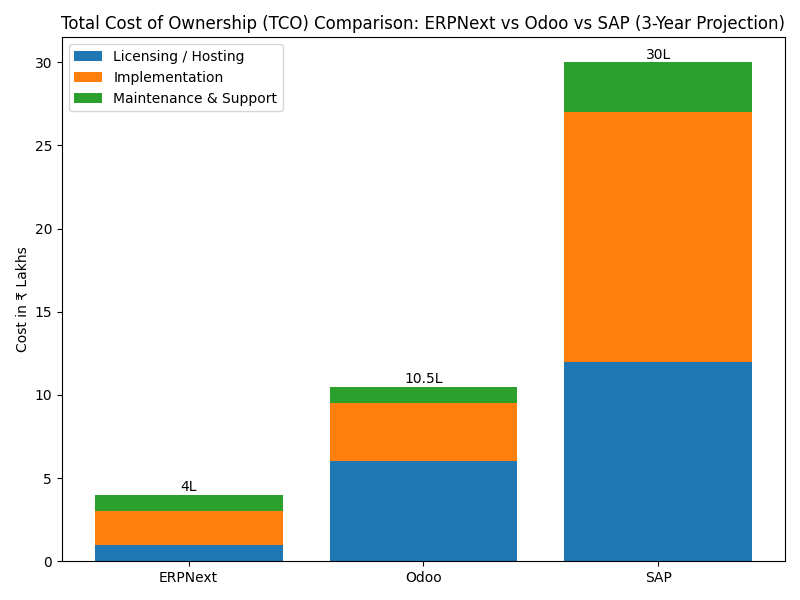
The chart below aggregates Licensing, Implementation, and 3-year Maintenance costs for ERPNext, Odoo, and SAP, providing a clear picture of total cost differences. Each bar shows the total 3-year TCO:
- ERPNext: 4L
- Odoo: 10.5L
- SAP: 30L
Pro Tip: SMEs often focus only on licensing. Evaluating the total 3-year cost ensures you account for implementation and maintenance, revealing the real ROI.
8. Conclusion: Which ERP Delivers the Best Value for Indian SMEs?
Selecting an ERP is a financial and operational decision. Features matter, but what impacts SMEs most is cost, ROI, scalability, and operational fit.
- ERPNext: Fastest ROI, low upfront cost, strong for manufacturing and distribution.
- Odoo: Flexible, modular, ideal for project/service-based SMEs.
- SAP: Enterprise-grade, suitable for complex operations, but high total cost.
Bottom Line: Indian SMEs seeking predictable costs, fast deployment, and strong ROI will find that ERPNext offers the most practical and financially sound path.
Take the Next Step With Confidence
Before committing ₹5–30 lakh to an ERP, get a realistic, rupee-by-rupee view of total cost. Our team will analyze your operations, modules, and user requirements to deliver a tailored 3-year TCO comparison, helping you choose the ERP that truly fits your business.
