
Non-profit organizations operate with a noble purpose, prioritizing social impact and community service over profitability. Yet, these mission-driven entities face a complex operational reality behind the scenes. Efficiently managing donors, tracking varied funds, and measuring the real-world success of diverse programs are essential tasks that can often overshadow the primary objective when managed inefficiently. Maintaining financial transparency is critical for sustaining donor trust and regulatory compliance, making robust operational systems not just a benefit, but a necessity for survival and growth in a competitive philanthropic landscape.
The Operational Burden: Fragility in Fragmentation
For many NGOs, growth paradoxically introduces greater complexity and administrative burden. As organizations expand their outreach and diversify their funding streams, relying on manual processes or disconnected software tools becomes a significant bottleneck. Donor records might be stored in isolated spreadsheets, financial data hidden within accounting software that doesn’t “talk” to program management, and program updates scattered across various documents and email threads. This fragmented approach creates an invisible hurdle that drains resources and slows down critical initiatives, limiting the organization’s potential.
This lack of integration and centralization over time inevitably leads to severe operational inefficiencies. The process of generating reliable, comprehensive reports for stakeholders or compliance purposes becomes slow and prone to errors. Administrative overhead increases dramatically as valuable staff time is dedicated to data reconciliation rather than strategic initiatives. Most critically, these inefficiencies can lead to erosion of trust with donors who increasingly demand clarity and prompt reporting. Without centralized data and structured processes, demonstrating the precise impact of contributions becomes a challenge. This where an ERP transforms operation.
Centralizing for Impact: How ERP Solutions Transform NGOs
To overcome these deeply embedded operational challenges, non-profits require more than just separate specialized tools; they need an integrated system that unites every facet of their operation. This is precisely the power that ERP solutions like ERPNext bring to the sector. An ERP (Enterprise Resource Planning) system isn’t just for multi-national corporations; it’s a unified platform where an NGO can manage its entire spectrum of activities, from tracking individual donor interactions to measuring the impact of a specific village sanitation program, all within the same environment.
By centralizing data and automating routine processes, ERPNext drastically reduces administrative workload and vastly improves visibility across the entire organization. NGO leaders can easily gain a clear, real-time overview of financial health, program progress, donor contributions, and volunteer activities without needing to manually aggregate data from different sources. This shift from reactive management to proactive oversight helps mission-driven organizations operate more efficiently, ensure rigorous financial accountability, and devote a greater portion of their resources directly to their core causes.
Key Capabilities Driving the NGO Transformation
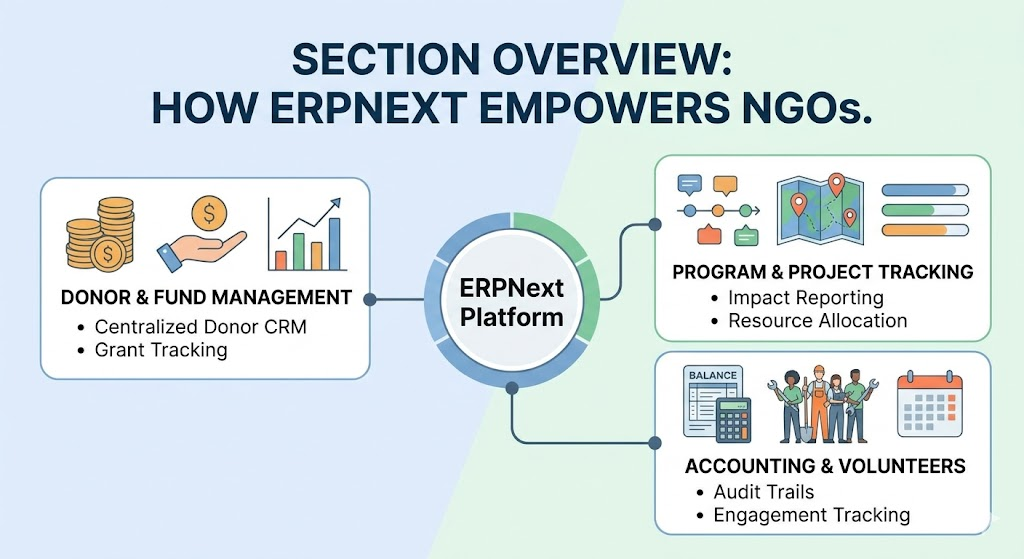
Implementing ERPNext is a strategic decision that equips a non-profit organization with specific, integrated capabilities designed to directly address and neutralize the sector’s most persistent operational challenges. It’s not simply about replacing old software; it is about adopting a digital framework that actively supports mission delivery through streamlined processes. The transition fundamentally shifts the operational model by introducing automated efficiency and unprecedented visibility into four key pillars that define most NGO operations:
Donor Engagement and Fund Tracking
- Centralized CRM
- maintain comprehensive profiles of all donors
- view detailed donation histories easily
- Automated workflows
- simplify regular donor communication
- manage personalized engagement campaigns efficiently
Financial Accounting and Grants
- Fund and grant tracking
- allocate incoming funds to specific projects
- maintain clear financial transparency for all stakeholders
- Audit trails and compliance
- generate detailed financial reports automatically
- simplify external audits with organized record
Program Monitoring and Impact
- Project lifecycle management
- track key project milestones from planning to execution
- monitor resource utilization against budgets
- Impact measurement
- measure the real-world outcomes of specific initiatives
- analyze program performance for better decisions
Resource Coordination
- Volunteer database
- register volunteers and manage profiles centrally
- assign roles based on skills and availability
- Event management
- simplify logistics for fundraising events or on-the-ground operations
- track participation and contributions effectively
By utilizing these capabilities within a single system, organizations eliminate the overhead of manual data movement and the high risk of error from disjointed spreadsheets. This structural shift moves an NGO beyond simple process automation toward becoming a data-informed, highly responsive entity, fundamentally capable of scaling its impact without being crushed by administrative complexity. The resulting efficiency allows leadership to focus directly on community needs, leveraging accurate data to improve both internal resource allocation and external reporting.
Validating the ERP Advantage: NGO Management Paradigms Compared
When non-profit organizations adopt an integrated ERP system, the benefits extend far beyond simple time savings. For executive directors and boards, an ERP platform provides the indispensable data foundation for strong governance, showing exactly how funds are managed and where they are most effective. This transparency strengthens trust with donors and serves as a critical asset when applying for competitive grants or complying with strict audits.
Beyond trust, improved operational efficiency profoundly impacts day-to-day effectiveness. Automation handles repetitive, time-consuming tasks like donor receipting and volunteer coordination, liberating staff for direct mission work. Furthermore, leadership teams gain access to real-time data visualizations, enabling more informed strategic planning and rapid responses to emerging community needs, ensuring that resources are always deployed where they create the maximum social impact.
| Traditional NGO Management | ERPNext for Non-Profits |
| Fragmented donor data in files | Single, 360-degree donor CRM view |
| Manual, error-prone fund tracking | Automated accounting & audit trails |
| Disconnected project & volunteer tools | Integrated system for all operations |
| Slow, manual compliance reporting | Real-time, transparent reporting |
| Limited scalability | Designed for rapid organizational growth |
Scaling for the Future: Why ERPNext is the Strategic Foundation
In an era of increased competition for funding, adopting a modern ERP solution is no longer a luxury. The traditional, ad-hoc approach of using fragmented tools cannot support the complexity or the transparency requirements of growing organizations. Making the move to a centralized system is a defining step in an NGO’s maturity, allowing it to transition from reactive administrative firefighting to proactive, strategic execution of its mission.
This transition builds long-term institutional resilience. By centralizing data and standardizing workflows, organizations reduce dependence on individuals for institutional memory and create scalable systems that can handle growth. Furthermore, the robust data collected becomes a critical asset for demonstrating measurable social impact, attracting larger grants, and fostering deeper relationships with a dedicated base of supporters who value transparency.
Engineering Your Social Mission with Gnosys Digital
Successful ERP implementation is not just a technical deployment; it’s a critical strategic change that requires profound alignment between technology and organizational goals. At Gnosys Digital, we specialize in helping non-profit organizations successfully adopt and optimize ERP solutions. Our expert team takes the time to deeply understand your specific operational challenges and missional priorities, engineering an ERPNext implementation that doesn’t just centralize information but actively strengthens and streamlines your core workflows for maximum impact.
We offer a complete suite of services designed to ensure your digital transformation is smooth and yields immediate, measurable benefits for your cause. From the initial system configuration and data migration through custom module development to comprehensive user training and reliable ongoing support, Gnosys Digital is your dedicated technology partner, committed to your long-term operational excellence and your community mission. Contact us today to learn how we can help you build the precise digital infrastructure you need to maximize your impact.
Conclusion
Non-profit organizations today face increasing expectations from donors, stakeholders, and regulatory bodies. Transparency, accountability, and measurable impact have become essential elements for building long-term trust and sustaining funding in a digital-first world. An integrated system like ERPNext is the bridge that connects noble intentions with efficient execution.
Adopting a modern ERP system allows NGOs to streamline their operations, manage funds more effectively, and maintain accurate reporting across all programs. With centralized data and automated processes, organizations gain better visibility into their activities and can make more informed decisions. Instead of struggling with administrative complexity, organizations can focus their energy on what truly matters: creating meaningful and lasting social impact.
Schedule a Consultation:
https://gnosysdigital.com/erpnext-implementation/erpnext-for-non-profits-ngos/
