
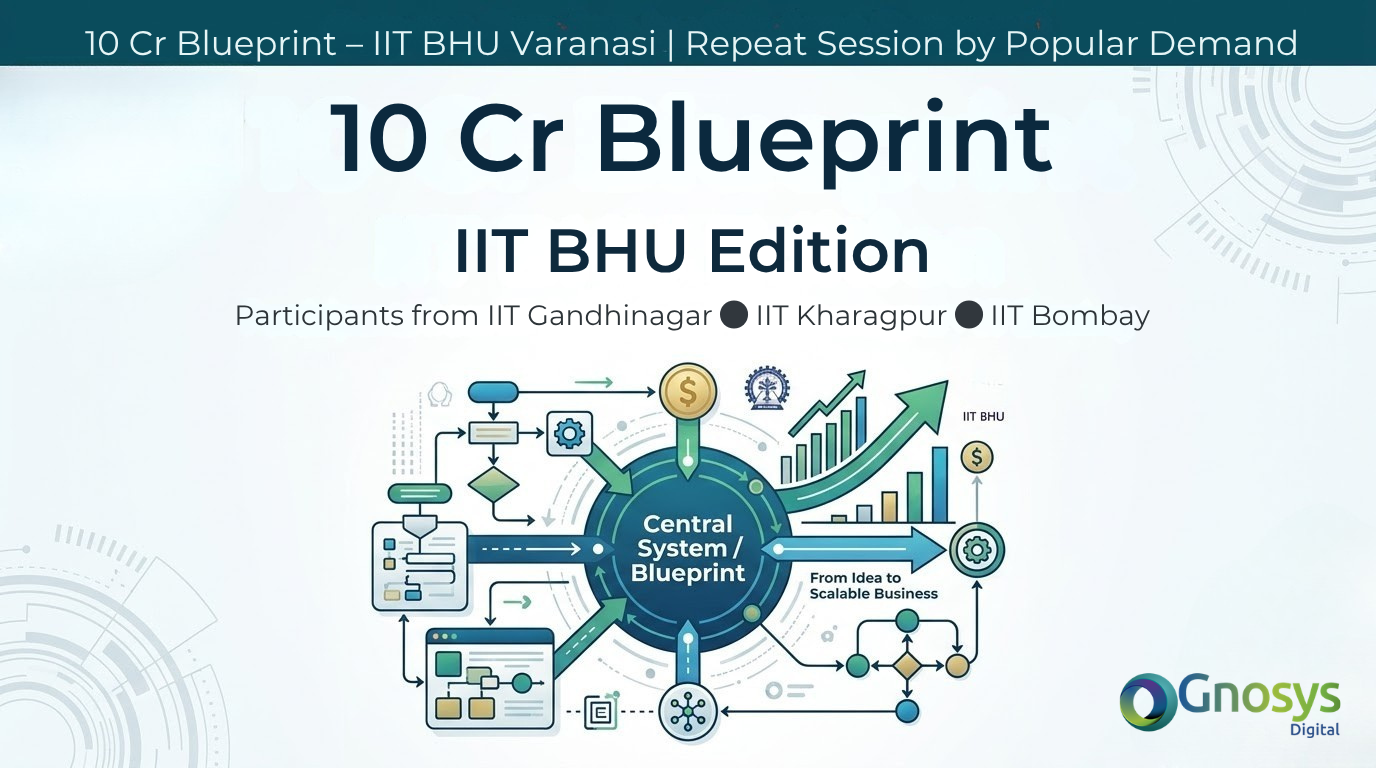
An exclusive roundtable discussion featuring CA Ranganayaki Rangachari, Dr. Shanker Viswanath, Deepak Verma, and Aditya Shah, moderated by CA Hiral Mehta.
Executive Summary
On March 19, 2026, over 70 students, research scholars, and early-stage founders gathered for an intensive 2-hour roundtable discussion on the 10 CR Blueprint – IIT BHU Edition. The session brought together four practitioners with combined experience of over 90 years across finance, banking, M&A, corporate training, and technology.
The central theme was clear: Scaling from idea to 10 crore is not just about ambition, it’s about financial hygiene, systems thinking, founder mindset, and smart funding choices.
The discussion covered four critical pillars:
- Financial Blind Spots – Why understanding fixed vs. variable costs matters from day one
- Systems & Processes – How to build control without killing culture, even with a 2-person team
- Founder Evolution – The mindset shift from student/researcher to leader
- Funding Strategy – Bootstrap vs. raise? What actually works for early-stage ventures
This blog captures the key insights, real-world examples, and actionable takeaways shared by our esteemed panelists.
The Panel
| Speaker | Expertise |
|---|---|
| CA Ranganayaki Rangachari (Rama) | 24+ years |
| Dr. Shanker Viswanath | 29+ years |
| Deepak Verma | Associate Director, Standard Chartered Bank |
| Aditya Shah | CTO, Sterling Global Group |
| CA Hiral Mehta | Moderator |
Topic 1: Financial Blind Spots
Led by CA Ranganayaki Rangachari, supported by Deepak Verma and Aditya Shah
The Single Biggest Mistake Founders Make
Rama opened with a powerful observation:
“I can afford not to understand technology. But not knowing finance is fatal for any business. Even the smallest mom-and-pop store has to understand finance.”
Key Insight: Founders don’t need to become accountants, but they must understand the basics of fixed vs. variable costs, cash flow, and the difference between profit and cash.
Fixed vs. Variable Cost: The Foundation of Profitability
Rama emphasized the critical distinction:
“What is my fixed cost, and what is my variable cost? For every unit I produce or service I deliver, the variable cost varies. If you’re not able to recover your variable cost, there’s no point in doing that business.”
Actionable Takeaway: Understand your contribution margin. Know that if your fixed cost is high, your profit comes at a later stage. A 10% sensitivity on the top line can have a huge impact on the bottom line.
The Importance of a Business Plan
“Once your idea is ideated and you have your IP, you should have a business plan. What are you going to achieve in the next 3 months, 6 months, 12 months? If that basic structure isn’t there, you’re flying blind.”
Rama stressed that founders often focus so much on the top line that they lose sight of the bottom line. The blueprint matters.
Cash is King, Not Profit
“Profit is fine, but cash is the king. Do I have cash at the right time for the right operations? If you can’t pay a vendor on time, you won’t get raw materials in time. You won’t deliver in time.”
Actionable Takeaway: Plan your cash flow for the next 15-30 days. Understand your cash conversion cycle. As Rama shared from her 25 years of experience: “Under-commit and over-perform on payments. Pay one day in advance, but don’t delay one day later. It brings reputation to the organization when you’re in crisis.”
Internal Controls from Day One
Rama emphasized: “From day one, if you have processes in place, internal controls in place, you’ll be in a better position to achieve what you want rather than trying to implement what should have been implemented yesterday.”
Simple internal control: Ensure that even in your absence, your organization can run. It shouldn’t be dependent on you.
Fixed vs. Variable Cost in Practice
Aditya Shah added a critical nuance:
“Startups often misunderstand capital expenses versus variable expenses. If you develop technology, you have to spread its cost over multiple clients. Otherwise, after 2 years, you won’t have money to redevelop.”
Deepak Verma reinforced this with a real-world example:
“The largest edtech startup went from a $18 billion valuation to nothing. Apart from other problems, they didn’t understand their financials while scaling. They moved from online to offline by acquiring fixed costs they couldn’t sustain. Understand the difference between fixed and variable costs. Don’t just be greedy to grow 5x in 3 years. Be sustainable.”
Topic 2: Systems & Processes
Led by Dr. Shanker Viswanath, supported by Aditya Shah
The Mindset Shift: Everyone Makes Financial Decisions
Before diving into systems, Dr. Shanker made a powerful point about mindset:
“Does your HR person ever say they’re not a finance person? No. But the marketing guy does. Yet when you need to recruit someone at 65 lakhs against a budget of 50 lakhs, that’s a financial decision. Every decision, whether to pay insurance this month or delay, is a financial decision. You can’t escape finance.”
Revenue is Just Math
Dr. Shanker brought a participant, Mayank Srivastava, into the conversation to demonstrate:
“Revenue = Orders executed × Average order value.”
If your average order value is ₹2 lakhs, you need 50 orders to hit ₹1 crore. At a 25% conversion rate, you need 200 qualified leads, about 4 per week.
The real question: “Do you have a system that guarantees you 4 qualified leads per week?”
“Math without a system is merely on paper. With systems, it becomes actionable predictability.”
The Six Business Levers
Dr. Shanker outlined the six levers every business should track:
- Prospects – How many people know about you?
- Qualified Leads – How many are genuinely interested?
- Conversion Ratio – What percentage becomes a customer?
- Average Order Value – What’s the typical transaction size?
- Revenue Generation – Tracked over time
- Repeat Orders – Customer lifetime value
A Practical Exercise: Tap Your Network
Dr. Shanker asked Mayank:
“How many contacts do you have in your phone?”
“About a thousand.”
“Now, discount 20% for relatives and friends. You have 800 people who don’t know what you’re doing. If you send them a non-salesy message saying, ‘I’ve completed my PhD, and I’m starting this project. If you know someone who needs this, please connect me,’ even a 5% conversion gives you 40 leads instantly.”
Actionable Takeaway: Your network is your first lead generation system. Use it.
The Danger Zone: When the Founder is the System
Dr. Shanker shared a case study of an MSME auto-component manufacturer:
“At one point, he was approving everything: vendor selection, pricing, dispatch, complaints. At ₹7 crore, chaos started. He didn’t need more sales. He needed decision clarity.”
The solution: A Decision Rights System with four levels:
- Level 4: Founder decides everything
- Level 3: Team recommends, founder decides
- Level 2: Team recommends and decides
- Level 1: Team decides independently
“If every decision needs you, growth will stop at you.”
For Two-Person Teams: Keep It Simple
“You don’t need complexity. You need clarity.”
Simple system for small teams:
- Track leads in an Excel sheet (even that’s a system)
- Have a weekly pipeline review
- Fix ownership: who owns what?
“Without clarity, it becomes the beautiful story of everybody, anybody, somebody, and nobody. Ultimately, nobody did it.”
The Dubai Digital Agency Case Study
A boutique agency was stuck because every pitch required a founder, every proposal was customized by a founder, and every customer was serviced by a founder.
The fix:
- Standard proposal templates
- Defined pricing tiers
- Sales scripts that captured the founder’s confidence
- Qualification checklists for clients
- Fortnightly CRM reviews
“If sales only work when you’re in the room, you have a dependency problem, not a systems problem.”
The Three R Framework
For a diagnostic center scaling from ₹3.5 crore to ₹7 crore:
- Role Clarity – Who does what?
- Review Rhythm – Weekly, 15-day, monthly reviews (not to find fault, but to identify where the team is collectively stuck)
- Recognition – Acknowledge innovation. Compensate for it.
If It’s in Your Head, It’s Effort. If It’s Documented, It Can Become an Asset.
“Document your lab protocols. Prepare SOPs. Create training manuals. When knowledge lives only in people’s minds, you can’t replicate and scale faster.”
Actionable Takeaway: Write down three things you did yesterday. Ask yourself: which of these can someone else do? If the answer is “none,” you have a problem. Your business is hidden in what you’re doing daily.
Topic 3: Founder Evolution
Led by Deepak Verma, supported by Dr. Shanker Viswanath and Aditya Shah
Resilience: The Non-Negotiable Trait
Deepak opened with a powerful observation:
“One thing I’ve seen in promoters who succeed is resilience. They stick to their idea. The biggest example? Flipkart. In 2007, nobody was aware of startups as an ecosystem. Their first sale? ₹560. After 8 months. Imagine IIT passouts earning crores, making a ₹560 sale after 8 months. But they stuck with it.”
Key Insight: Resilience isn’t about overnight success. It’s about staying committed when nothing is working.
Vision and Mission: The Foundation
“Your vision shouldn’t have quantified boundaries. Your mission can. But the vision should be open. In the era of technology, ideas can come from anywhere. In Mumbai, they say ideas come at Tapri. At IIT BHU, they say ideas come at Lanka. Sit, discuss, and let the idea evolve.”
Skill Enhancement: Grow Your People
Deepak shared the Zeroda example:
“Nikhil ensured that as they grew from 1 to 5 to 100, skill enhancement of his people was prioritized, whether in finance, regulation, or sales. The founders who succeed invest in their people.”
The 5-Time Failure Founder
Deepak shared a story that resonated deeply:
“I met a 28-year-old founder whose LinkedIn profile said ‘5-time failure.’ I asked him why. He said, ‘I started Misho, sold it to Vidit. I started InShort, reached 50 million subscribers, but TikTok got banned, so I sold.’ He called that failure because he ‘could have been a 10,000 crore company.’ But here’s what he learned: he made his lawyer and chartered accountant stakeholders. Now, whenever there’s an inquiry, they advocate for him.”
The lesson: Your definition of failure matters. If you learn from it, it’s not failure, it’s evolution.
The Now Agraal Story
“A founder started a supply chain company. Did everything himself. Grew to ₹5-15 crore, but then stalled. He later succeeded in a short video by delegating. The moment you give responsibility, people feel accountable. That’s what makes them grow.”
Forward and Backward Integration
Deepak cited Flipkart and Amazon’s “pay now, pay later” mechanism:
“A promoter has to think forward AND backward. One business increased its valuation from 100 crore to 350 crore just by adding a credit mechanism. A small idea, a small trick, a small mechanism helped them grow.”
The Zepto Example
“Zepto started with ’10-minute delivery’ even though it was initially unattainable. The idea in the consumer’s mind is clear: they will deliver in 10 minutes. Even if it takes 15 or 20, you’re still getting delivery. Understand the thought process of a promoter.”
Making Stakeholders Partners
Deepak emphasized:
“I’ve seen promoters who don’t want to give equity. But when you make key people stakeholders, they become accountable. In my 18 years of experience, having such shareholders can enhance your valuation by 5-10%.”
The Emotional Hurdle: From Doer to Delegator
Dr. Shanker added:
“Fear is False Evidence Appearing Real. How do you handle it? You can forget everything and run away. Or you can face everything and rise above it. If you’re in IIT, you’ve already taken the second route.”
Fear and Failure
Dr. Shanker shared his own journey:
“I failed 10 times in CA. My mother told me to go speak to people who passed. That’s when I learned. Failure is not the end. Success is not the end. Failure is just the beginning of learning.”
Aditya Shah added:
“Thomas Edison’s factory burned down. Instead of crying, he called his wife and said, ‘Come see the biggest fireworks you’ll ever see.’ How you handle fear and failure determines whether you’ll succeed.”
Topic 4: Funding Strategy
Led by CA Ranganayaki Rangachari, Deepak Verma, and Aditya Shah
Debt vs. Equity: Understanding the Trade-off
Rama explained:
“Debt is the cheapest form of money. Interest is tax-deductible. But you have to service it in time. If your cash flow supports it, debt is great. If not, equity, though expensive, comes with no repayment obligation. You pay only when you make money.”
Key Insight: Equity is the most expensive form of capital because you give up control and share future profits. But for early-stage ventures without predictable cash flow, it’s often the only option.
When to Give Equity
Rama advised:
“When you bring an investor, ensure you don’t give 76% initially. Some decisions need 50% majority, some need 75%. Keep enough to maintain control. But if you have to list, you’ll eventually need to give 25%.”
Convertible Notes: A Flexible Alternative
“Convertible notes are interesting. You don’t value the company today. You convert at a later stage when your model is proven. If you’re doing well, you get a higher valuation. If not, the investor gets it cheaper.”
The Best Option for Early Stage: Bootstrap, Friends & Family, Government Schemes
Rama was emphatic:
“The biggest mistake is chasing VC too early. For going from 2 crore to 5 crore or 10 crore, VC is not for you. Look at government schemes, MSME subsidies, seed funding from DST, BIRAC, VITEC.”
Deepak added:
“RBI has clarified that ECB (External Commercial Borrowing) can be taken by startups. The ecosystem is evolving. Use it.”
Government Schemes: Underutilized and Available
Rama shared:
“During COVID, DST gave 50 lakh subsidy with 1% interest under the CovAid program. There are schemes for women-led startups, medtech, and edtech. Applications aren’t even fully coming in! Work with an incubator, IIT BHU has one. Reach out. The government is promoting startups like never before.”
The 50 Lakh Seed Funding Opportunity
“I work with lots of tech companies. I see 50 lakh seed funding coming with just your knowledge and idea. They’re not even asking for much stake. You just need to apply, pitch, and get mentoring.”
ESOPs: Attracting Talent Without Cash
“When you don’t have money, ESOPs can attract talent. Create a 10% ESOP pool. Look at OYO, their top people have made crores because they grew with the company. When employees put in blood and sweat, they should grow with you.”
Valuation: A Subjective Science
Rama explained the three valuation methods:
- Cost Approach – Assets minus liabilities. Works for asset-heavy businesses. But it’s past value.
- Market Approach – Compare with competitors. Works if you have a peer.
- Income Approach (DCF) – Project future cash flows for 6-7 years, discount at weighted average cost of capital. This is best for startups.
“No two valuers will arrive at the same value. That’s why valuation is a science and an art. The courts have consistently held that if the valuer has applied judgment and tested assumptions, the valuation stands.”
Angel Investors Bet on Vision, Not Valuation
Aditya Shah added a critical point:
“When angel investors ask you for a valuation, they may not be the right kind of angel investors. Angels bet on vision, not valuation. Choose them carefully.”
He shared the Google example:
“Google’s first investor wrote them a $100,000 check. They didn’t even have a bank account. The check was made out to ‘G O G L E’ because that’s how they heard the name. That investor believed in the vision.”
Creative Funding: Think Outside the Box
Aditya shared his own experience:
“When I started my cloud business, we used vendor financing, deferred payments to data centers. We got customer financing through advances on MVP. I also did service work (building websites) to fund the lean business. Even Azim Premji used to teach tuition to fund his early days. Think differently.”
The 14-Year-Old Founder
Deepak shared an inspiring example:
“I met a 14-year-old founder who was on Shark Tank. His thought process was so clear. He said, ‘I don’t want to be a doer. I’ll create a team, make them partners, and we’ll grow together.’ That’s the mindset.”
Q&A Highlights
How Can a Founder Apply Fixed vs. Variable Cost to R&D?
Rama: “At the initial stage with no revenue model, you need funding bootstrapping, friends and family, or seed funding from incubators. Once the model is ready, R&D cost gets written off over the product’s lifespan.”
What Are Simplified Internal Controls for Small Businesses?
Rama: “Ensure one person’s work is checked by another. Simple things like scheduled data backups. Start small, develop with complexity.”
How Critical Is It for Mentors to Understand the Business?
Rama: “First, understand what the business does. If you don’t know whether they’re manufacturing iPhones or laptops, how can you advise on systems?”
Is There a Free Valuation Calculator?
Rama: “You can use ChatGPT with basic inputs: top line, bottom line, capex requirements, working capital for 6-7 years. It can do basic financial modeling. Some of my startup founders do it themselves and impress me.”
How to Connect with the Panelists After the Session?
Hiral: “You have our contact details in the registration link. Reach out to us, and we’ll connect you with the right person.”
What Should Young Founders Do to Succeed?
Dr. Shanker shared four tips:
- Effort must match vision. If you dream at 10, your effort can’t be at 2 or 3.
- Preempt. How can you do one thing better than your competitor?
- Provide massive value first. The principle of reciprocity gives value, and customers will be forced to pay you.
- Sharpen your saw. The woodcutter who cut 100 trees on day one, 80 on day two, and only 10 on day four forgot to sharpen his axe. Keep adding value to yourself every day.
Closing Thoughts from Each Speaker
Dr. Shanker Viswanath
“Effort, preemption, massive value, and sharpening your saw. These are the four things that will help you scale. And remember: failure is just the beginning of learning. Fear is False Evidence Appearing Real. Face everything and rise above it.”
CA Ranganayaki Rangachari
“Three mantras: First, know every line item in your financial statement. Second, understand that liquidity is what your business needs to run. Third, governance from day one. If you have governance, your business will scale.”
Deepak Verma
“Resilience is everything. Be committed to what you’re doing. Don’t give up. Your definition of failure matters if you learn from it; it’s not failure. Network is your net worth. Make stakeholders partners in your growth.”
Aditya Shah
“Systems will always take you forward. Even as a solo founder, document everything. The day I have nothing to do is the success of my systems. Choose angel investors who believe in your vision, not just your valuation.”
Key Takeaways for Aspiring Founders
| Area | Action Item |
|---|---|
| Financial Hygiene | Know the difference between fixed and variable costs. Cash is king. Governance from day one. |
| Systems | Your network is your net worth. Reach out to 800 people on your phone. Even a 5% conversion gives you 40 leads. |
| Delegation | Implement a Decision Rights System. Ask what system is missing to make your team capable, not why they’re incapable. |
| Mindset | Resilience is non-negotiable. Failure is learning. Fear is false evidence appearing real. |
| Funding | Don’t chase VC too early. Explore government schemes, MSME subsidies, and seed funding. Bootstrap, use friends and family, and work with incubators. |
| Network | Your network is your net worth. Reach out to 800 people in your phone. Even a 5% conversion gives you 40 leads. |
What’s Next?
The session concluded with a note that this is just the beginning. The IIT BHU ecosystem is vibrant with ideas, and the panelists encouraged participants to reach out, apply to incubators, explore government schemes, and build.
To connect with any of our panelists or learn more about scaling your business, reach out to us at connect@gnosysdigital.com.
About Gnosys Digital
Gnosys Digital helps growing businesses move from manual, disconnected operations to integrated, system-driven execution. We work with business owners to bring visibility across sales, operations, and finance, reduce founder dependency, and implement scalable business systems using ERP frameworks.
