
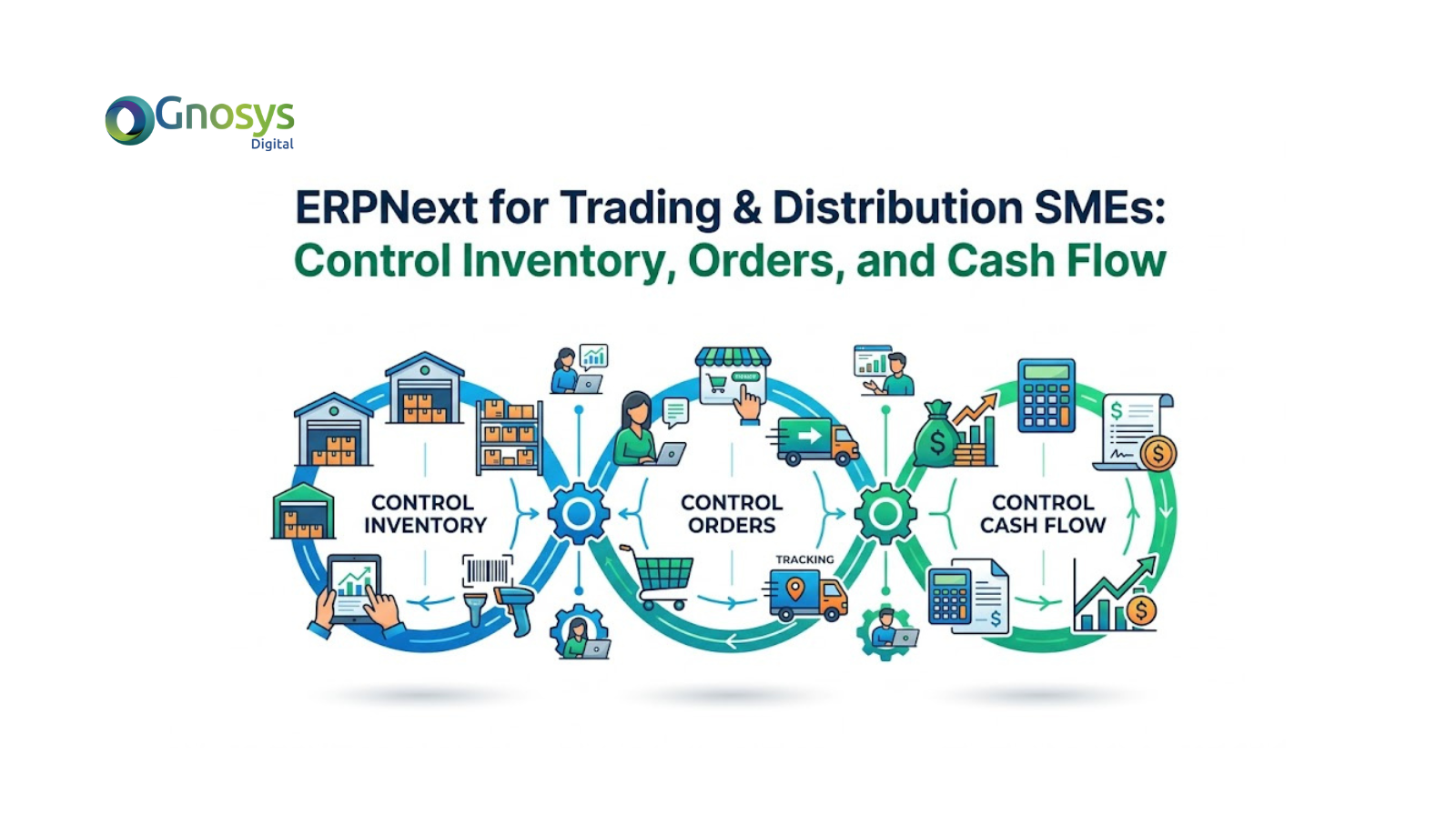
Trading and distribution businesses operate in a fast-moving environment where margins are tight and timing is everything. A small delay in order processing or a mismatch in inventory can quickly impact profitability. As operations grow, managing multiple warehouses, suppliers, and customers becomes increasingly complex.
Many SMEs struggle with issues like delayed orders, blocked cash flow, and confusion around stock levels. These problems not only slow down operations but also limit the ability to scale efficiently. Instead of focusing on growth, businesses end up spending time fixing operational gaps.
This is where a system like ERPNext becomes essential. By bringing all processes into one platform, it helps businesses gain control, improve visibility, and run operations smoothly without constant firefighting.
Key Problems in Trading & Distribution
Trading and distribution companies often face multiple operational challenges that directly affect growth and profitability. These issues may seem manageable at first but become major bottlenecks as the business scales and complexity increases.
One of the biggest challenges is cash flow management, which is often impacted by delayed collections and excess inventory. When money is stuck in unsold stock or pending payments, it restricts the ability to invest in new opportunities. At the same time, inventory mismanagement across warehouses creates confusion and inefficiencies.
Common problems include:
- Cash flow issues due to delayed collections and overstocking
- Inventory mismanagement across multiple warehouses
- Order delays caused by manual processes
- Lack of real-time visibility in stock and order status
Why These Problems Happen
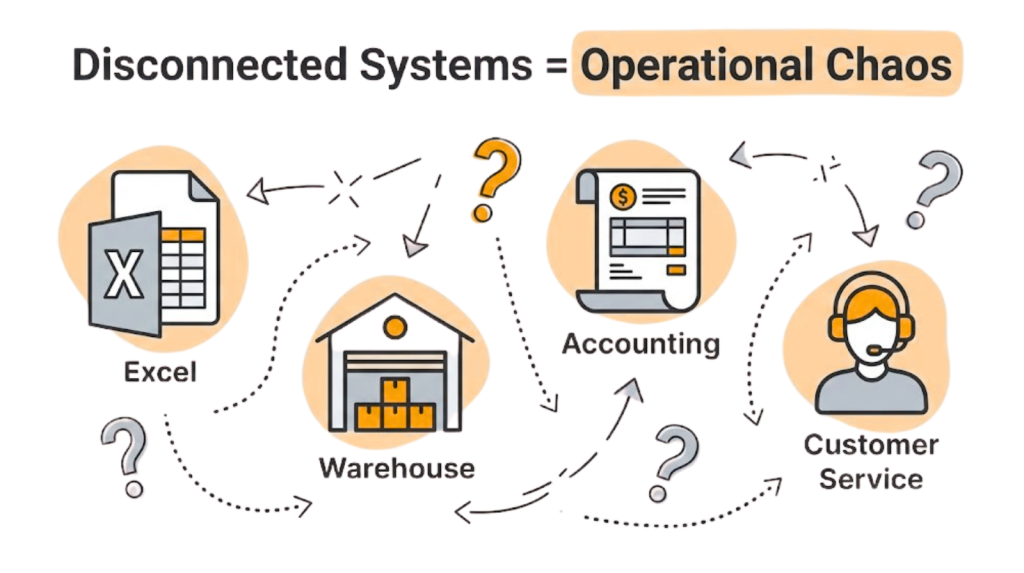
The root cause of most operational challenges lies in disconnected systems that do not communicate with each other. Many businesses rely on separate tools for accounting, inventory, and warehouse management, often using Excel sheets alongside basic software. This creates data silos and inconsistencies.
Without proper workflow integration, processes like purchase, stock updates, sales, and delivery operate independently instead of as a connected flow. This lack of coordination leads to delays, duplication of work, and frequent errors in daily operations.
Manual tracking further adds to the problem by increasing dependency on human input. Errors in data entry, delayed updates, and poor demand planning make it difficult to maintain accuracy, ultimately affecting decision-making and overall efficiency.
ERPNext End-to-End Workflow
To solve these challenges, businesses need a system that connects every stage of operations into a seamless workflow. ERPNext provides an end-to-end process that ensures smooth coordination between purchasing, inventory, sales, and delivery.
The workflow begins with purchase management, where businesses can create supplier orders and track incoming stock efficiently. Once the stock is received, it is automatically updated in the system, providing real-time visibility across warehouses without manual intervention.
The next stages include sales and delivery, where orders are created, invoiced, and dispatched in a structured manner. Every step is connected, ensuring that there are no gaps or delays, and operations flow smoothly from one stage to the next.
How ERPNext Streamlines Operations
Efficiency in trading and distribution comes from reducing manual effort and improving coordination across processes. ERPNext achieves this by automating workflows that would otherwise require constant monitoring and manual updates. This significantly reduces the chances of errors and delays.
Real-time inventory visibility across warehouses ensures that businesses always know what stock is available and where it is located. This helps in making better decisions regarding purchasing, transfers, and order fulfillment, avoiding both stock shortages and overstocking.
By integrating sales and purchase processes, ERPNext ensures that every transaction is connected and updated instantly. This leads to faster order processing, smoother operations, and improved overall productivity across the business.
Benefits for Trading Businesses
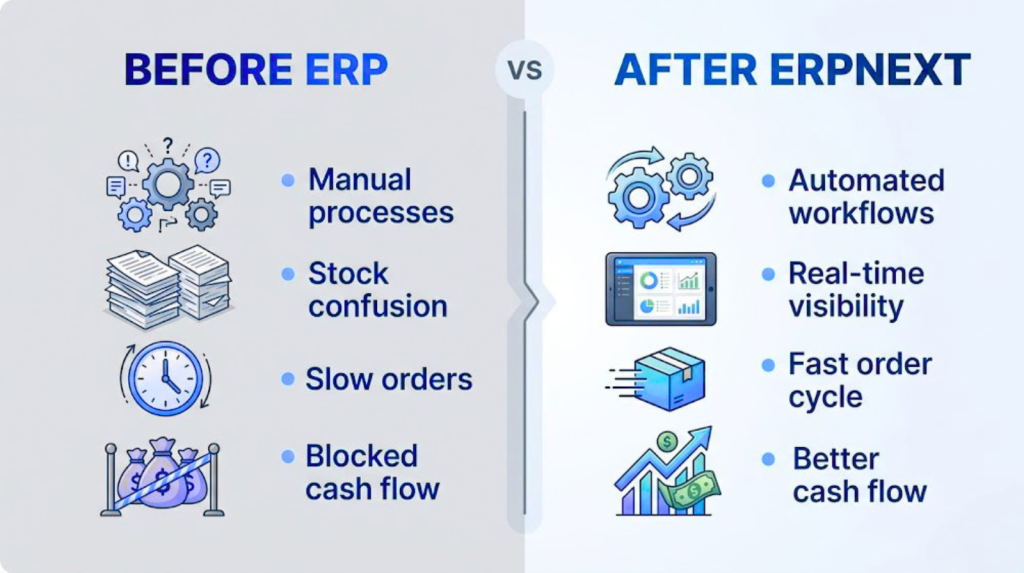
One of the most noticeable benefits of implementing ERPNext is a faster order cycle. Orders can be processed quickly, and dispatch planning becomes more efficient, reducing delays and improving customer satisfaction. With fewer errors and better coordination, businesses can handle higher volumes without increasing complexity.
Cash flow also improves significantly when operations are streamlined. Businesses can avoid overstocking through controlled purchasing while ensuring that invoicing and collections happen on time. This creates a healthier financial cycle and improves liquidity.
Better tracking of receivables and payables gives businesses complete financial clarity. Instead of guessing or relying on outdated reports, decision-makers can act based on real-time data, ensuring stability and growth.
Additional Advantages
Beyond core operations, ERPNext provides additional features that further enhance efficiency and control. Businesses can manage multiple warehouses seamlessly, ensuring that inventory is distributed and utilized effectively across locations.
Features like batch and expiry tracking are especially useful for industries dealing with perishable or regulated products. These capabilities help maintain compliance while reducing losses due to expired or unsold inventory.
| Feature | What It Does | Business Impact |
| Multi-Warehouse Management | Tracks stock across locations | Better inventory distribution |
| Batch & Expiry Tracking | Monitors product lifecycle | Reduces losses & ensures compliance |
| Demand Forecasting | Predicts future stock requirements | Improves planning & purchasing decisions |
| Central Dashboard | Unified business overview | Faster and better decision-making |
Conclusion
In trading and distribution, success depends on how well you manage inventory, orders, and cash flow. ERPNext helps businesses bring all these elements together into one streamlined system, reducing delays and improving overall efficiency.
By eliminating manual processes and disconnected systems, ERPNext enables businesses to operate with clarity and confidence. It not only solves current operational challenges but also creates a strong foundation for future growth and scalability.
If you’re looking to gain control over your operations and scale without chaos, now is the right time to act. Start your ERPNext implementation today and take your trading business to the next level. Book a demo now and experience the difference. 🚀
Schedule a Consultation:
https://gnosysdigital.com/erpnext-implementation/erpnext-for-retail-smes/
