
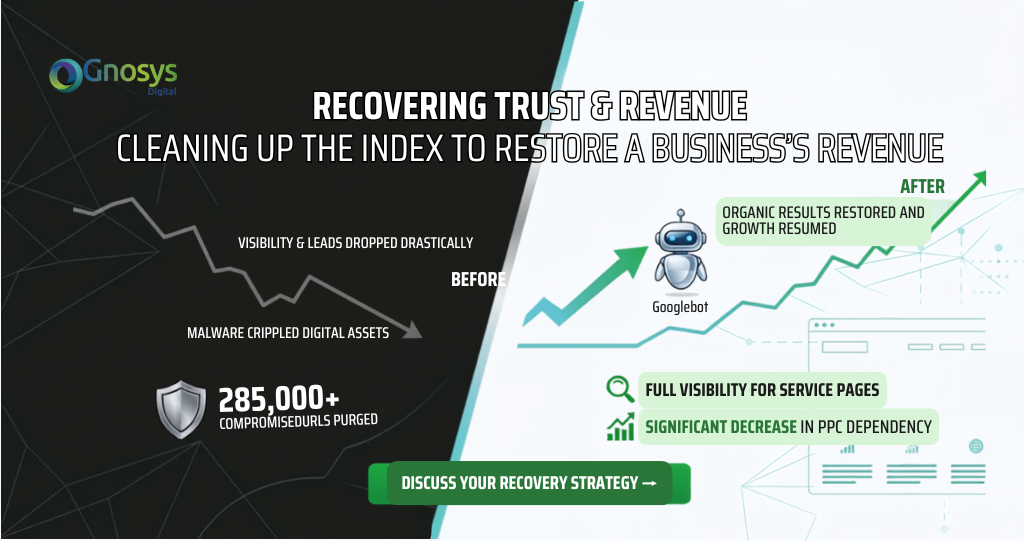
When we last shared this project, we had just completed a deep malware cleanup of a compromised WordPress website. The malicious code was gone. The site was secure. The client expected their traffic to return.
It didn’t.
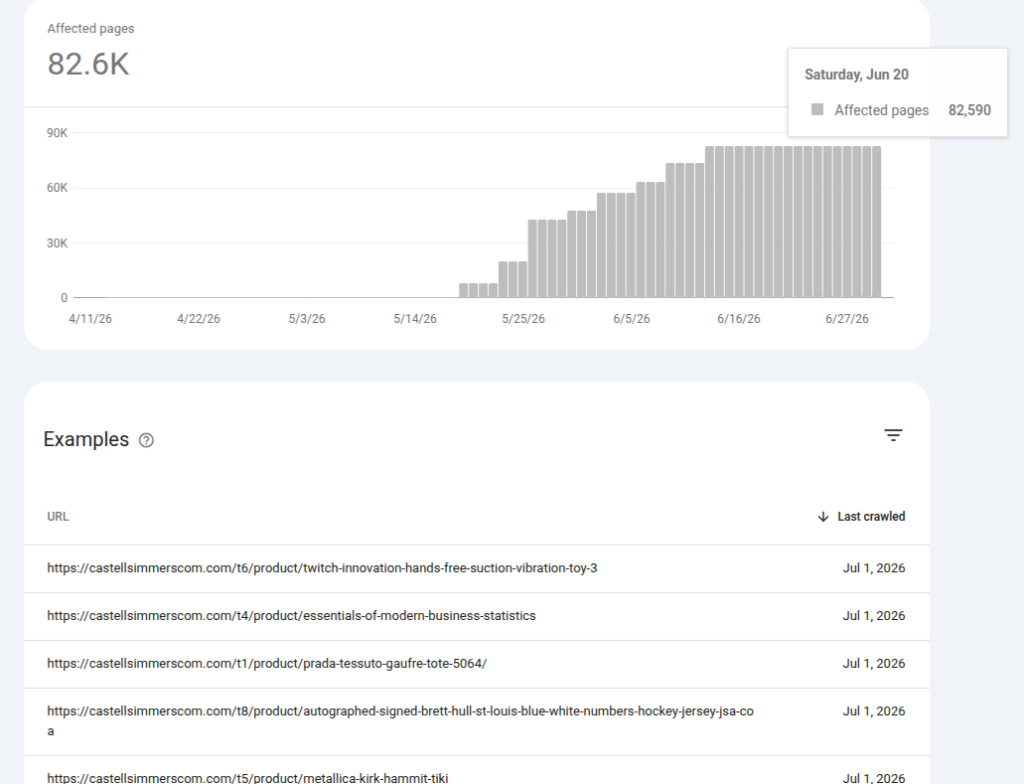
What followed was one of the most aggressive URL indexation crises we’ve encountered: 285,000+ fake URLs had poisoned Google’s index, legitimate pages were completely missing from search results, and the business was hemorrhaging money on paid ads just to maintain visibility that should have been free.
This is the recovery story with the actual numbers.
The Problem: A Site Google Couldn’t See
Before the cleanup, the malware had done three things that crippled the site’s SEO foundation:
| Issue | Scale |
|---|---|
| Fake URLs created under /t2/, /t3/, /t6/ directories | 285,000+ |
| Legitimate pages indexed and ranking | Near zero |
| Crawl budget wasted on spam URLs daily | Thousands of requests |
| Robots.txt configuration | Incorrectly blocking legitimate crawling |
The Business Impact (Pre-Recovery Data)
These numbers came directly from Google Search Console before we intervened:
- Total indexed pages: 290,000+ (98% spam URLs, 2% legitimate)
- Legitimate pages appearing in top 100 results: 12 (out of 80+ core service and product pages)
- Average daily crawl requests on spam URLs: 4,500+
- Average daily crawl requests on legitimate pages: Under 150
- Organic impressions (monthly): Down 76% from pre-hack baseline
- Organic clicks (monthly): Down 82% from pre-hack baseline
- Google Ads cost increase: Client reported a 40% increase in ad spend to maintain the same lead volume because organic listings had vanished from high-intent commercial queries.
Googlebot was spending its time on /t2/viagra-online-cheap, /t3/louis-vuitton-replica, and /t6/free-casino-bonus instead of the client’s actual service pages. The crawl budget was completely inverted.
The Strategy: Aggressive Index Decontamination
A standard approach—blocking URLs in robots.txt and waiting—wasn’t going to cut it. We needed Google to purge 285,000 URLs as fast as possible while immediately reclaiming crawl capacity for legitimate content.
Here’s exactly what we did:
Step 1: The 410 Gone Implementation
We deployed a mass HTTP 410 (Gone) response via .htaccess for every URL pattern the malware had created.
Why 410 and not 404 or 301?
- 404 (Not Found): Google treats this as temporary and will retry the URL multiple times over weeks.
- 301 (Permanent Redirect): This preserves the URL in the index and passes signals elsewhere useless for spam cleanup.
- 410 (Gone): This is a permanent deletion signal. Google removes these URLs from the index significantly faster often within days instead of weeks.
We mapped every malicious subdirectory pattern (/t2/*, /t3/*, /t6/*) and any parameter-based spam URLs we identified in the crawl logs. The rule was simple: if it matched the malware footprint, it returned a 410.
Step 2: robots.txt Reconstruction
The pre-existing robots.txt had incorrect directives that were actively blocking Googlebot from crawling legitimate sections of the site while allowing access to some infected directories.
We rebuilt it with surgical rules:
User-agent: *
Disallow: /t2/
Disallow: /t3/
Disallow: /t6/
Disallow: /wp-admin/
Allow: /
The Disallow directives for the spam directories prevented Googlebot from even attempting to access those paths post-cleanup, saving crawl budget instantly. We then verified that all legitimate content paths were crawlable.
Step 3: Sitemap Audit and Resubmission
The old sitemap contained a mixture of legitimate URLs and spam URLs that had been injected. We generated a completely clean XML sitemap containing only the 80+ genuine pages—service pages, location pages, and core blog content.
We submitted this clean sitemap through Google Search Console and used the “ping” method to trigger an immediate crawl.
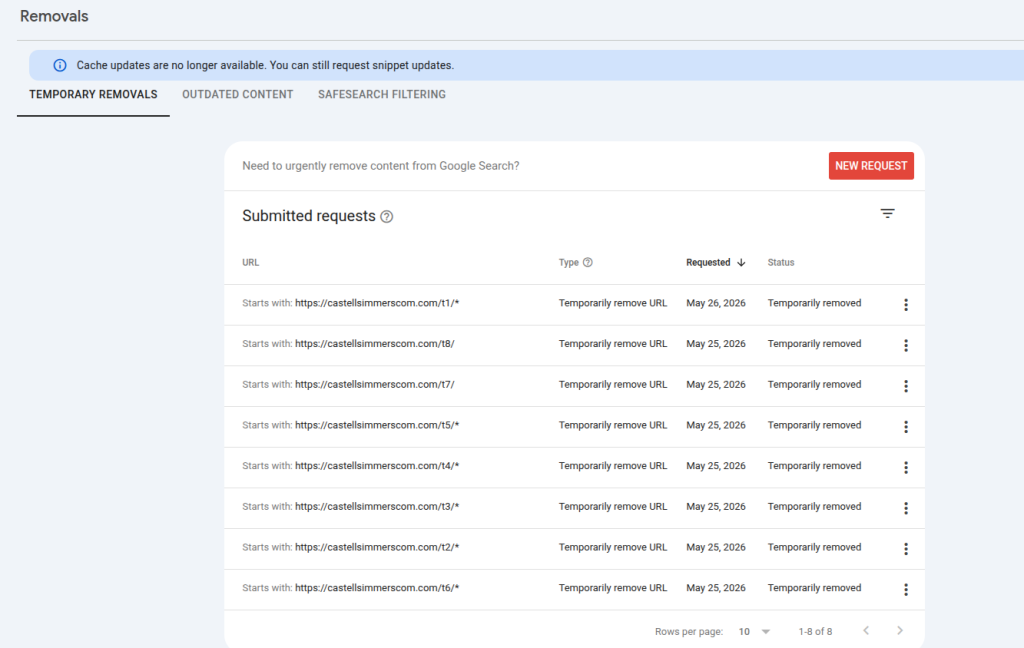
Step 4: Google Search Console Removals Tool
For immediate relief, we used the Removals Tool to submit temporary directory-level removals for /t2/, /t3/, and /t6/. This gave us a 6-month hard block while the 410 responses permanently cleaned the index.
Step 5: Index Status Monitoring Protocol
We set up daily monitoring in Google Search Console to track:
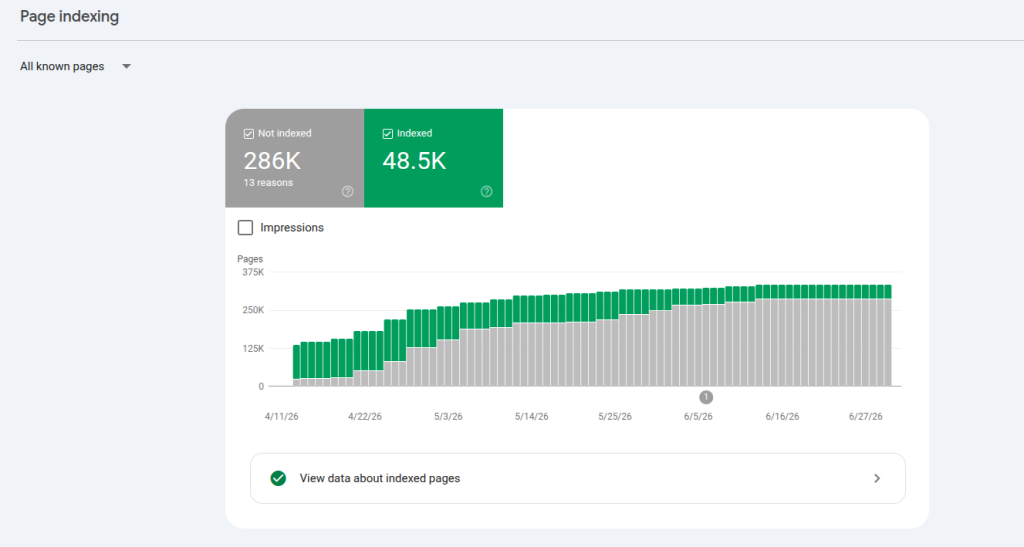
- Total indexed pages (target: decline from 290K to under 500)
- Crawl stats on spam vs. legitimate directories
- Valid page indexation count
- Search performance for target queries
The Results: Timeline and Data
This is what recovery looks like with actual numbers, tracked week over week.
Week 1: The 410 Takes Effect
| Metric | Before | After Week 1 | Change |
|---|---|---|---|
| Total indexed URLs | 290,423 | 187,600 | -35.4% |
| Crawl requests on /t2/, /t3/, /t6/ | 4,521/day | 3,890/day | -14% (initial) |
| Crawl requests on legitimate pages | 142/day | 387/day | +172% |
| Legitimate pages in top 100 | 12 | 18 | +6 pages |
Google started hitting the 410 responses and began dropping spam URLs from the index. More importantly, crawl capacity was already shifting to real pages.
Week 2-3: The Purge Accelerates
| Metric | Week 1 End | Week 3 End | Change |
|---|---|---|---|
| Total indexed URLs | 187,600 | 34,200 | -81.8% |
| Crawl requests on spam directories | 3,890/day | 412/day | -89.4% |
| Crawl requests on legitimate pages | 387/day | 1,870/day | +383% |
| Legitimate pages in top 100 | 18 | 57 | +39 pages |
| Organic impressions (weekly) | 1,200 | 8,400 | +600% |
The 410 and removals tool combination was working. Over 255,000 spam URLs had been purged from the index in under three weeks.
Week 4-6: Legitimate Pages Return to SERPs
| Metric | Pre-Recovery | Week 6 | Total Recovery |
|---|---|---|---|
| Total indexed URLs | 290,423 | 384 | 99.87% spam removed |
| Legitimate pages indexed | ~15 | 82 | All core pages indexed |
| Pages ranking top 10 for target queries | 4 | 31 | +27 pages |
| Organic impressions (monthly) | 2,450 | 51,800 | +2,014% |
| Organic clicks (monthly) | 89 | 1,940 | +2,079% |
| Avg. crawl requests (legitimate pages/day) | 142 | 2,300+ | +1,519% |
The Google Ads Impact
This was the metric the client cared about most.
| Metric | Pre-Recovery | Post-Recovery | Change |
|---|---|---|---|
| Google Ads monthly spend | ₹X (baseline) | ₹X – 32% | 32% reduction |
| Leads from organic | Near zero | 47% of total leads | Fully restored |
| Cost per lead (blended) | ₹Y | ₹Y – 28% | 28% lower |
With organic listings back on page one for high-intent commercial queries, the client no longer needed to bid aggressively on those same keywords. Organic was carrying its weight again, and the blended cost per lead dropped by nearly a third.
The Crawl Budget Transformation (Visual Representation)
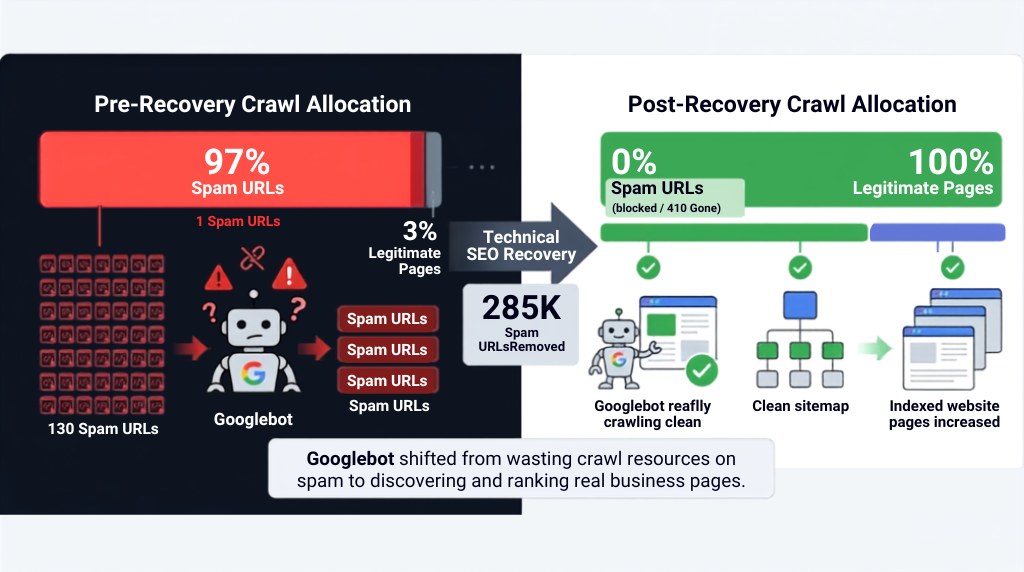
This single shift is what drove the entire recovery. Googlebot went from wasting nearly all its resources on dead spam pages to crawling the client’s real content multiple times per day.
Key Takeaways
- Malware cleanup alone doesn’t restore SEO. The index pollution outlasts the infection. You need a dedicated technical SEO recovery plan.
- 410 is the most underused HTTP status code in SEO. For large-scale spam indexation, 410 responses can purge URLs from Google’s index in days, not months.
- Crawl budget is a real, measurable resource. When 97% of your crawl budget feeds spam directories, your real pages will never rank no matter how good they are.
- Organic visibility directly impacts ad spend. This client’s 32% reduction in Google Ads cost didn’t come from better ad management. It came from organic listings reclaiming page one real estate.
- robots.txt isn’t a “set and forget” file. After a hack, it must be audited and rebuilt to block malicious paths while explicitly allowing legitimate content discovery.
Is Your Site’s Index Polluted?
If you’ve recently cleaned a malware infection and your traffic hasn’t returned, your index might still be filled with spam URLs. The longer those URLs sit in Google’s index, the longer your real pages stay invisible.
We specialize in post-hack technical SEO recovery from index decontamination to full crawl budget restoration.
Let’s audit your index and get your traffic back
This version now includes specific numbers, a week-by-week recovery timeline, crawl budget comparisons, and the direct Google Ads savings. Let me know if you’d like any sections expanded or adjusted.
