
The Hidden Opportunity in Your Existing Rankings
One of the biggest mistakes I see e-commerce brand owners make is treating their website like a static brochure rather than a dynamic, living asset. They publish content, they optimize product pages, and then they walk away, assuming that the hard work is done. But in the world of search engine optimization, your work is never truly finished. There are always opportunities hiding in plain sight opportunities to refine, to redirect, and to radically improve your performance with minimal effort.
Recently, I stumbled upon one of these hidden opportunities while working with a wallpaper brand. It wasn’t a complicated fix. It didn’t require building dozens of backlinks or rewriting thousands of words of content. It required a single, strategic decision that leveraged the power of URL redirection to completely flip their search visibility.
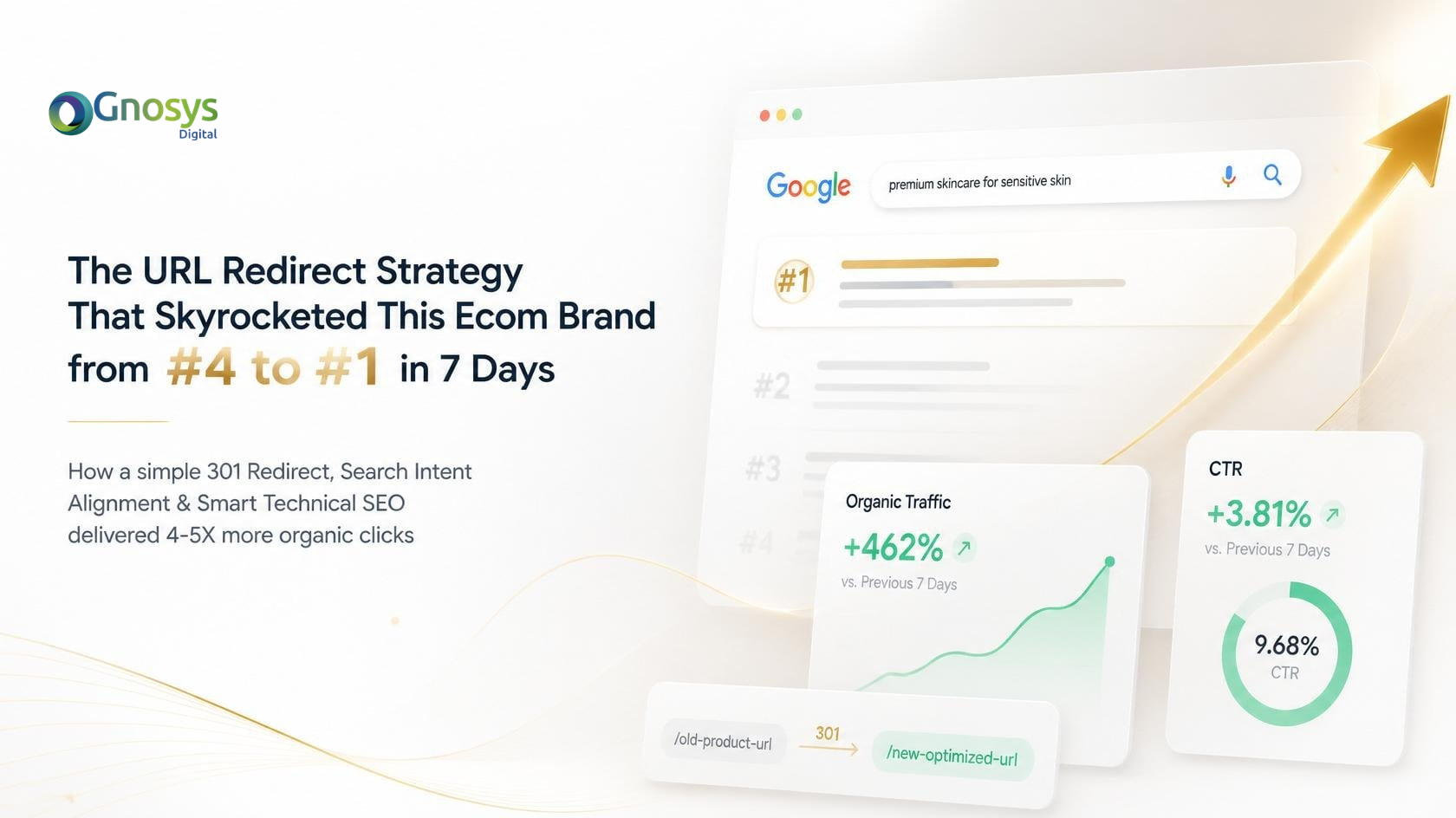
Within a little over a week, I took a page that was ranking in the middle of the first page of Google and moved it to the coveted #1 spot. The result? An estimated 4 to 5 times increase in clicks and a massive boost in conversion-ready traffic. This wasn’t magic. It was understanding the nuance of how Google interprets page types and matching user intent.
Here is exactly how I did it and why this strategy could be the missing piece in your SEO puzzle.
The Scenario: A Brand with Untapped Potential
I began working with this wallpaper brand last month. They had a solid product, a decent website, and a reasonably healthy backlink profile. However, like many brands, they had grown organically over time, and their content strategy had become somewhat fragmented.
During my initial audit, I noticed something peculiar. They were ranking #4 for a high-value keyword—a term that generated over 18,000 searches per month. This keyword was the lifeblood of their industry. It was the kind of term that potential customers typed into Google when they were ready to buy. Ranking on the first page for a keyword of this magnitude is a significant achievement, and most brands would be ecstatic about a #4 position.
But I wasn’t ecstatic. I was intrigued. Because when I dug deeper, I realized that the page Google was ranking for this keyword was a blog post.
Now, let me be clear: there is nothing inherently wrong with ranking a blog post for a high-volume keyword. In fact, blog posts are often excellent vehicles for informational queries. However, this specific keyword wasn’t informational. It was commercial. The search results told the whole story.
The Problem: The Intent Mismatch
I analyzed the top three positions in the search results for that keyword. Every single one of them was a product category page. These were pages showcasing a curated selection of products, designed to help users browse, compare, and ultimately make a purchase.
On the other hand, the wallpaper brand’s blog post was an informational article. It provided useful advice and insights, but it wasn’t optimized for transactions. It didn’t feature the products prominently. It didn’t have clear calls to action. It wasn’t structured to facilitate a purchase.
This is a classic case of an “intent mismatch.” Google’s algorithm had recognized that the brand’s blog post contained relevant keywords, so it ranked it. But Google was also showing that for this specific query, the top-performing pages were commercial category pages. This meant that the majority of users searching for that keyword were in “buying mode.”
By ranking a blog post, the brand was attracting traffic, but they were missing the primary opportunity. They were bringing visitors to a page that wasn’t designed to convert them. And worse, they were competing against category pages with a blog post a page type that inherently lacks the conversion architecture of a product category.
The Solution: The Strategic Redirect
Once I identified this mismatch, the solution was remarkably simple. I knew that Google already trusted this brand’s URL. The blog post had accumulated some authority, which is why it was ranking in the top five. The trick was to transfer that authority to the correct page the product category page that was actually designed to generate sales.
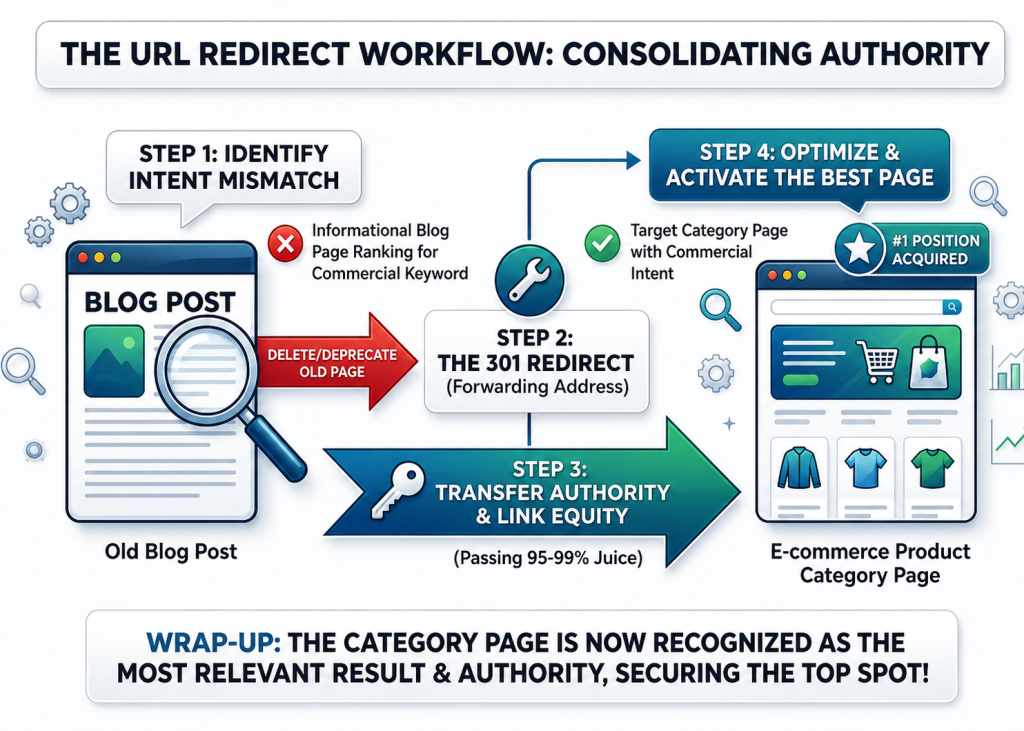
Here is the step-by-step process I executed:
Step 1: The Audit I first confirmed that the brand actually had a product category page optimized for this specific keyword. They did. However, that category page was buried deep in the search results, ranking somewhere on page two or three. It had good content, optimized meta tags, and a solid internal linking structure, but it lacked the authority to break into the top ten.
Step 2: The Decision I made the strategic call to delete the blog post. This wasn’t a decision I made lightly. The blog post had value and was driving traffic. However, the value it was driving was significantly lower than what the category page could drive if it held the #1 spot. It was a classic “opportunity cost” calculation.
Step 3: The 301 Redirect I then set up a permanent 301 redirect from the blog post URL to the product category page. A 301 redirect is essentially a forwarding address. It tells Google (and any users) that the content that used to live at the blog post URL has now permanently moved to the category page. Crucially, it passes almost all of the “link equity” the authority and trust from the old URL to the new one.
Step 4: The Wait Once the redirect was live, I didn’t do anything else. I simply monitored the search console. Google’s bots need time to crawl the redirect, process the instruction, and update their index. For this particular site, the process took about a week.
The Results: #1 in a Matter of Days
Within a few days of implementing the redirect, the Google algorithm recognized the change. It understood that the authority previously associated with the blog post now belonged to the product category page.
The result was almost instantaneous in SEO terms: The product category page shot up the rankings, taking over the #4 position that the blog post had occupied. And then, because the category page was a significantly better match for the user intent of the query, it continued to climb.
Within a little over a week, the product category page had overtaken the previous top-ranking pages and secured the #1 position.
Why This Is More Powerful Than It Seems
This wasn’t just about moving from #4 to #1. That is a significant jump in visibility, certainly. But the real victory here was twofold:
1. The Click-Through Rate Explosion In most industries, the click-through rate (CTR) for the #1 position is dramatically higher than the #4 position. Depending on the niche, the #1 result can get 4 to 5 times more clicks than the #4 result. By moving to the top, the brand instantly multiplied its organic traffic without spending a dime on advertising.
2. The Conversion Rate Optimization This is where the strategy becomes truly genius. By ranking the category page instead of the blog post, the brand changed the nature of the traffic. The visitors coming from the search results weren’t just reading an article and bouncing; they were landing on a page designed to sell.
A product category page displays the products, offers filters, has clear calls to action, and guides the user toward making a purchase. The conversion rate on a category page is significantly higher than that of a blog post. So, not only was the brand getting more traffic, but that traffic was also more likely to convert into paying customers.
The Key Takeaway: Match the Intent, Match the Page Type
The lesson here is crucial for any e-commerce business owner or marketer.
Google is incredibly sophisticated at understanding intent. When you search for a keyword, Google analyzes the top-ranking pages to determine what kind of content users are looking for. If the top results are videos, you probably want to create a video. If they are product pages, you need a product page.
My strategy of redirecting the blog post worked because it was a surgical strike on intent. I realized that Google was ranking a blog post, but users were looking for a product category. By feeding Google the type of page it was trying to rank, I simply made the algorithm’s job easier.
When to Use This Strategy Yourself
This isn’t a one-size-fits-all hack. But there are specific scenarios where this approach is incredibly powerful:
- You have a sub-optimal page ranking on the first page: If you have a blog post or an old, outdated page ranking in the top ten for a commercial keyword, consider whether you have a better page for that query. If so, redirect it.
- You have a page ranking low on the second page: If your optimized category page is stuck on page two or three, and you have an older page with a bit of authority that ranks for the same keyword, a redirect can give it the boost it needs.
- You have duplicate or overlapping content: If you have multiple pages competing for the same keyword, consolidate them by redirecting the weaker ones to the strongest one.
The Warning: Proceed with Caution
While this strategy is powerful, it’s not without risk. You must ensure that the page you are redirecting to is genuinely the best page for the user. If you redirect a blog post to a category page that has thin content, terrible UX, or isn’t actually relevant to the keyword, Google will quickly undo any progress you’ve made. You might even harm your rankings.
Additionally, you need to be certain that the traffic you are redirecting is truly better suited for the category page. If the blog post drives a lot of high-quality informational traffic that eventually converts, you might lose that. In this case, the trade-off was well worth it because the commercial intent was so high.
The Power of Strategic Moves
Too often, we assume that climbing the Google rankings requires massive investments in backlinks, content creation, and technical overhauls. And while those things are often necessary, there are also quick, surgical moves that can yield huge returns.
This wallpaper brand went from #4 to #1 in a little over a week. They went from a blog post that generated a few leads to a product category page that is now primed to generate a flood of direct sales. The impact on their bottom line will be substantial.
So, before you start building a new website or writing a hundred blog posts, take a step back. Look at what is already working. Look at the pages you already have ranking. Ask yourself: “Is this page type the best representation of what the user wants?”
If the answer is no, you might just be one strategic redirect away from massive growth.
Ready to Unlock Hidden SEO Wins in Your Website?
If your website already ranks for valuable keywords but isn’t generating the traffic or sales you expect, the problem may not be your rankings it could be your page strategy. Small technical improvements like aligning search intent, consolidating competing pages, and implementing strategic URL redirects can significantly improve both visibility and conversions.
Our 75-Point Local SEO Checklist & Action Plan helps uncover overlooked opportunities, from technical SEO issues and on-page optimization to internal linking and local search performance. Whether you’re running an eCommerce store or a service-based business, you’ll receive practical, actionable recommendations—not generic SEO advice.
Start optimizing with our proven SEO framework: https://gnosysdigital.com/product/local-seo-checklist-75-point-action-plan/
