
Running multiple business lines should multiply your profits, not your problems. But for most SME owners, managing trading, manufacturing, services, and e-commerce feels like running several separate companies at once, each stuck inside its own software, its own spreadsheets, and its own daily chaos.
This guide shows how one unified ERP system replaces that scattered toolset, removes the guesswork, and gives you complete control. You get one dashboard, one source of truth, and one scalable platform for every business unit you manage.
Why Multi-Business SMEs Lose Control as They Grow
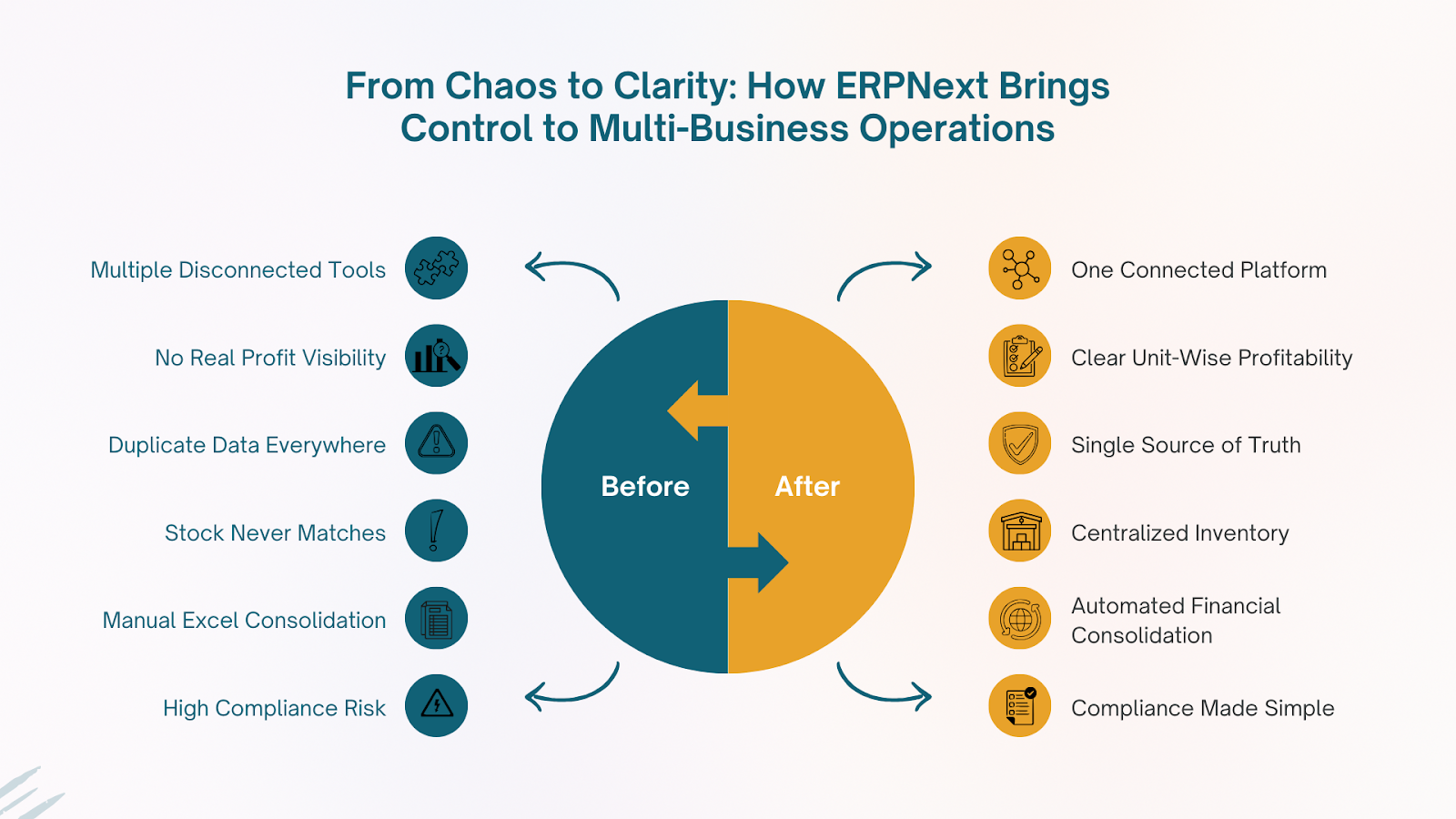
Multiple Tools, Zero Integration
Trading runs on Tally. Manufacturing is locked inside spreadsheets. Services rely on a standalone CRM. E-commerce operates through yet another platform. None of these systems talks to each other.
Profitability Blind Spots
You can’t clearly see which business lines generate profit, which drain cash, or where margins are leaking.
Data Duplication and Multiplying Errors
Vendors, customers, items, and taxes get re-entered across different systems. Every duplication creates another risk of mistakes that compound over time.
Monthly Financial Consolidation Crisis
Teams spend days, sometimes weeks, merging numbers from multiple software into Excel. By the time the report is ready, it’s already outdated.
Mounting Compliance and Audit Risk
Mismatched GST entries, scattered audit trails, and inconsistent approval workflows turn every compliance cycle into a stressful, high-risk exercise.
This isn’t just inefficient. It’s a structural barrier to growth.
ERPNext is built to eliminate these obstacles by replacing disconnected tools with one unified system that connects every part of your business.
How ERPNext Brings Control to Multi-Business Operations
ERPNext is designed for complexity. Instead of forcing every business unit into a single rigid process, it gives each line its own structure while keeping everything connected under one unified system.
1. Structure Each Unit Independently While Keeping Them Integrated
Solves: Multiple tools for multiple units.
Create separate companies, cost centers, or profit centers for trading, manufacturing, services, or any other vertical. Each runs with its own workflows and chart of accounts, yet rolls up cleanly into a unified group structure.
2. See Every Rupee Clearly, Both Segmented and Consolidated
Solves: Zero visibility across business lines.
Gain automatic group-level consolidation, along with deep, unit-level visibility. Instantly track revenue, costs, margins, and cash flow for every vertical without guesswork.
3. One Inventory System That Works Across All Business Lines
Solves: Duplicate data and inconsistent stock records.
Manage trading stock, factory inventory, and retail outlets from one system. Use shared or separate item lists, track batches and serials, and move stock between units without manual duplication.
4. Workflows Tailored to the Needs of Each Business Type
Solves: Rigid, one-size-fits-all processes.
ERPNext adapts to each unit:
- Manufacturing: BOMs, work orders, MRP
- Trading: Procurement, pricing, stock reconciliation
- Services: Projects, tasks, timesheets
- Retail and E-commerce: POS, returns, shipping
Everything runs in one place without forcing mismatched processes together.
5. Clean, Secure, Role-Based Access for Every Team
Solves: Data clutter and poor access control.
Sales teams see only sales. Production teams see only manufacturing. Finance sees everything. Role-based permissions protect sensitive data and maintain clarity across units.
6. Reports That Matter: Real-Time, Segmented, and Consolidated
Solves: Monthly financial consolidation chaos.
View real-time dashboards for each business line alongside automated group-level statements. You instantly know what’s performing, what needs improvement, and what needs to stop, without using Excel.
What Actually Changes When You Run One Unified ERP
Adopting one ERP system isn’t just a technical upgrade. It changes the way you run your entire multi-business portfolio. Here’s what improves when everything moves into a single, connected platform:
1. Strategic Control Replaces Daily Firefighting
You finally see which business unit drives profit and which one drains resources. Decisions stop being guesses and become clear, numbers-backed calls on where to invest, optimise, or exit.
2. Decisions Move at the Speed of Your Business
Real-time dashboards show performance across all units as it happens. What once required weekly meetings and reports now takes a quick glance to understand.
3. Significant Cost Reduction and Efficiency Gains
One ERP replaces four or five disconnected systems. You cut software costs, eliminate manual reconciliation, and free your team from repetitive data entry.
4. Scaling Becomes a Strategy, Not a Struggle
New business lines, branches, or services can be added through configuration instead of new systems.
5. Compliance Stops Being a Source of Stress
Automated GST, unified approval workflows, and consistent audit trails across units turn compliance into a predictable, low-effort process instead of a monthly scramble.
Real-World Scenarios: How ERPNext Solves Common Multi-Business Problems
| Your Business Scenario | The Problem You Face Today | How ERPNext Solves It Instantly |
| You run Trading and Manufacturing together | Procurement, stock, and production run on separate systems. Constant manual coordination. | One connected flow from purchase to production to delivery. No duplication, no mismatch. |
| You operate Retail stores and an E-commerce channel | Online and offline stock never match. Reconciliation takes hours. | Centralized inventory across all channels with real-time updates. |
| You sell Services and Physical Products | Invoices, projects, and inventory are split across different tools. | Projects, items, billing, and delivery run in one unified platform. |
| You manage multiple branches, franchises, or brands | Each location works with its own data. No clear consolidated view. | Real-time dashboards and consolidated reporting across all branches. |
| You own a group of different companies | Inter-company billing and group-level reporting are messy and slow. | Automated inter-company transactions and clean group financials. |
| You add new business lines frequently | Each vertical needs a new tool, causing confusion and rising costs. | Add new units with simple configurations inside the same ERP. |
| Your teams use 4–6 different apps daily | Data duplication, errors, and zero integration. | Replace multiple tools with one fully integrated system. |
| You can’t see accurate profitability per business line | Numbers come from spreadsheets and manual merging. | Unit-wise and group-wise profitability dashboards are updated in real time. |
The Bottom Line
If your business is growing faster than your systems, ERPNext is the upgrade that brings everything under control.
One source of truth. One connected workflow. One platform that scales with every new venture.
Our Implementation Blueprint for Multi-Business Success
Rolling out one ERP across multiple business lines is not a software task. It’s a transformation project that turns your entire operation into a unified digital command center. Our process is structured, deliberate, and designed to make every phase predictable and low-risk.
Phase 1: Discovery and Mapping
Map workflows, dependencies, and bottlenecks to ensure ERP fits actual business needs.
Phase 2: Architecture Design
Design company hierarchy, cost centers, and profit centers for clean data separation and scalable reporting.
Phase 3: Workflow Configuration
Tailor workflows for each unit: manufacturing, trading, services, while keeping all processes connected.
Phase 4: Automation and Integration
Automate inter-company transactions, stock movements, approvals, and consolidated reporting.
Phase 5: Customization and Dashboards
Deliver unit-wise and consolidated KPIs, financials, and inventory health dashboards for instant visibility.
Phase 6: Training and Onboarding
Role-specific onboarding ensures smooth adoption and minimal disruption.
Phase 7: Continuous Optimization
Ongoing support, quarterly reviews, and updates keep ERP aligned with new business lines and strategic goals.
The Outcome
A unified ERP that feels tailored for each unit, eliminates chaos, and scales with every new business line or branch.
Stop Juggling Systems. Start Scaling with Control.
Managing multiple business lines should help you grow, not force you to rely on spreadsheets, Tally entries, and scattered apps that never work together. If your operations feel held back by disconnected tools, ERPNext gives you the unified control you’ve been missing.
A single platform. One source of truth. Real visibility across trading, manufacturing, services, retail, or any mix you run.
Free 30-Minute Strategy Session
You’ll walk away with clarity, not sales pressure.
- A clear review of your current operational gaps
- A customized ERPNext walkthrough based on your exact business mix
- A simple, realistic implementation roadmap you can act on
This is the fastest way to understand how a unified ERP can eliminate chaos and support real growth.
Take the first step toward seamless operations.
Book your free strategy session today.
