
For decades, ERP systems have served as the backbone of business operations. Organizations have relied on them to manage finance, inventory, procurement, and human resources within a centralized platform. By replacing spreadsheets and disconnected tools, ERP systems helped businesses maintain operational control and improve efficiency.
However, most traditional ERP platforms were designed primarily for record-keeping. They capture transactions, store historical data, and generate reports about past activities. While this structure supports operational management, it rarely provides meaningful insight into what the data actually means.
Artificial Intelligence is now changing the role of ERP systems. Instead of simply storing information, modern ERP platforms are beginning to analyze patterns, forecast trends, and recommend actions that help organizations make smarter decisions.
The Core Limitations of Traditional ERP Systems
Traditional ERP systems play an essential role in managing daily operations, but they often struggle to support modern decision-making. Their design focuses heavily on storing and organizing information rather than interpreting that information.
Many organizations still depend on manual analysis to extract insights from ERP data. Managers must review multiple reports, compare numbers, and interpret trends before deciding what actions to take. This slows down decision-making and increases the risk of missed opportunities.
Another major challenge is delayed visibility. Reports are often generated daily, weekly, or monthly, which means leadership teams may only see operational issues after they have already impacted performance.
Key Limitations of Traditional ERP
- Heavy reliance on manual data entry
- Focus on reports instead of insights
- Limited predictive capabilities
- Slow response to operational changes
Traditional ERP vs AI-Powered ERP
The emergence of Artificial Intelligence is redefining how ERP systems function. Instead of acting only as data repositories, AI-powered platforms actively analyze business data and provide recommendations.
| Capability | Traditional ERP | AI-Powered ERP |
| Data Processing | Stores historical transactions | Continuously analyzes real-time data |
| Reporting | Static operational reports | Intelligent insights and recommendations |
| Forecasting | Limited forecasting tools | Predictive analytics and trend detection |
| Decision Support | Manual interpretation required | AI-assisted decision guidance |
| Operational Role | Record keeping system | Strategic intelligence platform |
This transition represents a major shift in enterprise systems. Businesses are moving from simply documenting past activities toward platforms that actively support strategic decisions.
Why Artificial Intelligence Changes Everything
Artificial Intelligence introduces a new level of intelligence to enterprise systems. Instead of simply organizing business data, AI can analyze large datasets in real time and identify patterns that humans might miss.
Machine learning models also allow ERP platforms to move beyond historical reporting. By studying past data patterns, AI can forecast future outcomes such as demand changes, financial trends, or operational risks.
Another important advantage is automation. AI-powered ERP systems can automate routine operational decisions, allowing teams to focus on strategic planning rather than repetitive administrative tasks.
Key Capabilities AI Brings to ERP
- Predicting demand fluctuations
- Detecting financial anomalies
- Forecasting cash flow trends
- Automating inventory replenishment
The Rise of AI-Powered ERP Systems
As Artificial Intelligence becomes more integrated into enterprise technology, ERP systems are evolving into intelligent operational platforms. These systems continuously monitor data across departments and translate it into actionable insights.
Instead of requiring managers to analyze multiple reports, AI-powered ERP platforms can highlight emerging risks, operational inefficiencies, and business opportunities. This helps organizations respond faster to changes in markets and operations.
Workflow automation is another key advancement. Many repetitive processes, such as purchase order creation, production scheduling, and routine approvals, can now be managed automatically by intelligent systems.
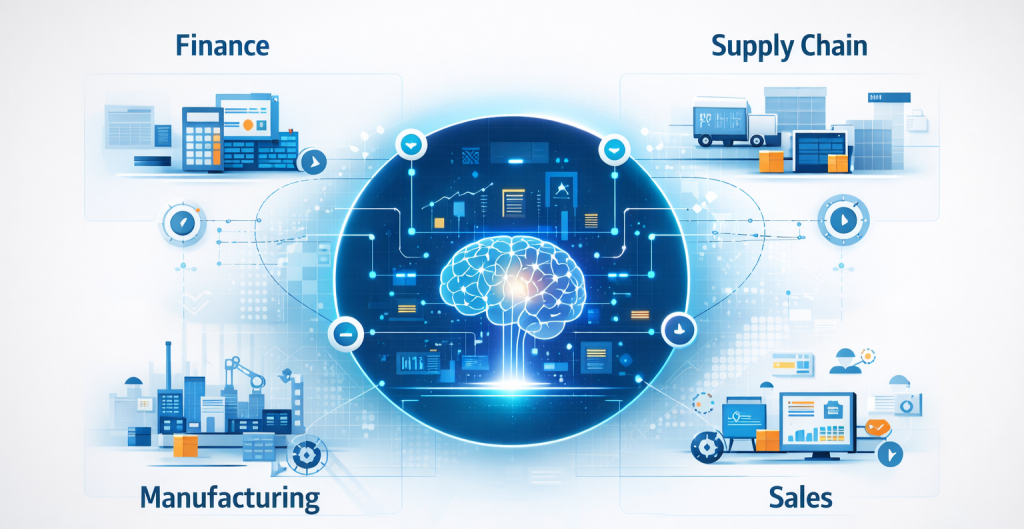
How AI Will Transform Key Business Areas
AI integration will not impact just one department. It will influence every major function within an organization by improving decision-making and operational visibility.
Finance
Finance teams traditionally rely on historical reports to evaluate performance. AI introduces predictive financial intelligence that helps organizations anticipate cash flow changes and detect unusual transactions in real time.
Supply Chain
Supply chains are affected by supplier performance, logistics delays, and demand fluctuations. AI-powered ERP platforms can analyze these factors and predict potential disruptions before they impact operations.
Manufacturing
Manufacturing environments benefit from predictive maintenance. AI can analyze machine performance data to detect early warning signs of equipment failures, reducing unexpected downtime and repair costs.
Sales
Sales forecasting becomes far more accurate with AI. By analyzing customer behavior, seasonal patterns, and market trends, AI-powered ERP systems can predict demand and identify high-value customer opportunities.
The Autonomous Enterprise
As AI continues to evolve, organizations are moving toward what many experts call the Autonomous Enterprise. In this model, ERP systems continuously monitor operations and recommend strategic actions based on real-time data.
Instead of waiting for leadership teams to review reports and respond to issues, intelligent ERP platforms can proactively identify risks and opportunities. For example, the system might detect inventory shortages, supply chain disruptions, or sudden demand changes before they affect business performance.
The goal is not to replace human decision-making but to enhance it. AI acts as an intelligent assistant that processes complex data and supports managers with data-driven recommendations.
How the Autonomous Enterprise Operates
- AI continuously monitors operational data
- Systems identify risks and opportunities automatically
- Managers receive recommended actions in real time
Challenges Organizations Must Prepare For
Despite its advantages, the transition toward AI-powered ERP systems also presents several challenges. Organizations must address both technological and cultural factors to adopt these systems successfully.
One of the most critical requirements is high-quality data. AI models depend on accurate and well-structured information. Poor data quality can lead to unreliable predictions and ineffective automation.
Integration complexity is another major challenge. Many companies operate multiple software systems, including CRM platforms, accounting tools, and supply chain systems. Ensuring that AI can access unified data across these platforms requires careful planning.
Organizations must also invest in training and change management. Employees need to understand how AI systems generate insights and how those insights should support business decisions.
Strategic Takeaways for Business Leaders
Business leaders should begin preparing for the transformation of ERP systems today. The companies that successfully integrate AI into their enterprise platforms will gain a major competitive advantage.
To prepare for this transition, organizations should focus on building a strong digital foundation and aligning their operational systems with data-driven decision-making strategies.
Key Priorities for the Future
- Invest in a strong data infrastructure
- Integrate AI with core business systems
- Adopt intelligent automation
- Shift from reactive to predictive operations
Conclusion
Traditional ERP systems have played a critical role in helping businesses manage operations and maintain structured data environments. They provided organizations with the ability to centralize financial, operational, and supply chain information within a single platform.
However, the future of ERP is moving beyond record keeping. Artificial Intelligence is transforming enterprise systems into intelligent platforms capable of analyzing patterns, predicting outcomes, and recommending strategic actions.
Organizations that embrace AI-powered ERP systems will operate with greater agility, respond faster to market changes, and make more confident decisions. The companies that adapt early will not only improve operational efficiency but also gain a significant competitive advantage in the evolving digital economy.
