
Most Indian SMEs run on tight margins, and every rupee invested in software has to show real, measurable return. This is exactly where ERPNext stands out.
Indian SMEs face constant pressure to improve efficiency while keeping costs low. Most ERP systems promise automation and visibility, but licensing fees, long implementation cycles, and hidden charges make them hard to sustain. ERPNext changes that by offering enterprise-grade capabilities at a price that SMEs can actually afford.
This blog explains why ERPNext stands out as India’s most budget-friendly ERP and how it helps small businesses operate with the same clarity and structure as larger companies.
A Pune-based trading company reduced stock mismatches by 60% and cut monthly accounting hours in half after shifting from spreadsheets to ERPNext. They went live in under four weeks without paying a single rupee for licenses.
1. Zero Licensing Cost
For small and medium businesses, licensing fees can quickly turn even a basic ERP into a major expense. Most traditional ERP systems charge per user or per module, and these costs rise as the business grows. For small teams, recurring fees like these can become a serious financial burden.
ERPNext removes this problem entirely. Every core module, Accounting, Inventory, HR, CRM, Projects, and Manufacturing, is available without any licensing or per-user fees. You can add users, expand departments, or scale operations without worrying about rising software costs.
For example, a small trading firm with 10 employees can grow to 25 users without paying a single extra rupee for licenses.
This means SMEs can direct their budget toward implementation, customization, and process improvements instead of spending just to access the software. With ERPNext, businesses save money while gaining full control over their operations.
2. All Essential Modules Included
Even after overcoming licensing costs, many SMEs face a bigger challenge—ERPs that don’t provide all the features needed to manage daily operations. Budget systems often limit functionality, leaving businesses to juggle multiple tools. ERPNext takes the opposite approach, offering a complete suite of modules without extra charges.
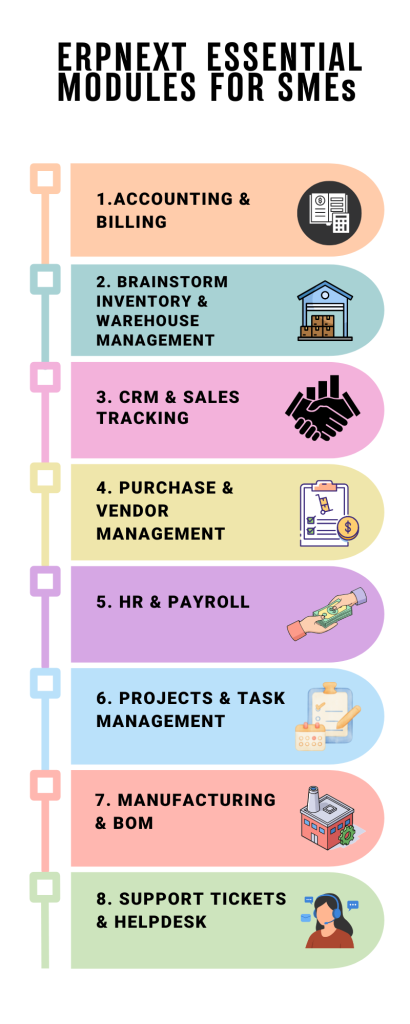
You get access to:
- Accounting and Billing – Smooth financial management with accurate reporting
- Inventory and Warehouse Management – Keep stock organized and under control
- CRM and Sales Tracking – Manage leads, customer interactions, and sales pipelines
- Purchase and Vendor Management – Streamline procurement and vendor relationships
- HR and Payroll – Simplify employee management and payroll processing
- Projects and Task Management – Track deadlines, tasks, and project progress efficiently
- Manufacturing and BOM – Plan production and manage bills of materials
- Support Tickets and Helpdesk – Maintain excellent customer service without gaps
3. Faster Implementation Reduces Total Cost
Lengthy ERP projects can cost SMEs both time and money, delaying the very benefits they were hoping to gain. Many systems require months of configuration, development, and repeated training. For small businesses, this slow rollout can disrupt operations and increase costs.
ERPNext solves this with pre-configured modules, simple workflows, and SME-focused design. Businesses can go live in just a few weeks, gaining efficiency without the long wait. For example, a growing trading company was able to implement ERPNext in three weeks, avoiding months of planning and setup.
SMEs experience faster rollout because:
- Setup is straightforward – Teams can start using the ERP immediately
- Customization is easier – Reduces reliance on expensive developers
- Training takes less time – Employees adopt the system faster
- SME-focused workflows – No complex enterprise processes to slow you down
With ERPNext, SMEs achieve faster deployment, lower total cost, and minimal operational downtime, getting real value from their ERP in weeks, not months.
Hidden Cost Breakdown for Indian SMEs
Where SMEs actually save money with ERPNext:
• No per-user fees
• No upgrade fees
• Lower hosting cost
• Less dependency on developers
• Faster go-live reduces man-hours wasted
| Feature | ERPNext | Traditional ERP |
| Licensing Cost | Zero licensing fees, unlimited users | High per-user or per-module fees |
| Customization Cost | Most changes are done with minimal coding | Customization almost always requires expensive developers |
| Scalability | Add users, branches, and warehouses at no extra cost | Scaling triggers higher licensing and upgrade fees |
| Hosting Options | Flexible: Cloud or low-cost self-hosting | Mostly cloudy with costly subscriptions |
| Implementation Time | Weeks (SME-ready workflows) | Months due tothe complex configuration |
| Upgrade Cost | Free updates, no hidden charges | Paid upgrades and annual renewal costs |
4. Affordable Hosting Models
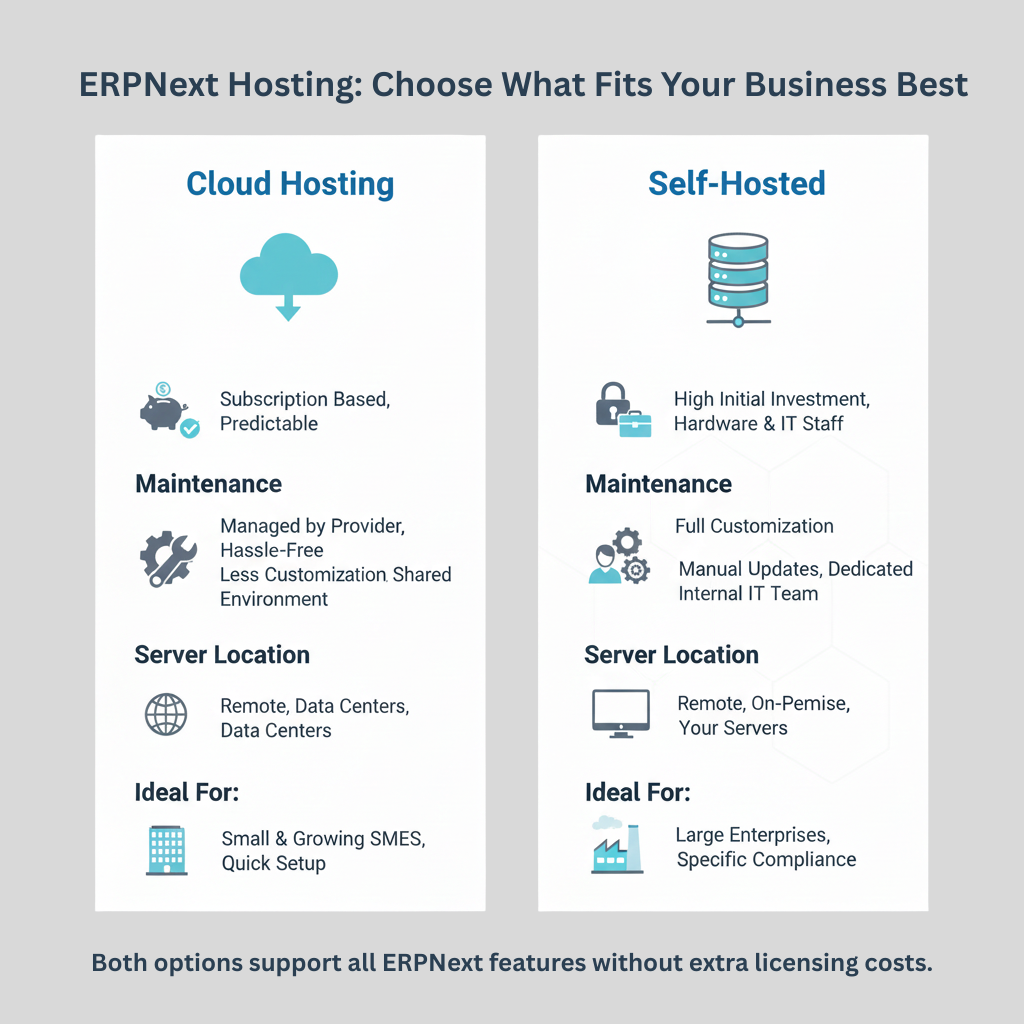
For many SMEs, hosting costs and IT management can quickly inflate the total ERP expense. ERPNext solves this by offering flexible hosting options that give businesses control over both cost and convenience.
SMEs can choose between two models:
- Cloud Hosting – Ideal for companies that prefer predictable monthly costs and minimal IT involvement. Servers, updates, and maintenance are handled externally, so teams can focus entirely on business operations.
- Self-Hosted – Perfect for SMEs that want full control and low long-term costs. Hosting on an affordable Indian server ensures strong performance while keeping annual expenses minimal.
5. Customization Without Heavy Developer Cost
Even small customizations in traditional ERPs often require expensive developers, quickly driving up costs for SMEs. ERPNext solves this problem by allowing extensive customization with minimal coding. Businesses can adjust the system to fit their processes, not the other way around.
SMEs can easily:
- Add custom fields – Capture business-specific data effortlessly
- Modify print formats – Tailor invoices, quotations, and reports
- Change workflows – Align approvals with internal processes
- Create automation rules – Reduce repetitive tasks and save time
- Adjust forms and doctypes – Adapt the system as business needs evolve
For example, a growing retail business added custom fields and automated approvals without hiring a developer, saving both time and money.
With ERPNext, SMEs enjoy powerful customization while keeping long-term expenses low.
6. Scalable Without Extra Charges
Many traditional ERP systems become more expensive as businesses grow. Adding users, branches, warehouses, or products often triggers extra license fees, making expansion costly and complicated for SMEs.
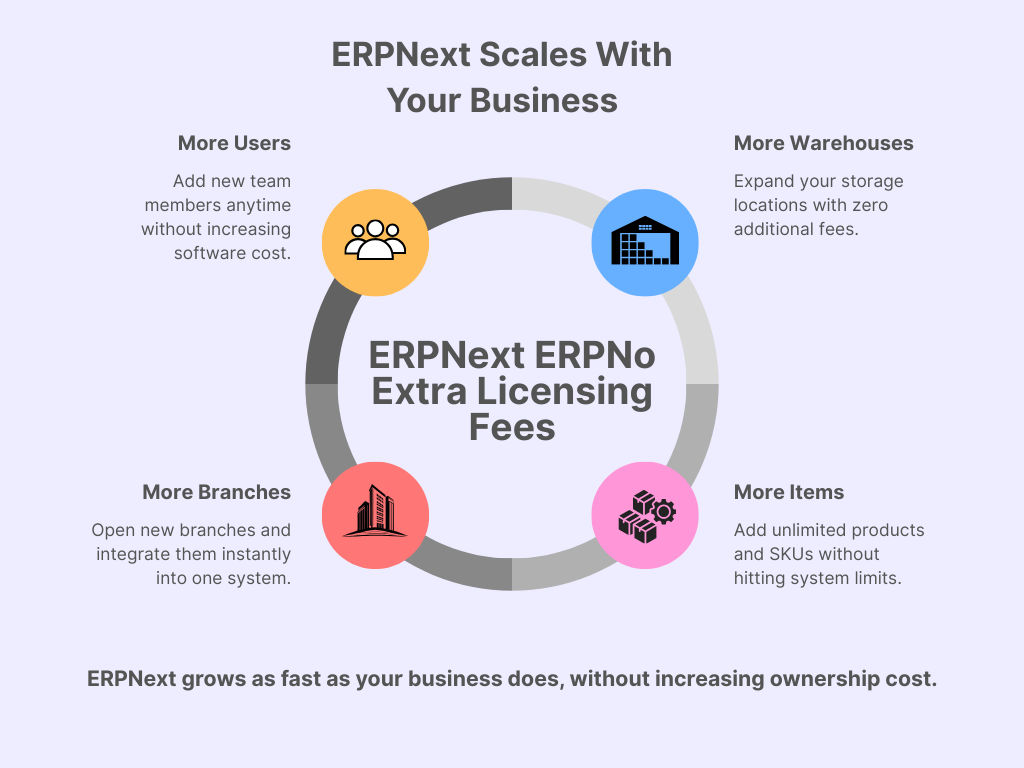
ERPNext removes these barriers entirely. The system is designed to scale with your business without increasing software expenses. You can expand operations freely, knowing your ERP costs remain predictable.
Businesses can easily add:
- More users – Support team growth without extra fees
- More warehouses – Expand inventory management as operations grow
- More branches – Manage multiple locations seamlessly
- More items – Increase product lines without additional cost
7. Strong Community and Continuous Improvements
ERPNext stands out not just for its features, but also for the strength of its community. Unlike traditional ERPs that charge for upgrades or new features, ERPNext benefits from a large global and Indian developer network that continuously contributes improvements, updates, and security patches.
These enhancements are released regularly and made available at no extra cost. SMEs can stay current with the latest functionality and security without worrying about yearly upgrade fees or surprise charges.
For example, small businesses using ERPNext automatically receive updates that improve workflows and strengthen system security, keeping operations smooth and up-to-date.
This continuous development ensures ERPNext remains modern, secure, and efficient, giving SMEs long-term stability and zero recurring upgrade expenses.
Who Should Choose ERPNext?
ERPNext is the ideal choice for SMEs that need a powerful ERP system without overspending. It works best for businesses that:
- Have limited IT budgets – Maximize functionality without high software costs
- We are growing quickly – Adding users, branches, or warehouses without extra fees
- Struggle with outdated or fragmented software – Consolidate operations in one platform
- Value transparent, predictable costs – Avoid hidden fees and surprise charges
If your business fits any of these criteria, ERPNext offers a practical, cost-effective solution to streamline operations and support growth.
Final Thoughts
ERPNext offers the perfect balance of functionality, flexibility, and affordability for Indian SMEs. It delivers automation, clear workflows, and operational visibility without the high licensing fees or hidden costs common in traditional ERP systems.
With fast implementation, fully integrated modules, easy customization, scalable options, and transparent support, ERPNext is easily the most budget-friendly ERP solution for small and medium businesses in India. Businesses can grow confidently, optimize operations, and achieve measurable results without financial strain.
If you want expert assistance in deploying ERPNext quickly and cost-effectively, the right guidance can help your business go live in just a few weeks, minimizing disruption while maximizing value.
Ready to Implement ERPNext for Your Business?
Most SMEs go live in under 21 days with our team.
Ready to Implement ERPNext for Your Business?
Get a complete, cost-efficient ERPNext setup with expert guidance tailored for Indian SMEs. Move from scattered processes to a fully structured system without overspending or delays.
👉 Start Your ERPNext Implementation Today:
