
How businesses outgrow spreadsheets, lose visibility, and regain control with ERPNext
Introduction
Every new year brings ambition, but inefficiencies do not disappear on their own.
In 2026, most businesses are not constrained by demand. They are constrained by disconnected data, manual reporting, and systems that cannot scale with growth. These limitations quietly slow decision-making, increase operational risk, and prevent leadership from having clear, real-time visibility into the business.
ERPNext addresses this problem at its core. It replaces fragmented tools and spreadsheets with a single source of truth, giving management real-time control across finance, sales, inventory, HR, and operations, without adding unnecessary complexity.
For businesses that want predictable, scalable growth in 2026, continuing with manual and disconnected systems is no longer a viable option. Moving to ERPNext is not just a technology upgrade; it is a strategic shift toward clarity, control, and long-term operational confidence.
The Real Problem Businesses Face Today
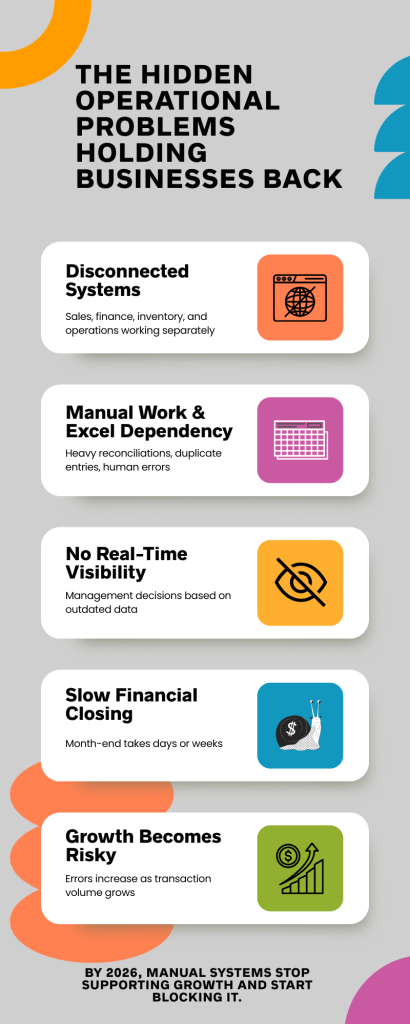
Inefficiency is the hidden cost that compounds quietly.
Most growing businesses are not failing because of low demand; they struggle because their internal systems cannot keep pace with growth. Before implementing ERPNext, we consistently see operational challenges that limit performance, delay decisions, and increase errors.
Common issues before ERPNext include:
- Departments in silos: Sales, accounts, inventory, and operations often work separately. This creates duplicated work, inconsistent data, and misaligned teams.
- Manual dependency: Heavy reliance on spreadsheets and manual reconciliations increases the risk of errors, consumes valuable time, and slows critical processes.
- No real-time insights: Management frequently relies on outdated reports or fragmented data. This delays decisions and reduces the ability to respond quickly to market changes.
- Slow month-end closing: Financial reconciliations and reporting cycles can take days or even weeks, draining time from analysis, planning, and strategy.
- Growing errors: As transaction volumes increase, mistakes multiply. Invoices, inventory counts, and accounting entries become more error-prone, creating operational and compliance risks.
These challenges do not remain isolated; they compound year after year. The inefficiencies that were manageable at a smaller scale quickly become critical bottlenecks. By 2026, businesses that continue relying on manual systems and disconnected tools will find that growth itself becomes a blocker, limiting scalability, profitability, and operational agility.
By understanding the real problems businesses face today, it becomes clear why a modern, integrated ERP system like ERPNext is no longer optional; it is essential for operational clarity and sustainable growth.
Why ERPNext Is the Right ERP for 2026
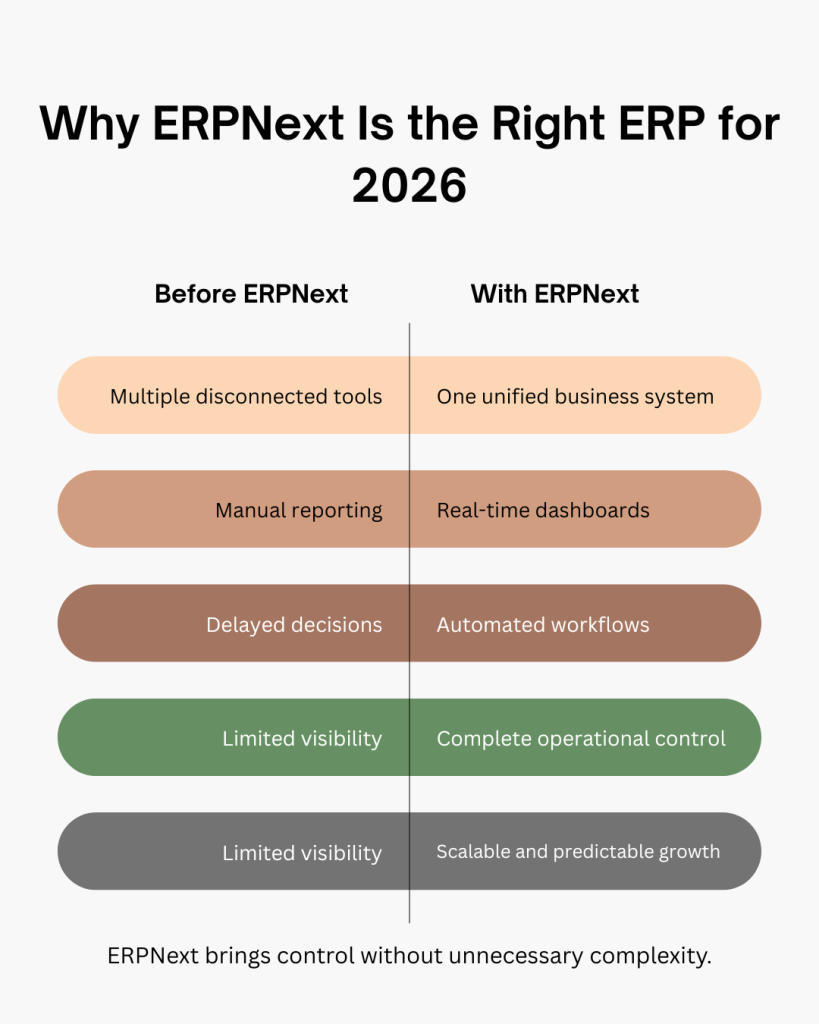
ERPNext is designed for modern businesses that want control without unnecessary complexity.
As businesses grow, operational challenges multiply. Siloed systems, manual processes, and delayed reporting can block scalability and reduce profitability. ERPNext is built to address these challenges, providing a unified, flexible, and scalable solution that supports growth in 2026 and beyond.
Key strengths of ERPNext include:
- Unified platform: Integrates accounts, sales, purchasing, inventory, HR, and manufacturing into a single system, eliminating silos and ensuring consistent data across all departments.
- Real-time dashboards: Provide instant, actionable insights that enable management to make confident, data-driven decisions without delays.
- Custom workflows: ERPNext adapts to your existing business processes rather than forcing your team to change the way they work, ensuring smoother adoption and better efficiency.
- Open-source and enterprise-ready: Combines the flexibility and transparency of open-source software with enterprise-grade reliability, security, and support.
- Scalable architecture: Suitable for small teams as well as multi-location businesses. As your company grows, ERPNext scales seamlessly to accommodate more users, processes, and transactions.
By consolidating operations into a single system, ERPNext reduces manual work, minimizes errors, and increases visibility across the organization. This not only improves day-to-day efficiency but also empowers leadership to plan and execute growth strategies with confidence.
ERPNext is more than software; it is a strategic foundation for operational clarity, control, and sustainable growth, making it the right ERP choice for businesses aiming to thrive in 2026.
What Changes After ERPNext Implementation
ERPNext fundamentally changes how a business operates. It shifts the organization from reactive problem-solving to proactive, data-driven management.
When implemented correctly, ERPNext delivers visible improvements across every department. This is not just about automating individual tasks. It is about creating control, clarity, and confidence so teams can work efficiently and leadership can make informed decisions based on real-time data.
Key Changes Businesses Experience After ERPNext
One source of truth across departments
All core functions, finance, sales, inventory, HR, and operations operate on a single, unified system. Data silos are eliminated, inconsistencies are reduced, and every team works with accurate, up-to-date information.
Faster and more confident decision-making
Real-time dashboards and reports provide instant visibility into business performance. Management no longer waits for manual reports or reconciled spreadsheets. Decisions are made quickly, using reliable and current data.
Reduced manual work and fewer operational errors
Standardized workflows and automated processes significantly reduce repetitive tasks. Manual errors decline, processes become predictable, and teams can focus on higher-value work instead of constant corrections.
Faster month-end closing and improved compliance
Financial closing cycles that once took days or weeks are completed faster and with greater accuracy. This improves compliance, strengthens reporting, and frees leadership to focus on planning and analysis.
Clear accountability and stronger collaboration
Role-based dashboards, permissions, and approvals bring transparency across teams. Responsibilities are clearly defined, collaboration improves, and operational ownership becomes visible.
ERPNext’s impact goes beyond efficiency. By providing a centralized operational backbone, it enables businesses to anticipate challenges, respond proactively, and scale with confidence. Instead of reacting to delays and errors, organizations gain control over their operations and build a strong foundation for sustainable, long-term growth.
Why ERPNext Implementation Fails for Some Businesses
ERP software itself rarely fails. Most failures are the result of poor implementation.
ERPNext is a powerful and flexible platform, but its success depends on how well it is planned, configured, and adopted across the organization. Many businesses encounter challenges not because of the technology, but because critical implementation steps are overlooked. When ERP is treated as a technical installation rather than a business transformation, the risk of failure increases significantly.
Common Reasons ERPNext Implementations Fail
Treating ERPNext as a plug-and-play solution
Assuming ERPNext will work effectively without proper configuration or process alignment leads to confusion, inefficiencies, and user frustration.
Migrating data without proper validation
Importing historical data without cleaning and verification introduces inaccuracies. This undermines trust in the system and creates operational issues from the start.
Ignoring existing business processes
Implementing ERP without understanding current workflows forces teams into inefficient workarounds or system bypasses, limiting adoption and reducing return on investment.
Lack of training and change management
When users are not adequately trained or prepared for new ways of working, resistance increases. Teams often revert to old tools, reducing the system’s effectiveness.
No post-go-live support and optimization
Without continuous monitoring and improvement, small issues accumulate. Over time, the system fails to deliver long-term value.
The key takeaway is simple: ERPNext is not the problem. Implementation success depends on a structured, business-first approach that prioritizes strategy, process alignment, data integrity, user adoption, and ongoing support.
Businesses that follow a disciplined implementation methodology avoid common pitfalls and transform ERPNext into a strategic asset, one that delivers operational clarity, efficiency, and sustainable growth.
The Gnosys Digital Approach to ERPNext Implementation
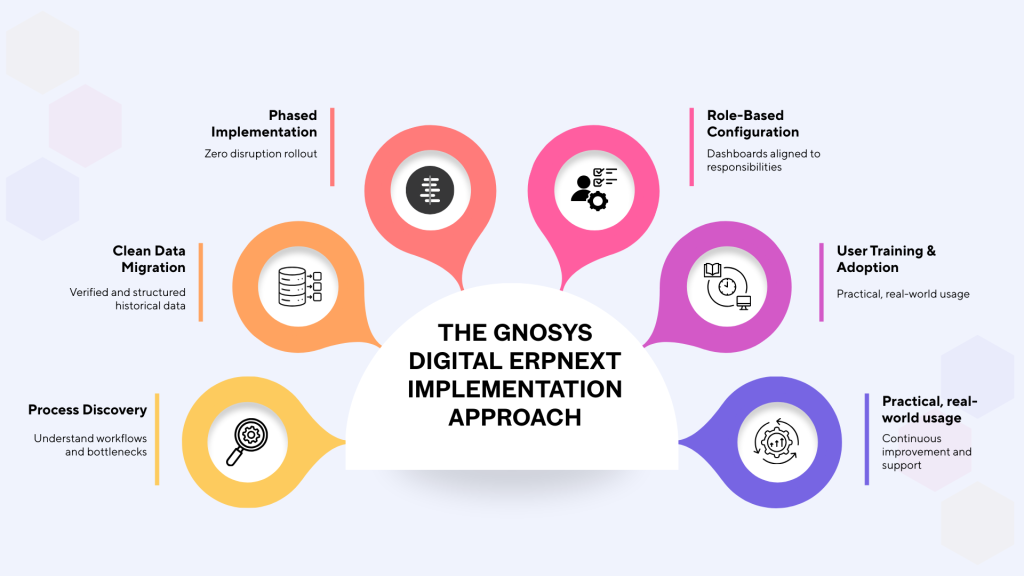
At Gnosys Digital, ERPNext implementation is approached as a business transformation, not merely a software installation.
We recognize that ERPNext succeeds only when technology is aligned with business processes, people, and long-term strategy. Our structured implementation methodology is designed to eliminate common ERP pitfalls and ensure the system becomes a trusted operational backbone rather than just another tool.
Our ERPNext Implementation Methodology
Process-first discovery
We begin by understanding how your business actually operates. Existing workflows, dependencies, and bottlenecks are carefully analyzed so ERPNext is configured to support real processes instead of forcing teams to change unnecessarily.
Clean and validated data migration
Historical data is reviewed, structured, and verified before migration. This ensures accuracy from day one, builds trust in the system, and prevents operational disruptions caused by unreliable data.
Phased rollout for stability
ERPNext is implemented in controlled stages, starting with the most critical modules. This phased approach minimizes disruption, supports smooth adoption, and allows teams to adapt gradually.
Role-based dashboards and accountability
Dashboards, workflows, and permissions are aligned with actual responsibilities. This improves transparency, strengthens accountability, and enhances collaboration across departments.
User training and adoption focus
Training is centered on real-world usage, not just system features. Teams learn how ERPNext supports their daily work, leading to faster adoption, fewer errors, and consistent usage.
Post-go-live support and optimization
Our engagement continues beyond go-live. We monitor performance, resolve issues, and continuously optimize workflows to ensure ERPNext evolves with your business needs.
Our Objective
The goal of the Gnosys Digital approach is straightforward: deliver an ERPNext system that teams trust, management relies on, and the business can confidently scale with. By treating ERP implementation as a holistic transformation rather than a technical deployment, we ensure ERPNext drives clarity, efficiency, and long-term growth.
Why 2026 Is the Right Time to Act
Every year of delay quietly compounds inefficiency, errors, and missed opportunities.
For growing businesses, continuing with manual processes, disconnected systems, and spreadsheet-based operations may feel manageable in the short term. Over time, however, these inefficiencies accumulate. Reporting slows down, errors increase, operational bottlenecks emerge, and leadership loses real-time visibility into the business.
By 2026, postponing ERP implementation is no longer a cost-saving decision. It becomes a strategic risk.
ERPNext Is the Backbone of Sustainable Growth
ERPNext is not just another software investment. When implemented correctly, it becomes the operational backbone of the business.
It brings finance, sales, inventory, HR, and operations into a single, integrated system, allowing organizations to operate with clarity and control.
What Acting Now Enables Your Business to Achieve
- Eliminate data silos and streamline workflows across departments
- Reduce manual work and operational errors, improving accuracy and efficiency
- Accelerate month-end closing while maintaining compliance and reporting accuracy
- Improve accountability and collaboration through role-based visibility
- Scale operations confidently without adding unnecessary complexity
The Cost of Waiting Keeps Rising
Delaying ERP adoption increases the hidden cost of inefficiency. Errors continue to multiply, decision-making remains slow, and management operates without reliable, real-time insights. Meanwhile, competitors that adopt modern systems move faster, operate leaner, and respond more effectively to market changes.
Acting now allows your organization to build a strong operational foundation, gain real-time control, and position itself for predictable, scalable growth in 2026 and beyond.
ERPNext is no longer optional for businesses serious about growth.
It is a strategic investment in control, clarity, and long-term success.
Conclusion: Take Control in 2026
The businesses that thrive in 2026 won’t just work harder; they’ll work smarter. If your teams are still juggling spreadsheets, manual reconciliations, and disconnected tools, every day of inefficiency is holding back growth.
Imagine this:
- Every department works from one trusted system
- Decisions made in real time with complete confidence
- Month-end closing happening in hours, not days
- Errors reduced, accountability clear, and collaboration seamless
This is what ERPNext delivers, and what Gnosys Digital helps you achieve.
✅ Stop firefighting daily operations.
✅ Gain clarity, control, and confidence.
✅ Build a scalable foundation for growth in 2026 and beyond.
Your next step is simple:
👉 Book Your Free ERPNext Readiness & Planning Session
Let’s review your current processes, identify gaps, and outline a clear path to operational control. Don’t wait; every day you delay is a missed opportunity for efficiency, growth, and competitive advantage.
Take the first step today and transform chaos into confidence with ERPNext.
