
Introduction
Most businesses do not fail because of a lack of effort or opportunity. They struggle because their operations are fragmented. Accounting lives in one tool. Inventory in another. Sales data in spreadsheets. Management decisions are made with delayed or incomplete information.
ERPNext changes this fundamentally.
ERPNext is not just an accounting or inventory tool. It is a full business operating system designed to bring every department, process, and decision onto a single, reliable platform. For growing and mature businesses, this shift is not optional. It is essential.
The Real Problem: Disconnected Systems Slow Growth
As businesses scale, operational complexity increases naturally. New departments are introduced, transaction volumes rise, compliance requirements expand, and management expectations shift from basic reporting to real-time insight. However, most organizations attempt to manage this growth using systems that were never designed to operate together.
Over time, manual workarounds become standard practice. Teams rely on spreadsheets to bridge system gaps, data is re-entered multiple times across tools, and reporting becomes a reconciliation exercise rather than a decision-making asset.
The most common symptoms of disconnected systems include:
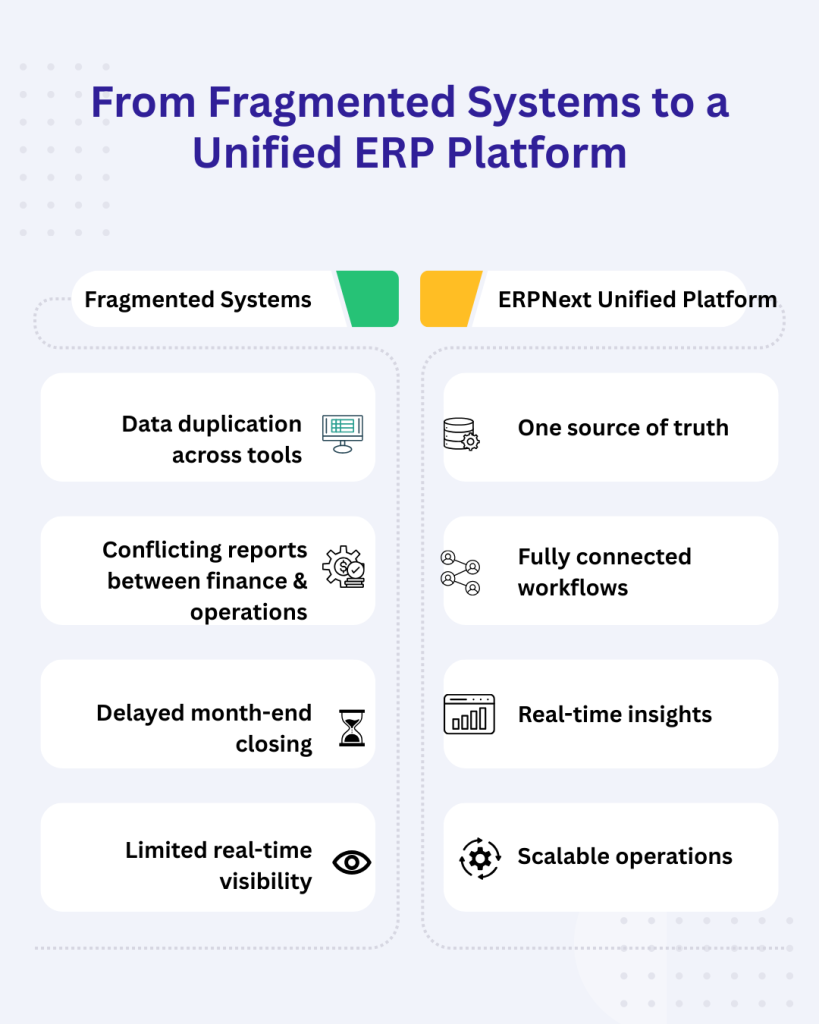
- Data duplication across tools, leading to errors and inconsistent records
- Conflicting reports between finance and operations, reducing trust in numbers
- Delayed month-end closing, as teams spend days reconciling data instead of analyzing it
- Limited real-time visibility, making proactive management nearly impossible
- High dependency on specific employees, who hold critical process knowledge outside the system
These challenges are often mistaken for operational inefficiencies or people-related issues. In reality, they are system-level failures. When core business functions operate in isolation, even strong teams struggle to maintain accuracy, speed, and control.
ERPNext addresses this problem at its foundation by unifying finance, inventory, sales, procurement, HR, and reporting into a single system. With one source of truth and fully connected workflows, businesses move from fragmented operations to consistent, clear, and scalable control.
What Makes ERPNext Different From Traditional ERPs
Many traditional ERP systems were built for large enterprises with rigid processes, long implementation cycles, and high operating costs. While powerful, they often become difficult to adapt as businesses evolve. Changes require heavy customization, reporting remains inflexible, and everyday users struggle with complexity.
ERPNext takes a fundamentally different approach. It is designed to support growth without locking businesses into rigid systems or long-term technical debt.
1. One Fully Integrated Platform
ERPNext unifies accounting, inventory, sales, purchasing, manufacturing, HR, CRM, and project management within a single database. Every transaction flows through the same system, ensuring consistency, accuracy, and alignment across all departments. There are no synchronization delays, no duplicate records, and no reliance on third-party connectors. What finance sees is exactly what operations execute.
2. Process-Driven, Not Feature-Driven
Unlike traditional ERPs that treat modules independently, ERPNext mirrors real business workflows. A single sales order automatically updates inventory, billing, taxation, accounting entries, and management reports. This end-to-end process reduces manual handoffs, minimizes errors, and keeps data connected at every stage.
3. Transparency and Real-Time Insights
ERPNext enables decision-making at every level with role-based dashboards that deliver relevant, real-time insights. Stakeholders can monitor performance, track exceptions, and act on data immediately, ensuring decisions are based on facts rather than delayed reports.
4. Flexible Without Fragility
ERPNext allows businesses to customize fields, workflows, and reports without compromising system stability. This balance of flexibility and control ensures the platform evolves with the business, avoiding fragile customizations that are costly to maintain over time.
ERPNext as a Decision-Making Engine
The true value of ERPNext goes far beyond automation. Automation improves efficiency, but clarity improves leadership. ERPNext delivers clarity by ensuring that every business decision is backed by accurate, real-time data from a single source of truth.
When systems are fragmented, management decisions are often reactive. Leaders spend time questioning reports, reconciling numbers, and validating assumptions before taking action. ERPNext removes this uncertainty by centralizing data across finance, operations, sales, and inventory.
With ERPNext in place, leadership can answer critical questions instantly:
- Which products and services are genuinely profitable, after accounting for all direct and indirect costs
- Where working capital is getting blocked, whether in slow-moving inventory, receivables, or inefficient procurement
- Which customers are driving sustainable growth, and which introduce operational or financial risk
- How efficiently teams and processes are performing across departments and locations
By delivering consistent, real-time visibility, ERPNext shifts decision-making from hindsight analysis to forward-looking strategy. Management moves from reacting to problems after they occur to anticipating risks, identifying opportunities, and steering the business with confidence.
Implementation Matters More Than Software
ERPNext’s success is determined far more by how it is implemented than by the software itself. Even the most capable ERP platform can fail if it is deployed without a clear understanding of business processes, data structure, and user responsibilities.
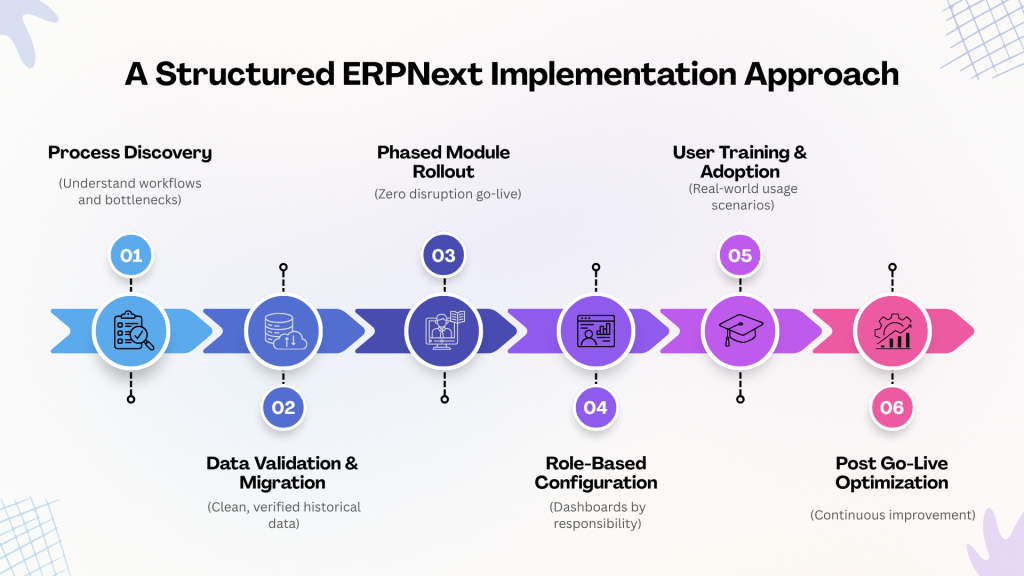
A professional ERPNext implementation begins with process discovery, not system configuration. Existing workflows, dependencies, and bottlenecks are carefully analyzed before the system is designed. This approach ensures ERPNext aligns with how the business actually operates, rather than forcing teams to adapt to abstract or disconnected processes.
Another critical factor is clean and validated data migration. Historical data must be structured, verified, and tested before it enters the new system. Poor data quality undermines reporting accuracy and erodes user trust from the start.
To minimize risk, successful implementations follow a phased rollout approach. Modules are introduced gradually, allowing teams to adapt without disrupting day-to-day operations. This reduces resistance, limits downtime, and ensures continuity.
Role-based access and dashboards are equally important. Users should see only what is relevant to their responsibilities, improving efficiency while maintaining control and data security.
Finally, user training must be practical and workflow-driven. Training focused on real business scenarios, rather than theoretical features, ensures adoption and long-term system usage.
ERPNext is a powerful platform, but its value is realized only when it is aligned with real business processes and implemented with discipline, structure, and experience.
Who Should Consider ERPNext Now
ERPNext is designed for organizations that have reached a point where basic tools and fragmented systems no longer support efficient growth. It is most effective when operational complexity increases and management requires greater visibility and control.
ERPNext is an ideal fit for:
- Growing businesses that have outgrown basic accounting software, where manual processes and disconnected tools are limiting efficiency
- Established companies relying on spreadsheets or legacy ERPs are facing challenges with flexibility, reporting accuracy, and system scalability
- Organizations requiring GST-compliant, audit-ready systems, with structured financial controls and reliable reporting
- Management teams demanding real-time visibility, rather than delayed or consolidated reports
- Businesses planning long-term scalability across locations, departments, or product lines
If day-to-day operations feel increasingly complex, reports take too long to reconcile, or strategic decisions are made with partial data, ERPNext is worth serious consideration. It provides the structure and clarity required to support sustainable growth and confident decision-making.
Final Thoughts
ERPNext is not just a tool you install. It is a system you operate your entire business on.
When implemented correctly, it replaces confusion with control, delays with clarity, and fragmented data with a single, reliable source of truth. Finance, operations, and management work from the same data, enabling faster execution and confident decision-making.
For businesses serious about scale, efficiency, and long-term operational control, ERPNext is not an upgrade. It is a transformation.
Ready to Simplify Your Operations with ERPNext?
If your business is ready to move beyond disconnected tools and fragmented data, we can help you implement ERPNext in a structured, low-risk way.
👉 Explore our ERPNext Implementation Services:
This service page outlines our approach, packages, and how we help companies deploy ERPNext successfully.
