
Introduction
What if your ERP system were the engine of your growth, not the anchor holding it back?
Imagine a business where sales track orders in spreadsheets, inventory lives outside the system, and finance spends weeks reconciling numbers. For many organizations, this is the reality of traditional ERP: it exists, but it is not fully trusted. Data is scattered, decisions are delayed, and teams work around the system instead of relying on it.
ERPNext takes a different approach. It is built for organizations that want operational control without unnecessary complexity. Instead of forcing teams to adapt to rigid software logic, ERPNext aligns with how businesses actually operate, while still enforcing structure, accountability, and data integrity.
This balance is what makes ERPNext a practical and scalable ERP solution for modern organizations.
The Problem With Traditional ERP Systems
Traditional ERP systems promise efficiency, but many fail to deliver meaningful results. These failures are rarely accidental. They are rooted in the design assumptions and implementation models of legacy ERP platforms.
Excessive complexity is one of the most common issues. Workflows are rigid and overloaded with steps that do not reflect real operational needs. Instead of enabling teams, the system slows execution and pushes users toward manual workarounds.
Customization introduces long-term risk. While traditional ERPs allow customization, they are expensive, fragile, and difficult to sustain. Over time, heavily customized systems become harder to upgrade, more unstable, and burdened with technical debt. Each change reduces reliability rather than improving performance.
Cost compounds the problem. High licensing fees, lengthy implementation cycles, and ongoing support costs delay return on investment and limit flexibility, particularly for growing organizations that need systems to adapt as they scale.
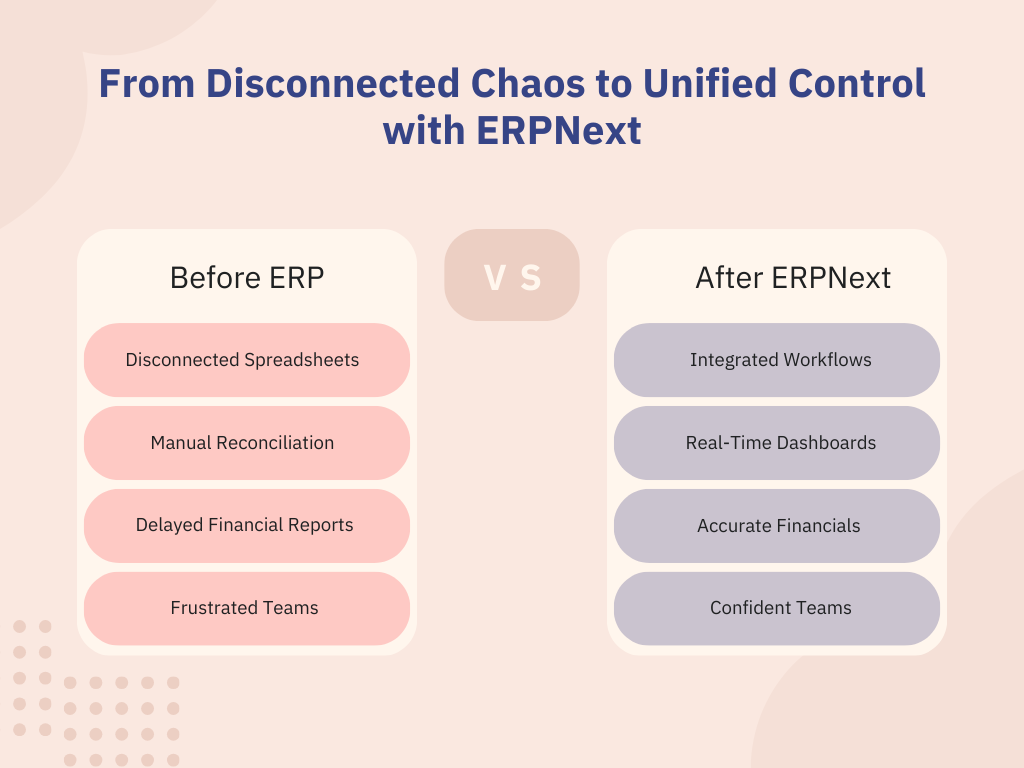
A familiar scenario illustrates this clearly. A mid-sized distribution business implements a traditional ERP to “bring everything together.” Within a year:
- Sales teams track orders in spreadsheets because the ERP is slow and cumbersome
- Operations manages inventory outside the system to avoid delays
- Finance spends weeks reconciling data each quarter because reports never fully align
The ERP exists, but the business does not run on it.
When critical work happens outside the ERP, data integrity is compromised, visibility is lost, and the system stops serving its core purpose.
ERPNext’s Philosophy: Simplicity With Structure
ERPNext is built on a disciplined philosophy: business processes should be structured enough to enforce control and accountability, but never so rigid that they hinder execution.
The system is designed to support how organizations actually work, not how software assumes they should work.
ERPNext provides standardized workflows across finance, sales, inventory, manufacturing, and human resources, grounded in real operational needs. At the same time, it allows configuration, and it creates genuine value without encouraging over-engineering.
Core principles include:
- Clean, consistent data models that eliminate duplication
- Transparent workflows that connect teams through shared information
- Minimal dependency on custom code, reducing long-term maintenance risk
- Clear ownership and approval structures without added bureaucracy
The result is an ERP that operational teams actually use, technical teams can maintain, and leadership can trust.
End-to-End Process Integration
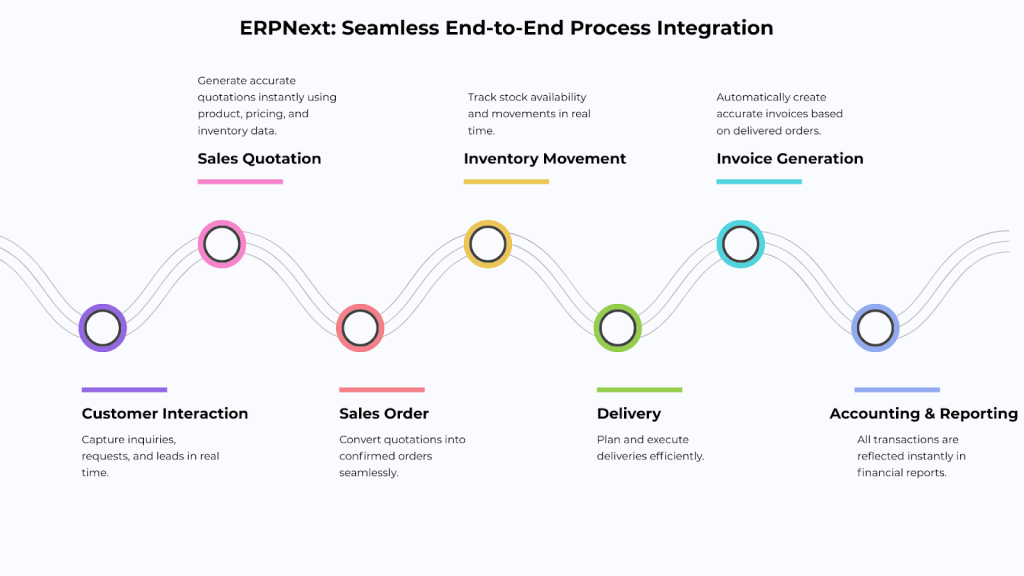
ERPNext connects activities across departments into a single, continuous workflow. Transactions move logically from one stage to the next, eliminating manual intervention and duplicate data entry.
For example, a sales quotation converts directly into a sales order. That order drives delivery planning and inventory movement. Once goods or services are delivered, invoices are generated automatically, and accounting entries are posted without delay.
Because every step is connected, processes remain aligned from initial customer interaction through final financial reporting. Teams no longer need to reconcile between systems or question which version of the data is correct.
This level of integration improves execution speed, reduces operational errors, and enables smoother collaboration across departments.
Real-Time Financial Accuracy
ERPNext delivers financial clarity by tightly linking operations with accounting.
Every operational transaction has an immediate financial impact. Sales, procurement, inventory, payroll, and projects post directly to financial records.
This enables:
- Up-to-date profit and loss visibility
- Automatic tax calculation and posting
- Accurate cost tracking by item, project, or department
- Financial reports that reflect operational reality
Finance teams no longer wait for month-end to understand performance. Leadership gains timely, reliable insight to support better decisions.
Operational Transparency Across Departments
ERPNext removes information gaps by ensuring departments work from the same system and the same data.
Sales teams see accurate availability and delivery timelines. Procurement teams act on real demand. Operations teams monitor execution and resolve issues early. Management gains a clear, real-time view of performance across the organization.
Teams act with confidence because the information is already aligned, reducing friction and improving accountability.
Built for Ambition: Scales With Your Vision
ERPNext is designed to support growth without forcing disruptive system changes.
Organizations can start with core modules such as accounting and sales, then expand into inventory, manufacturing, HR, or project management as needed. Approval structures and workflows evolve as complexity increases, without compromising system stability.
Growth happens within one unified platform, preserving consistency and operational discipline.
High Return Without Licensing Burden
ERPNext delivers enterprise-grade capability without enterprise-grade licensing costs.
Its open-source foundation lowers total cost of ownership while maintaining security, scalability, and functional depth across finance, operations, manufacturing, HR, and projects.
The lower TCO shortens the ROI timeline. More investment goes into configuration, adoption, and process optimization, the elements that actually create value.
Conclusion
ERPNext provides more than reports. It provides certainty.
The certainty that your data is accurate.
The certainty that your processes are under control.
In a complex business environment, that certainty becomes a competitive advantage.
By unifying operations, finance, and management within a single disciplined platform, ERPNext supports growth without sacrificing trust or clarity.
Take the Next Step With ERPNext
Choosing an ERP is a long-term strategic decision. The real value comes from how well it is implemented and aligned with your business.
At Gnosys Digital, we help growing organizations plan, implement, and optimize ERPNext with a focus on process clarity, data integrity, and long-term scalability.
Our team has led ERPNext implementations across manufacturing, distribution, and professional services, helping businesses like yours gain the control and clarity described above.
👉 Book Your Control-Without-Complexity Strategy Session
Make informed decisions with confidence. Let ERPNext become a strategic asset, not just another system.
