
The biggest threat to a professional services firm isn’t a lack of talent; it’s an excess of operational complexity.
Uncaptured billable hours, project overruns, and delayed invoices don’t just reduce margins. They quietly damage client confidence and slow long-term growth. When project delivery, time tracking, and accounting operate in disconnected systems, leadership loses clarity on real performance. Decisions become reactive, opportunities are missed, and profitability becomes unpredictable.
In many firms, teams spend more time reconciling data than delivering value. Finance struggles to match effort with revenue, delivery teams lack visibility into budgets, and management cannot accurately forecast cash flow or capacity. The result is operational friction that compounds as the firm grows.
ERPNext removes these blind spots by bringing your entire service lifecycle into one unified platform. From lead management and project execution to billing and financial reporting, every function operates on shared, real-time data. Teams collaborate better, leadership gains clear operational visibility, and billing becomes accurate and timely.
The Hidden Costs Slowing Professional Services Firms
Many professional services firms believe profitability challenges come from pricing pressure or market competition. In reality, the bigger problem often lies inside the organization.
Fragmented tools and disconnected workflows quietly drain revenue and productivity every day. Because these losses are gradual and spread across teams, leadership rarely sees the full financial impact until growth slows or margins shrink.
Here are the most common hidden costs affecting service firms.
The 15% Revenue Leak
One of the biggest profit killers is unbilled work. Consultants forget to log hours, expenses remain unrecorded, or billing gets delayed until details are lost.
Even small omissions add up. A few missed hours per employee each week can translate into a significant annual revenue gap. Once billable effort goes unrecorded, it becomes unrecoverable income.
Chronic Overload and Underutilization
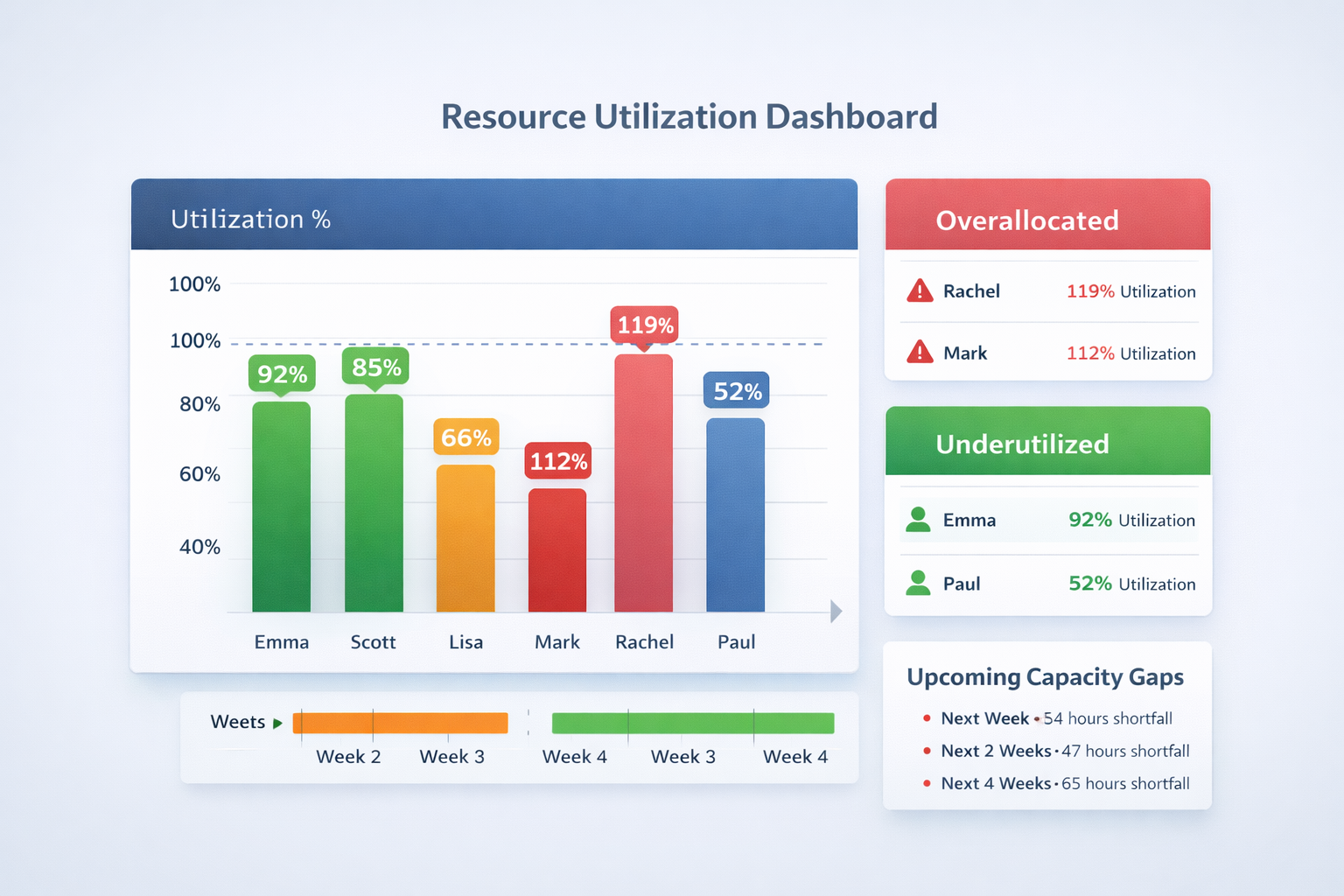
Many firms constantly overload their strongest performers while other team members remain partially underutilized.
This imbalance leads to burnout, declining work quality, and employee turnover on one side, while underused resources reduce revenue potential on the other. Without visibility into allocation, managers end up making staffing decisions based on guesswork.
Delayed Billing Creates Cash Flow Risk
Manual invoice preparation often requires collecting data from multiple systems and approvals from several stakeholders. This slows billing cycles and delays payments.
When invoices go out late, cash flow becomes unpredictable, making it harder to plan investments, hiring, or expansion. Firms end up working today but getting paid weeks or months later.
Projects Close Without Profit Clarity
Many service firms complete projects without knowing whether they actually made money.
Without real-time tracking of costs versus budgets, projects that appear successful may actually be eroding margins. Leadership cannot optimize pricing or delivery models if profitability data only becomes visible after project completion.
Client Knowledge Lives in Silos
Client communication, contracts, and project details are often scattered across inboxes, spreadsheets, and individual team members.
This lack of centralized information leads to inconsistent service delivery, slower responses, and missed upsell opportunities. When client history isn’t easily accessible, teams struggle to maintain continuity in relationships.
How ERPNext Transforms Services Operations
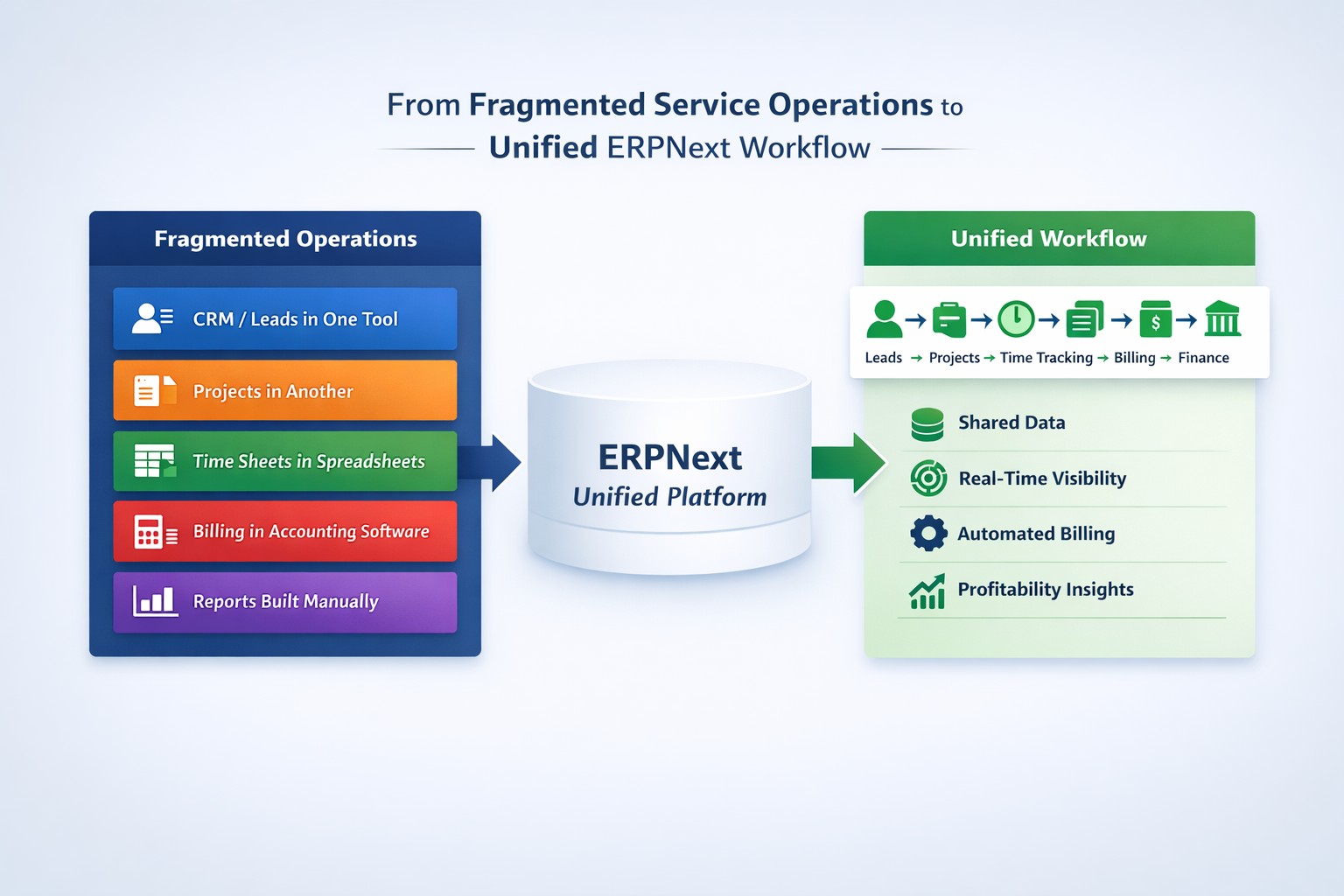
ERPNext replaces fragmented service operations with a single system where delivery, finance, and management work from the same data. Project execution, time tracking, billing, and financial reporting are fully connected, eliminating handoffs, rework, and blind spots.
This alignment changes how firms operate. Projects are managed with a financial context, billing reflects actual effort in real time, and leadership gains clear visibility into performance across the business.
The table below shows how ERPNext converts common operational challenges into measurable business outcomes.
| Operational Challenge | ERPNext Solution | Business Outcome |
|---|---|---|
| Unclear project profitability | Real-time cost vs. budget tracking with integrated project accounting | Leadership gains visibility into actual margins, enabling smarter pricing and project decisions |
| Manual time sheet to invoice process | Automatic conversion of approved time logs into invoice lines with workflow approvals | Faster billing cycles, fewer errors, and improved cash flow predictability |
| Guesswork in resource scheduling | Visual resource planning tools and utilization dashboards | Balanced workloads, improved billable utilization, and better delivery timelines |
| Scattered client data | Centralized CRM connected to projects, communication, and contracts | Stronger client relationships and faster, more consistent account management |
| Billing errors and delays | Automated billing workflows with validation and approvals | Accurate invoices, quicker collections, and higher client trust |
By replacing fragmented processes with connected workflows, ERPNext helps professional services firms move from reactive operations to proactive, data-driven management.
Key ERPNext Capabilities for Professional Services Firms
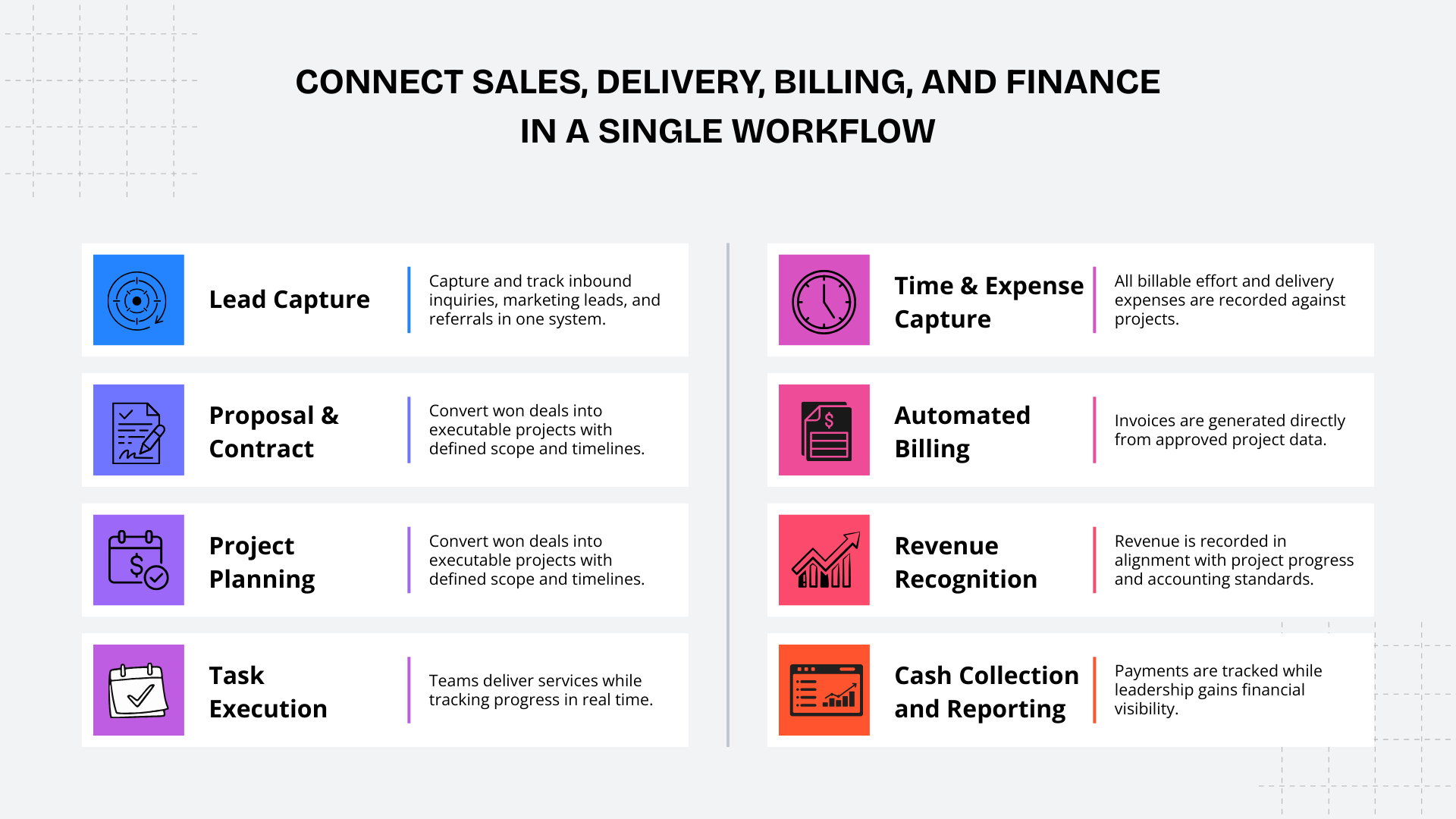
ERPNext delivers a comprehensive suite of tools designed specifically for service-driven businesses where success depends on efficient delivery, accurate billing, and effective resource management.
By connecting operational, financial, and client workflows, ERPNext enables firms to operate with clarity and control at every stage of service delivery.
Unified Project Management
ERPNext allows firms to manage projects from initial proposal through final delivery within a single system.
Teams can plan timelines, assign tasks, define milestones, and track budgets in real time. Project managers gain visibility into progress, costs, and potential risks early, helping ensure projects stay on schedule and within budget.
Leadership also gains insight into project performance across the organization, enabling better strategic planning.
Accurate Time & Expense Tracking
Accurate billing begins with accurate tracking.
ERPNext allows employees to log billable and non-billable hours directly against projects and tasks. Expenses incurred during delivery can also be captured and linked to projects.
Approved time and expense entries flow seamlessly into billing workflows, reducing missed charges and eliminating manual reconciliation work.
Automated Billing Models
Professional services firms often use multiple billing approaches depending on project type or client agreements.
ERPNext supports flexible billing models, including:
- Time and Material billing
- Fixed-fee project billing
- Milestone-based billing
- Retainer contracts
- Recurring service agreements
This flexibility allows firms to standardize billing while accommodating diverse client contracts.
Resource Utilization Monitoring
Resource utilization directly affects profitability in service businesses.
ERPNext provides dashboards and reports that show employee workloads, billable utilization, and project assignments. Leadership can identify overloaded or underutilized resources and rebalance workloads proactively.
This also helps forecast hiring needs and improve capacity planning as the business grows.
Integrated CRM
ERPNext includes built-in customer relationship management that connects sales and delivery teams.
Firms can manage leads, track proposals, record client interactions, and maintain contract details in one centralized platform. Delivery teams gain access to complete client histories, improving service consistency and communication.
Financial Transparency
ERPNext’s integrated accounting ensures financial data aligns with operational activity.
Finance teams gain instant visibility into project profitability, cash flow positions, and revenue recognition. Because project and financial data share the same system, reporting becomes accurate and timely, enabling better business decisions.
Real Business Impact: What Firms Experience After ERPNext Implementation
Professional services firms that implement ERPNext typically see measurable improvements across billing efficiency, project delivery, and financial visibility.
Because ERPNext connects delivery, finance, and management workflows into one platform, operational friction is reduced, and teams spend less time managing systems and more time delivering value.
Organizations commonly report outcomes such as:
- Faster billing cycles, reducing invoice preparation time from weeks to just a few days, and improving cash flow predictability
- Higher billable utilization, achieved by optimizing resource allocation and minimizing idle capacity across teams
- Reduced operational overhead, as workflow automation replaces manual coordination and data reconciliation tasks
- Improved client satisfaction, driven by transparent project tracking and consistent delivery communication
- Better control over project profitability, thanks to real-time financial and cost visibility
- Stronger delivery consistency, enabling teams to maintain quality standards across projects and clients
Example Industry Outcome
“With ERPNext, our invoice preparation time dropped from over a week to just two days, and we increased billable utilization by nearly 15%. Leadership now has full visibility into project profitability, and our delivery teams operate with clarity.”
— Managing Partner, IT Consulting Firm
This type of operational transformation allows professional services firms to shift from reactive management to predictable, scalable growth.
Why Professional Services Firms Need Specialized ERP Implementation
Many ERP systems are traditionally designed for product-based businesses where inventory, procurement, and manufacturing drive operations. When these systems are applied directly to service organizations, they often fail to support the realities of project-based delivery.
Professional services firms operate differently. Their primary assets are people, expertise, and time. Profitability depends on accurate project costing, efficient resource use, and timely billing. Generic ERP configurations often overlook these requirements, resulting in complex workarounds and limited adoption.
Professional services workflows demand capabilities such as:
- Flexible billing models supporting time and material, fixed fee, milestone, and retainer projects
- Accurate project costing that links effort, expenses, and revenue in real time
- Resource utilization tracking to balance workloads and maximize billable capacity
- Multi-currency billing for firms serving international clients
- Revenue recognition aligned with project delivery milestones and accounting standards
- Seamless integration between delivery, operations, and finance teams
A tailored ERPNext implementation ensures the platform reflects how your firm actually operates rather than forcing teams to adapt to rigid system structures.
When ERPNext is configured specifically for services workflows, firms gain better adoption, clearer financial visibility, and smoother collaboration across teams, enabling sustainable and scalable growth.
Who Benefits Most from ERPNext?
ERPNext is particularly valuable for organizations whose success depends on delivering expertise, managing projects efficiently, and maintaining accurate billing and financial control.
Service-driven firms often face challenges related to project visibility, resource utilization, and revenue tracking. By centralizing operations into one platform, ERPNext helps these organizations streamline workflows and scale delivery operations with confidence.
ERPNext is especially suitable for:
- IT & Software Development Firms, managing complex delivery pipelines and client projects
- Consulting Companies, requiring accurate time tracking and project profitability monitoring
- Digital Agencies, handling multiple concurrent client campaigns and retainers
- Marketing Firms, managing recurring client services and campaign execution
- Engineering & Architecture Firms, coordinating long-term projects with milestone-based billing
- Legal & Advisory Organizations, tracking billable hours and client engagements
- Accounting & Financial Service Providers, managing client service delivery alongside financial reporting
In short, any organization that delivers expertise-based services benefits from unified operations, accurate billing, and centralized financial visibility, all of which ERPNext provides in a single platform.
Ready to Eliminate Billing Leaks and Scale Profitably?
Book a Complimentary Services Operations Review
If your firm struggles with delayed invoices, resource conflicts, or limited visibility into project performance, it’s time to modernize your operations.
Our Complimentary Services Operations Review gives you a clear picture of revenue leaks, resource utilization gaps, and project profitability blind spots, plus a tailored roadmap showing exactly how ERPNext can fix them.
You’ll leave the session with actionable insights to accelerate billing, optimize resources, and make profits more predictable.
