
For ambitious trading and distribution SMEs, growth often amplifies chaos before it boosts profit.
More customers mean more orders to process. A broader product range increases the complexity of stock control. More warehouses demand tighter coordination. And when sales, purchasing, inventory, and finance operate in disconnected systems, leaders lose visibility into what is actually driving profit.
One inventory mismatch can mean a lost sale. A delayed invoice disrupts cash flow. Poor purchase planning locks working capital into slow-moving stock, restricting the ability to reinvest in growth.
When business data is scattered across spreadsheets and isolated tools, scaling becomes risky instead of rewarding. Teams spend more time fixing operational issues than serving customers or pursuing growth opportunities.
ERPNext replaces operational chaos with unified control, transforming fragmented workflows into a single operational platform that helps trading and distribution businesses grow with clarity, efficiency, and confidence.
The Hidden Costs of Operational Gaps in Distribution Businesses
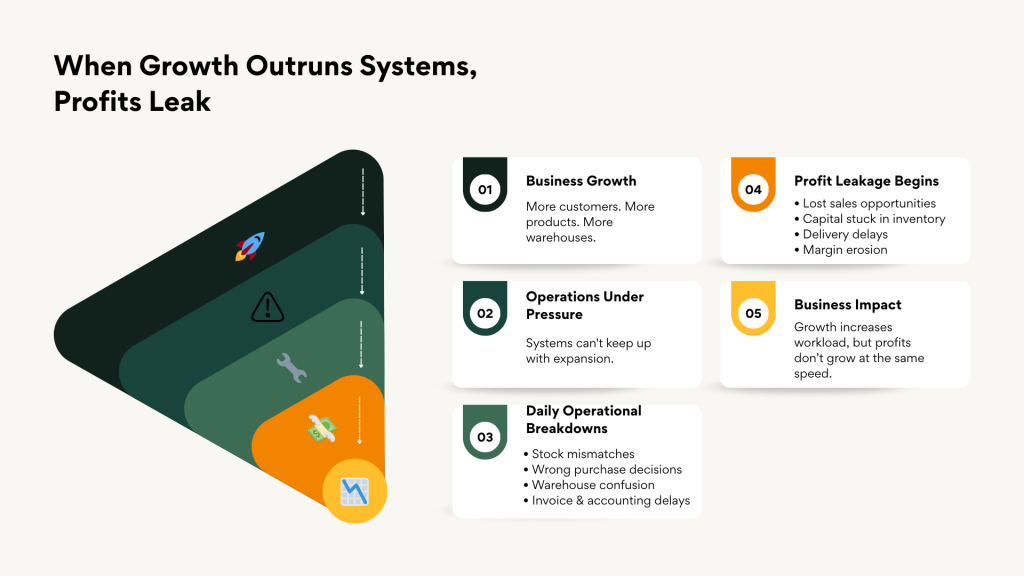
Many trading and distribution SMEs focus on increasing sales but overlook how much profit quietly leaks due to operational inefficiencies. Small gaps in inventory control, purchasing, finance, and warehouse coordination compound over time, turning growth into operational strain.
Here are the most common hidden costs businesses face:
Profit Erosion from Blind Stocking
Without real-time inventory visibility, businesses often overstock slow-moving items while running out of high-demand products. Excess stock locks valuable capital in warehouses, while stockouts result in lost sales and frustrated customers. Over time, both scenarios damage profitability and brand reliability.
Revenue Loss from Delayed Order Processing
Manual order handling slows confirmation, picking, packing, and dispatch. Delays force customers to look elsewhere, especially in competitive markets where delivery speed influences purchasing decisions. Each delayed order risks long-term customer loss.
Capital Lock Due to Poor Purchase Planning
When purchasing decisions are made without accurate sales and stock data, businesses end up buying either too much or too soon. This ties up working capital in inventory that may not move quickly, limiting cash available for expansion, marketing, or operational improvements.
Financial Blind Spots in Decision-Making
Delayed or manual accounting updates leave leadership operating on outdated numbers. Pricing, purchasing, and growth decisions are made without a clear view of margins, cash flow, or true profitability.
Warehouse Confusion Across Locations
Managing inventory across multiple warehouses or godowns without automation leads to mismatches between physical and recorded stock. This results in dispatch errors, delayed shipments, and customer complaints, while teams waste time reconciling inventory instead of fulfilling orders.
The Compounding Effect of Growth
As businesses grow, these operational gaps multiply. More orders, more products, and more warehouses amplify inefficiencies, making them harder and costlier to fix later.
Addressing these hidden operational costs early is essential for sustainable and profitable growth.
Before vs After ERPNext: Operational Transformation
The shift from disconnected systems to a unified ERP platform creates immediate and measurable improvements across trading and distribution operations. When processes move from manual coordination to automated workflows, efficiency, accuracy, and profitability improve across departments.
Here is how operations typically transform after ERPNext implementation:
| Business Challenge | ERPNext Capability | Tangible Business Outcome |
| Sales and purchase data exist in separate tools, creating mismatched records and delays | Unified order-to-cash and procure-to-pay workflows connect sales, purchasing, inventory, and finance | Faster invoicing, accurate order processing, and improved profit margins |
| Stock is tracked manually across warehouses, leading to uncertainty and frequent adjustments | Real-time multi-warehouse inventory tracking with automated stock updates | 20–30% reduction in excess inventory and significantly fewer stockouts |
| Financial reports are delayed due to manual data entry and reconciliation | Transactions automatically update accounting and financial records | Real-time profit, cost, and cash flow visibility for faster decisions |
| Inter-warehouse transfers rely on emails, calls, and paperwork | Automated stock transfers and warehouse tracking | Faster, error-free fulfillment and better warehouse coordination |
| Invoicing and payment tracking require constant follow-ups | Automated invoicing, payment tracking, and receivable management | Faster payment collection and improved cash flow cycles |
By unifying operations in one system, ERPNext removes guesswork from decision-making and replaces it with real-time business clarity, allowing trading and distribution SMEs to operate with confidence and scale efficiently.
Core ERPNext Capabilities for Trading & Distribution SMEs
ERPNext provides a single operational system built around the day-to-day realities of trading and distribution businesses. Instead of juggling separate tools for orders, inventory, finance, and customers, teams operate through one connected platform with shared, real-time data.
Key capabilities include:
Sales and Purchase Order Automation
From quotation to delivery and invoicing, ERPNext connects sales and procurement workflows end to end. Orders move faster, manual handoffs are reduced, and fulfillment becomes more predictable.
Multi-Warehouse Inventory Management
Businesses can manage stock across multiple warehouses or godowns with real-time visibility. Stock movements, transfers, and availability updates are instantly updated, ensuring accurate inventory control across locations.
Batch and Serial Number Tracking
For businesses dealing with regulated or high-value products, ERPNext enables tracking by batch or serial number, helping maintain quality control and traceability.
Supplier and Customer Lifecycle Management
ERPNext centralizes supplier and customer information, allowing businesses to track purchase history, payment behavior, communication records, and order activity in one place.
Automated Invoicing and Receivables Tracking
Invoices are generated directly from sales transactions, and receivables tracking ensures better follow-up and faster collections, improving cash flow.
Landed Cost Calculations
Additional expenses such as shipping, customs duties, and logistics costs can be accurately allocated to products, ensuring correct product costing and better pricing decisions.
Financial Accounting and Reporting
Every operational transaction updates accounting automatically, enabling real-time financial visibility, faster reporting, and accurate profitability analysis.
CRM and Customer Service Workflows
Sales teams and support teams can track leads, opportunities, service requests, and follow-ups, helping businesses deliver consistent customer experiences.
Real Business Impact After ERPNext Implementation
Trading and distribution SMEs that adopt ERPNext typically see measurable operational improvements within a short period after implementation. By connecting sales, purchasing, inventory, and finance in one system, businesses move from reactive problem-solving to proactive operational control.
Common outcomes include:
✅ Faster Order Processing and Dispatch
Automated workflows reduce manual coordination between sales, warehouse, and accounts teams, allowing orders to move from confirmation to delivery much faster.
✅ Accurate Stock Visibility Across Warehouses
Real-time inventory tracking eliminates uncertainty about stock availability, reducing both stockouts and excess inventory.
✅ Reduced Operational Errors
Shared data across departments minimizes duplication, incorrect entries, and communication gaps that often lead to costly mistakes.
✅ Stronger Supplier Coordination
Better purchase planning and supplier tracking improve procurement decisions and vendor relationships.
✅ Real-Time Financial Insights
Integrated accounting allows leadership to see profitability, receivables, and cash flow instantly instead of waiting for month-end reports.
✅ Better Customer Experience
Accurate deliveries, faster invoicing, and reliable stock availability improve customer satisfaction and retention.
✅ Scalable Operations Without Added Complexity
As order volume and warehouse locations grow, ERPNext scales operations without requiring additional manual processes.
ERPNext doesn’t just digitize operations; it creates a reliable operational backbone, enabling confident growth, improved margins, and sustainable business performance.
Real-World Result Example
One distribution client operating multiple warehouses faced frequent stock discrepancies and delayed invoicing before ERPNext implementation. Manual coordination between warehouses and accounting teams created operational confusion and slowed order fulfillment.
After deploying ERPNext:
“Our order processing time reduced by nearly half, and stock discrepancies dropped by over 40%. We finally have one accurate stock number across all warehouses. ERPNext gave us confidence to accept larger contracts without operational fear.”
— Founder, Electronics Distribution SME
With unified operational data and automated workflows, the business eliminated uncertainty, improved delivery performance, and unlocked new growth opportunities with confidence.
Why Implementation Expertise Matters
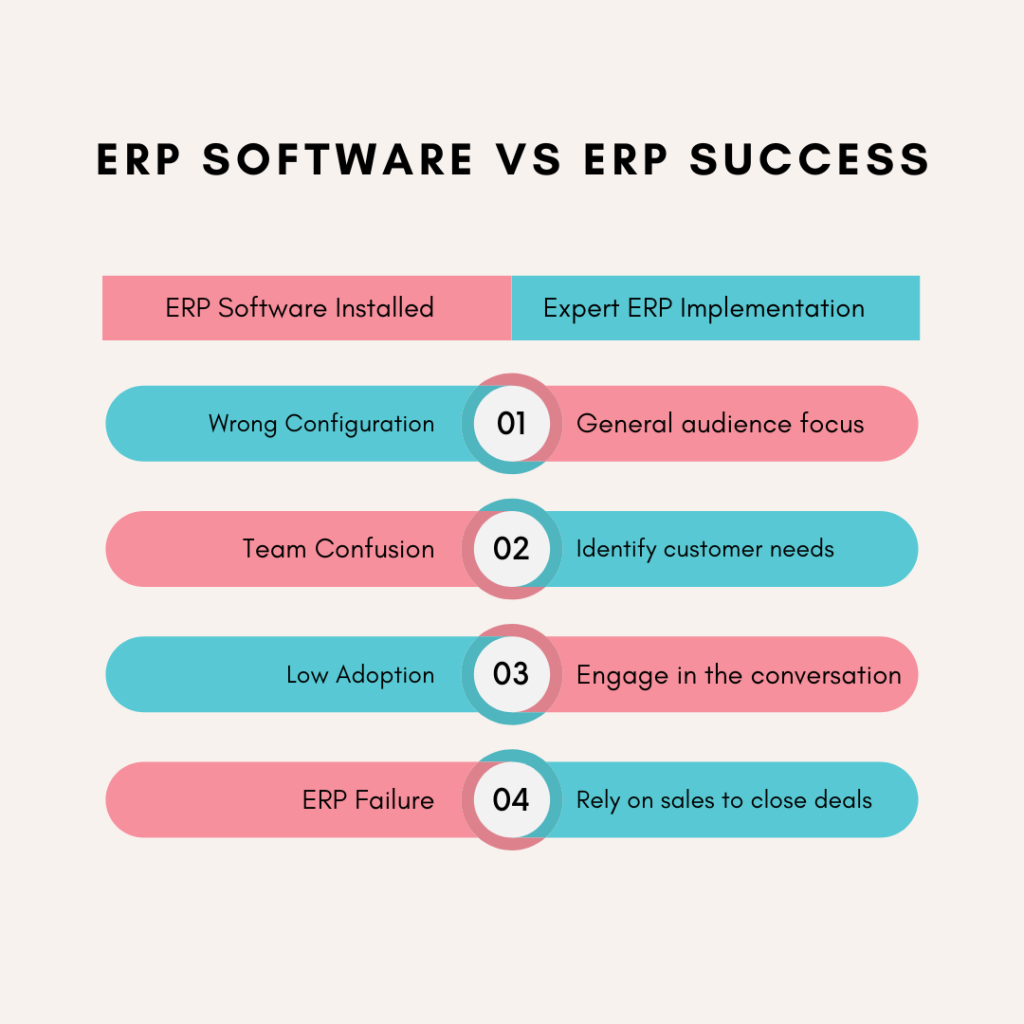
Installing ERPNext is only the first step. Real operational success comes from configuring the system to match your exact business workflows. Without proper setup, even the best ERP can slow teams down, create confusion, and erode profits.
Every trading and distribution business operates differently. An ERP setup designed for manufacturing or services will not properly support distribution operations. Critical workflows such as multi-location stock movement, landed cost allocation, pricing structures, and GST compliance must be configured correctly to deliver measurable results.
A poorly implemented ERP can slow teams down instead of improving efficiency.
Our ERPNext specialists focus on ensuring the system works around your business, not the other way around. This includes:
Workflow Alignment: ERPNext mirrors real distribution operations, eliminating manual workarounds.
Smooth Migration: Legacy systems and spreadsheets are transitioned without disrupting day-to-day operations.
Team Training & Adoption: Staff are empowered to use the system efficiently, reducing errors and delays.
Minimal Disruption: Deployment is fast, with operational continuity maintained.
Faster ROI: Automation and visibility deliver tangible improvements in inventory, cash flow, and order processing quickly.
The objective is simple: achieve operational efficiency from day one rather than creating confusion during transition.
Book a Complimentary Distribution Process Review
Ready to Gain Control Over Inventory, Orders, and Cash Flow?
If operational complexity is slowing your growth, now is the right time to unify your systems and gain full visibility across your business.
We offer a complimentary Distribution Process Review, where our ERPNext specialists analyze your current workflows and map your operational challenges to a clear, practical ERPNext implementation roadmap.
During this review, you will:
✔ Identify operational bottlenecks affecting profitability
✔ Discover automation opportunities across sales, inventory, and finance
✔ Receive a customized implementation approach tailored to your operations
👉 Claim Your Free Distribution Process Review Now
https://gnosysdigital.com/erpnext-implementation/erpnext-for-trading-distribution-smes/
