
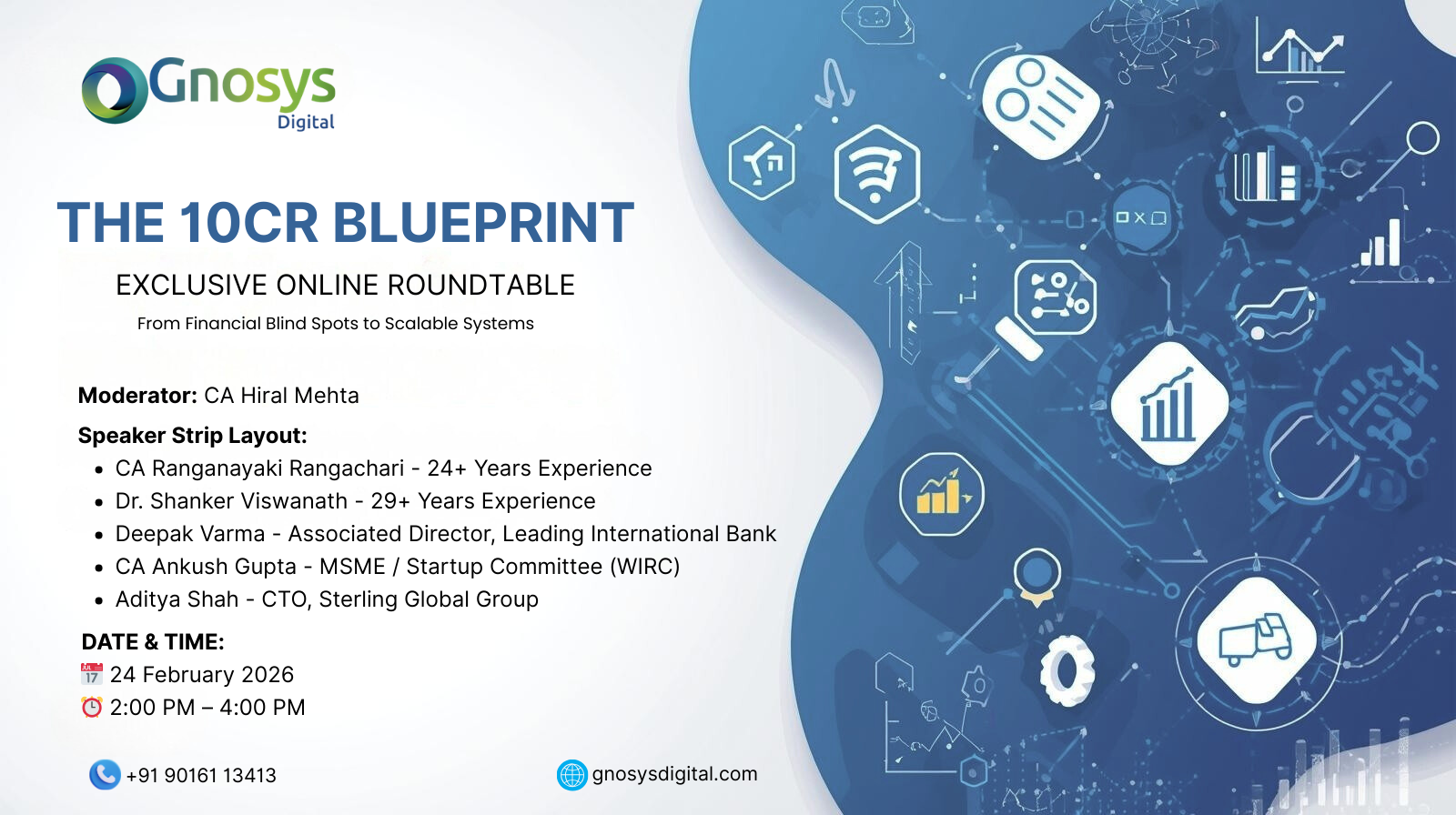
An exclusive roundtable discussion featuring CA Ranganayaki Rangachari, Dr. Shanker Viswanath, Deepak Verma, CA Ankush Gupta, and Aditya Shah, moderated by CA Hiral Mehta.
Executive Summary
On February 24, 2026, over 65 founders and business owners gathered for an intensive 2-hour roundtable discussion on the 10 CR Blueprint. The session brought together five practitioners with combined experience of over 120 years across finance, banking, M&A, corporate training, and technology.
The central theme was clear: Scaling to ₹10 crore is not just a sales milestone, it’s a leadership milestone. The discussion covered four critical pillars:
- Financial Blind Spots – Why most founders bleed cash without knowing it
- Systems & Processes – Building control without killing culture
- Founder Evolution – The mindset shift from doer to leader
- Funding Strategy – Bootstrap vs. raise? What actually works at this stage
This blog captures the key insights, real-world examples, and actionable takeaways shared by our esteemed panellists.
The Panel
| Speaker | Designation / Experience | Leading Topic |
| CA Ranganayaki Rangachari (Rama) | 24+ Years Experience | Financial Blind Spots |
| Dr. Shanker Viswanath | 29+ Years Experience | Systems & Processes |
| Deepak Varma | Associate Director – Leading International Bank | Founder Evolution |
| Aditya Shah | CTO, Sterling Global Group | Technology & Digital Strategy |
| CA Ankush Gupta | 20+ Years Experience | Funding Strategy |
| CA Hiral Mehta | Moderator | Session Moderator |
Topic 1: The ₹10 Crore Reality Check – Financial Blind Spots
Led by CA Ranganayaki Rangachari, supported by CA Ankush Gupta
The Single Biggest Mistake Founders Make
Rama opened with a powerful observation: “Promoters understand their business, their technology, everything, but when it comes to finance, they say it’s not my cup of tea. Not understanding finance is a fatal thing for any business.”
Key Insight: Founders don’t need to become accountants, but they must be able to read every line of their financial statement and understand what the numbers are telling them.
Fixed vs. Variable Cost: The Foundation of Profitability
Rama emphasized the critical distinction between fixed and variable costs:
“In a business where fixed costs are high, your profit line comes at a later stage. Even a 10% sensitivity on an upward or downward scale will have a huge impact on profitability.”
Founders must understand their contribution margin and perform sensitivity analysis: If my top line goes up or down by 10%, how does it affect the bottom line?
The Danger of No Business Plan
“You have a great product or service, you start off, but you don’t have a blueprint. You need short-term, medium-term, and long-term planning.”
Many startups operate without a clear roadmap, making it impossible to measure progress or identify when they’re off track.
Internal Controls: Not Optional, Even at Day One
CA Ankush Gupta shared a cautionary tale from his peer review experience:
“There was a famous event management company when asked about their flowchart, there was no finance department. Later, when we were appointed for an internal audit, we discovered major fraud because the company depended entirely on one CFO with no controls.”
His conclusion: “Delegation comes with internal controls. Financial hygiene, internal control, and delegation play a major role from 1 crore to 100 crores.”
The Cash Mantra
Rama’s final advice on financial governance was unforgettable:
“Don’t mix profit with cash. The most profitable organizations can lack cash and go bankrupt. Know your cash conversion cycle. Under-commit and over-perform on payments. Plan your cash flows wisely.”
She shared a principle she’s followed for 25 years: “Pay one day in advance, but don’t delay one day later. It brings reputation to the organization when you’re in crisis.”
Topic 2: Systems Before Scale – Building Processes That Don’t Kill Culture
Led by Dr. Shanker Viswanath, supported by Aditya Shah
Revenue is Just Math
Dr. Shanker opened with a powerful simplification:
“5 crore or 10 crore is just math. Revenue = Orders executed × Average order value.”
If your average order value is ₹5 lakhs, you need 200 orders to reach ₹10 crore. At a 25% conversion rate, that’s 800 qualified leads, about 15 per week, or 2-3 per day.
The real question: “How many of you have a system that guarantees this? Math without a system is merely on paper.”
The Danger Zone: 5 to 10 Crore
Dr. Shanker identified the critical transition:
“At 1 to 5 crore, the founder IS the system. At 10 crore, the system must REPLACE the founder. Growth without systems and structure leads to stress.”
Case Study: The Automotive Parts Manufacturer
A manufacturing MSME was stuck at ₹7 crore, with the founder approving everything, from vendor selection to pricing, dispatch, and complaints.
The diagnosis: They didn’t need more sales. They needed decision clarity.
The solution: A Decision Rights System with four levels:
- Level 4: Founder decides everything (the starting point)
- Level 3: Team recommends, founder decides
- Level 2: Team recommends and decides
- Level 1: Team decides independently
“Stop asking ‘Why is my team incapable?’ Start asking, ‘What system is missing to make them capable?'”
Case Study: The Dubai Digital Agency
A boutique agency was stuck because every pitch required a founder, every proposal was customized by founders, and every customer was serviced by a founder.
The fix: Moving from personality-driven to process-driven:
- Standard proposal templates
- Defined pricing tiers
- Sales scripts capturing founder confidence
- Qualification checklists for clients
- Fortnightly CRM reviews
The lesson: “If sales only work when you’re in the room, YOU are the biggest problem, not the system.”
The Three R Framework:
For a diagnostic center scaling during COVID, Dr. Shanker implemented:
- Role Clarity – Everyone knew exactly what they were responsible for
- Review Rhythm – Weekly, 15-day, and monthly reviews (not to find faults, but to identify where the team was collectively stuck)
- Recognition Mechanism – Acknowledging innovation to motivate scale
“If knowledge lives only in people’s minds, you cannot replicate and scale faster. Document lab protocols, SOPs, and training manuals. If it’s in your head, it’s effort. If it’s documented, it can become an asset.”
The ECS Framework for Scaling
Dr. Shanker concluded with a memorable framework:
“At 1-2 crores, do it by EFFORT. At 2-5 crores, it takes COURAGE to grow. At 5-10 crores, it’s all about SYSTEM. Don’t ask ‘How much will I have to do?’ Ask ‘What will work without me?”
Topic 3: The Founder’s Evolution – Letting Go to Grow
Led by Deepak Verma, supported by Dr. Shanker Viswanath and Aditya Shah
The Zeroda Example: Skill Enhancement and Process Focus
Deepak shared insights from Zeroda’s journey:
“Nikhil ensured that as they grew from 1 to 5 to 100, skill enhancement of his people was prioritized, whether in finance, regulation, or sales.”
He also highlighted a key strategic shift: instead of a purely top-down approach (goal → vision → mission), Zeroda used a bottom-up process focus:
“I’m going to figure out the process. My team will call 100 clients a day or meet 10 clients a day. Once two clients are acquired, they become advocates the cost of acquisition for the next clients goes down.”
The Story of Now Agraal: Learning to Delegate
Deepak shared a powerful story of a founder whose first supply chain company didn’t scale because he did everything himself, limiting growth to ₹5-15 crore.
“He was very strict about doing everything himself. Later, he succeeded in the short-video industry by delegating responsibility. The moment you give responsibility, the confidence of that person goes haywire; they feel accountable.”
The NMC Health Cautionary Tale
Deepak used the NMC Health collapse (from $18-20 billion to sold for $1) as a warning:
“Delegation was kept within family members, not given to third parties who could provide an unbiased assessment. If you keep everything in the family, bias will come. Even the health industry can fail.”
The 5-Time Failure Founder
A 28-year-old founder’s LinkedIn profile read “five-time failure.” Despite early exits (including one company later valued at 10,000 crore), he made his lawyer and chartered accountant stakeholders.
“He gave them a share. Now, whenever there’s an inquiry, those professionals advocate for him. Understand the psyche, he’s saying ‘I would have been a 10,000 crore company,’ but he made professionals partners in growth.”
The Zepto Example: The Power of a Bold Idea
“Zepto started with ’10-minute delivery’ even though it was initially unattainable. The idea in the consumer’s mind is clear: they will deliver in 10 minutes. Even if it takes 15 or 20, you’re still getting delivery. Understand the thought process of a promoter.”
Equity as a Value Driver
Rama added, “Equity is expensive. But the process of giving some whether through ESOPs or stock-linked performance bonuses brings tremendous value. When you make money, they make money with you.”
Topic 4: Funding, Valuation & the ₹10 Crore Math
Led by CA Ankush Gupta, supported by CA Ranganayaki Rangachari
The Biggest Mistake: Chasing VC Too Early
CA Ankush was emphatic:
“If an entrepreneur wants to go from 2 crore to 5 crore or 10 crore, venture capital is NOT for them. This is one of the biggest mistakes entrepreneurs and even professionals make.”
The Power of MSME Schemes and Government Subsidies
Ankush highlighted underutilized resources:
“There are many government schemes and MSME subsidies available. For a regular loan, interest might be 9-9.5%. For MSME subsidies, it’s 7-7.5%. The only thing needed is the discipline to apply.”
He shared an example of a garment manufacturer with a ₹6.5 crore turnover who had orders but no working capital confidence. After being guided to MSME schemes, he successfully took those orders and grew to ₹9-9.5 crore.
Consistency and Transparency Over Profitability
“There’s a myth that profitability is everything. Actually, transparency and consistency of your ratios play a more important role in generating funding than profitability alone.”
The Transition Journey
Ankush outlined the path:
“From proprietor to partnership to private limited or LLP, the transition should be gradual and smooth. First, build discipline and systems with government schemes. At 8-9-10 crore, then we can look at other funding options. Then go to Rama for valuation.”
Untapped Government Funding
Rama added: “There are startup schemes, seed funding from DST, BYAC, VITEC funds. Applications aren’t even fully coming in. Funds are available for women-led startups, medtech, and edtech. You just have to apply and pitch. 50 lakh seed funding can come with just your knowledge and idea.”
Q&A Highlights
On R&D Funding (Asked by Hariharan)
Rama: “At the initial stage with no revenue model, you need funding bootstrapping, friends and family, or seed funding from incubators. Your pitch should be ready. Once the model is ready, R&D cost gets written off over the product’s lifespan.”
On Simplified Internal Controls for Small Businesses (Asked by Audience)
Ankush: “Internal controls depend on client to client, industry to industry, and the potential of the client to absorb them.”
Rama: “Internal control starts with basic internal checks, one person’s work checked by another. Simple steps like scheduled data backups. Start small, develop with complexity.”
On Long-Term Funding Sources (Asked by Audience)
Rama: “Long-term funds come from promoter equity, term loans, CCPS, or long-term bank loans. A percentage of working capital that’s permanently locked in the business must come from long-term sources; it cannot be pulled from short-term.”
On Overcoming Founder Resistance to Change (Asked by Audience)
Dr. Shanker: “Quantify stuff for them. One founder had spent 20-30 lakhs on social media with no monitoring. When he saw the numbers, he got perspective. Start with a small, visible change. Frame advice as a leverage point showing benefit, not just as advice. Become their accountability partner.”
On How Critical It Is for Mentors to Understand the Business (Asked by Audience)
Rama: “First, understand what the business does. If you don’t know whether they’re manufacturing iPhones or laptops, how can you advise on systems? For general mentoring, maybe you can guide without deep process knowledge. But for specific guidance, you must understand the business.”
Closing Thoughts from Each Speaker
Dr. Shanker Viswanath
“At 1-2 crores, do it by EFFORT. At 2-5 crores, it takes COURAGE to grow. At 5-10 crores, it’s SYSTEM. Don’t ask ‘How much will I have to do?’ Ask ‘What will work without me?”
CA Ranganayaki Rangachari
“Three mantras: First, know every line item in your financial statement. Second, understand the liquidity your business needs to run. Third, governance, governance, governance. From day one, if you have governance, your business will scale.”
CA Ankush Gupta
“Compliance plays the most important role. Don’t run away from compliance. Take chartered accountants as your partners in growth, not as compliance cost centers.”
Deepak Verma
“Resilience is what a promoter must have. Be committed to what you’re doing. Everything else, money and compliance, will follow. Just don’t give up.”
Key Takeaways for Founders
| Area | Action Item |
|---|---|
| Financial Hygiene | Know every line of your financial statement. Understand fixed vs. variable costs. Never confuse profit with cash. |
| Internal Controls | Start with basic checks from day one. Document everything. Make compliance non-negotiable. |
| Systems | Build a monolithic system (ERP + CRM + HR), not scattered tools. Track your conversion ratio, average order value, and repeat orders. |
| Delegation | Implement a Decision Rights System. Stop asking “Why is my team incapable?” Ask “What system is missing to make them capable?” |
| Funding | Don’t chase VC too early. Explore MSME schemes and government subsidies first. Focus on consistency and transparency over profitability. |
| Mindset | Scaling to 10 crore is a leadership milestone, not just a sales milestone. Keep ego in check. Make key stakeholders partners in growth. |
What’s Next?
The session concluded with a suggestion from Deepak Verma: “The next session should be from 10 crore to 50 crore with the same set of people.”
Stay tuned for more from the 10 CR Blueprint series.
To connect with any of our panellists or learn more about scaling your business, reach out to us at connect@gnosysdigital.com.
About Gnosys Digital
Gnosys Digital helps growing businesses move from manual, disconnected operations to integrated, system-driven execution. We work with business owners to bring visibility across sales, operations, and finance, reduce founder dependency, and implement scalable business systems using ERP frameworks.
Did you attend the session? Share your key takeaways in the comments below!
