
Company Overview:
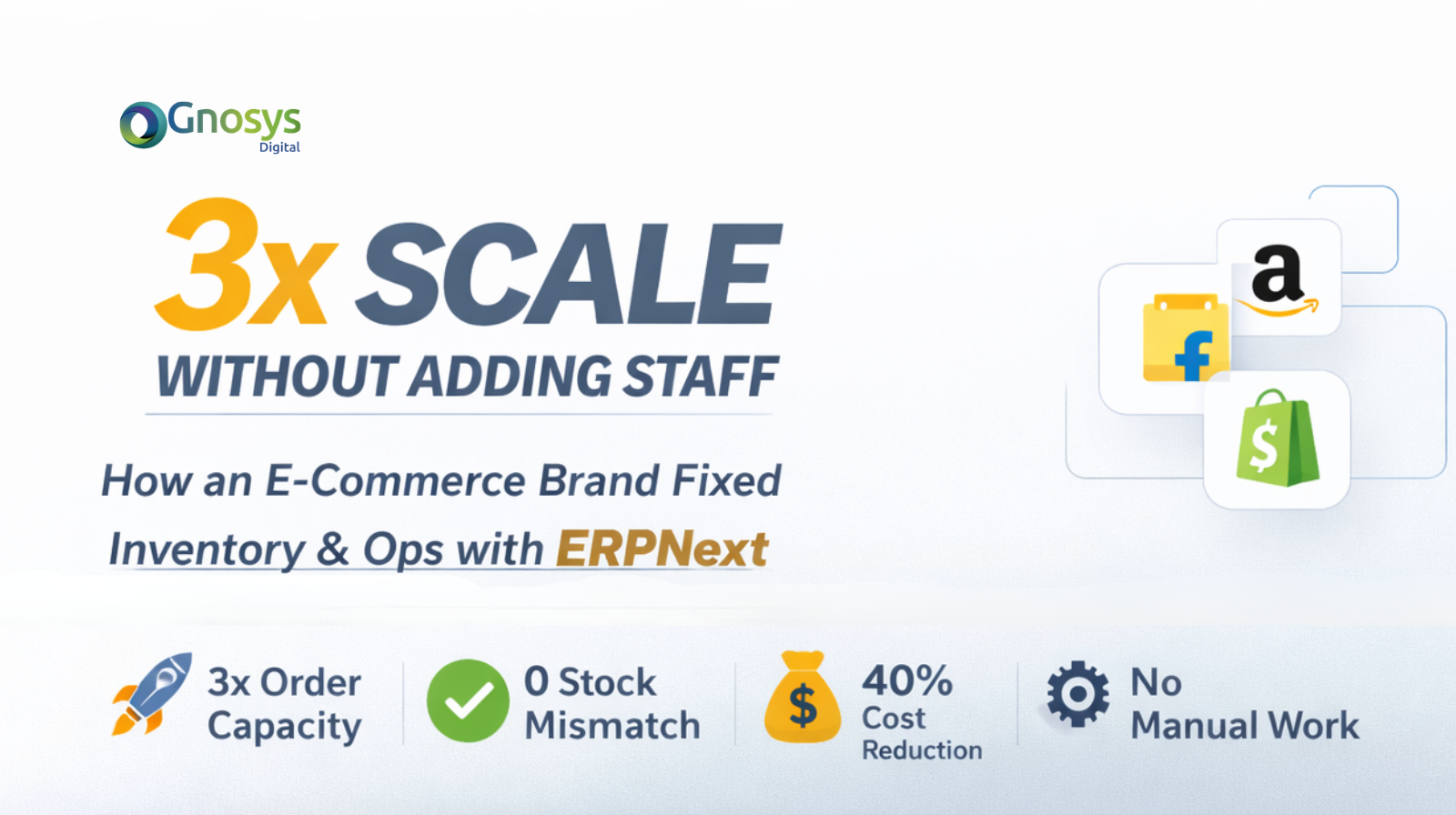
The client is a fast-growing D2C e-commerce brand selling across multiple marketplaces, including Amazon, Flipkart, and Shopify. Operating in a highly competitive environment, the company deals in high-volume order processing within the fashion and lifestyle category. As the brand scaled rapidly, daily order volumes increased significantly, putting pressure on existing operations and systems.
Growth Context & Challenge:
Despite strong sales growth, the company struggled to manage rising order volumes without expanding its operations team. Manual processes for order management, inventory tracking, and fulfillment coordination started creating bottlenecks. As a result, delays, stock mismatches, and operational inefficiencies began affecting customer experience and overall scalability, highlighting the need for a centralized and automated system.
Challenges / Problems
As the brand scaled rapidly across multiple marketplaces, operational complexity increased significantly. Managing orders from platforms like Amazon, Flipkart, and Shopify without a centralized system led to frequent stock mismatches and overselling issues. Inventory was not synced in real time, which caused cancellations, customer dissatisfaction, and negative marketplace ratings. At the same time, manual order processing slowed down fulfillment, increasing the chances of human errors and delaying shipments.
Key Challenges:
- Overselling and stock mismatch across multiple sales channels
- Manual order processing leading to delays and fulfillment errors
- No centralized system to manage inventory and orders together
- High dependency on the operations team for daily execution
- Difficulty handling increasing order volumes efficiently as the business scaled
These challenges created a bottleneck in growth, where increasing sales directly resulted in increased operational stress. Instead of scaling smoothly, the business became more dependent on manual effort, making it difficult to maintain efficiency, accuracy, and customer experience at higher volumes.
Solution
To eliminate operational chaos and support scalable growth, the company implemented ERPNext along with marketplace integrations. This created a centralized system where orders, inventory, and fulfillment processes were fully connected. Instead of managing each platform separately, the business could now operate from a single interface, reducing manual effort and improving accuracy across all operations.
Key Solutions Implemented:
ERPNext Order Management – Centralized Control:
All orders from multiple sales channels were consolidated into a single system, allowing the team to process and track orders without switching between platforms. This significantly reduced errors and improved order handling speed.
Inventory Management – Real-Time Stock Sync:
Inventory levels were updated in real time across all platforms, eliminating overselling and stock mismatches. This ensured accurate stock visibility and better planning for restocking.
Marketplace Integrations – Automated Order Flow:
Seamless integrations with platforms like Shopify and Amazon enabled automatic syncing of orders, reducing manual data entry and ensuring faster fulfillment.
Automation Workflows – Reduced Manual Work:
Automated workflows handled repetitive tasks such as order processing, status updates, and notifications, reducing dependency on the operations team and minimizing human errors.
Unified Dashboard – Complete Visibility:
A centralized dashboard provided real-time insights into orders, inventory, and fulfillment status, enabling better decision-making and smoother daily operations.
With ERPNext in place, the company transitioned from a fragmented and manual system to a streamlined and automated workflow. This not only improved operational efficiency but also enabled the business to handle increasing order volumes without expanding the team.
Implementation Approach
The implementation was designed to ensure a smooth transition from fragmented systems to a centralized ERP environment without disrupting daily operations. All sales channels were first connected with ERPNext, enabling seamless data flow between marketplaces and the internal system. Inventory was then synced across warehouses and platforms to ensure real-time accuracy, eliminating inconsistencies and manual reconciliation efforts.
Step-by-Step Execution:
- Connected all sales channels with ERPNext
- Synced inventory across warehouses and marketplaces
- Automated order processing workflows
- Trained internal team for smooth adoption
This structured rollout ensured that the team could gradually adapt to the new system while maintaining operational continuity. With proper training and support, the company quickly transitioned to a more efficient and automated workflow.
Results / Impact
After implementing ERPNext, the company experienced a significant transformation in its operations. Order processing became faster and more accurate, while real-time inventory synchronization eliminated stock mismatches across platforms. The business was able to scale aggressively without increasing its operations team, which directly improved profitability and efficiency.
Key Results:
- 3x increase in order handling capacity
- 0 stock mismatch across channels
- 40% reduction in operations cost
- Faster order processing with minimal manual effort
- Real-time visibility into inventory and sales
These improvements allowed the company to shift its focus from managing daily operational issues to driving growth and expanding its market presence.
Client Testimonial
The impact of ERPNext was clearly reflected in the client’s experience, as they were able to scale operations without adding complexity or manpower. The system eliminated major bottlenecks and brought clarity to previously chaotic processes.
“We scaled 3x without hiring a single ops person. ERPNext eliminated our biggest bottlenecks—inventory errors and manual processing.”
Call to Action
Scaling an e-commerce business is not just about increasing sales; it’s about building systems that can support that growth efficiently. If your operations are struggling to keep up with your growth, it may be time to rethink your backend processes.
👉 Scaling fast but ops can’t keep up? Let ERPNext handle your backend while you focus on growth.
👉 Book a demo or consultation: https://gnosysdigital.com/
