
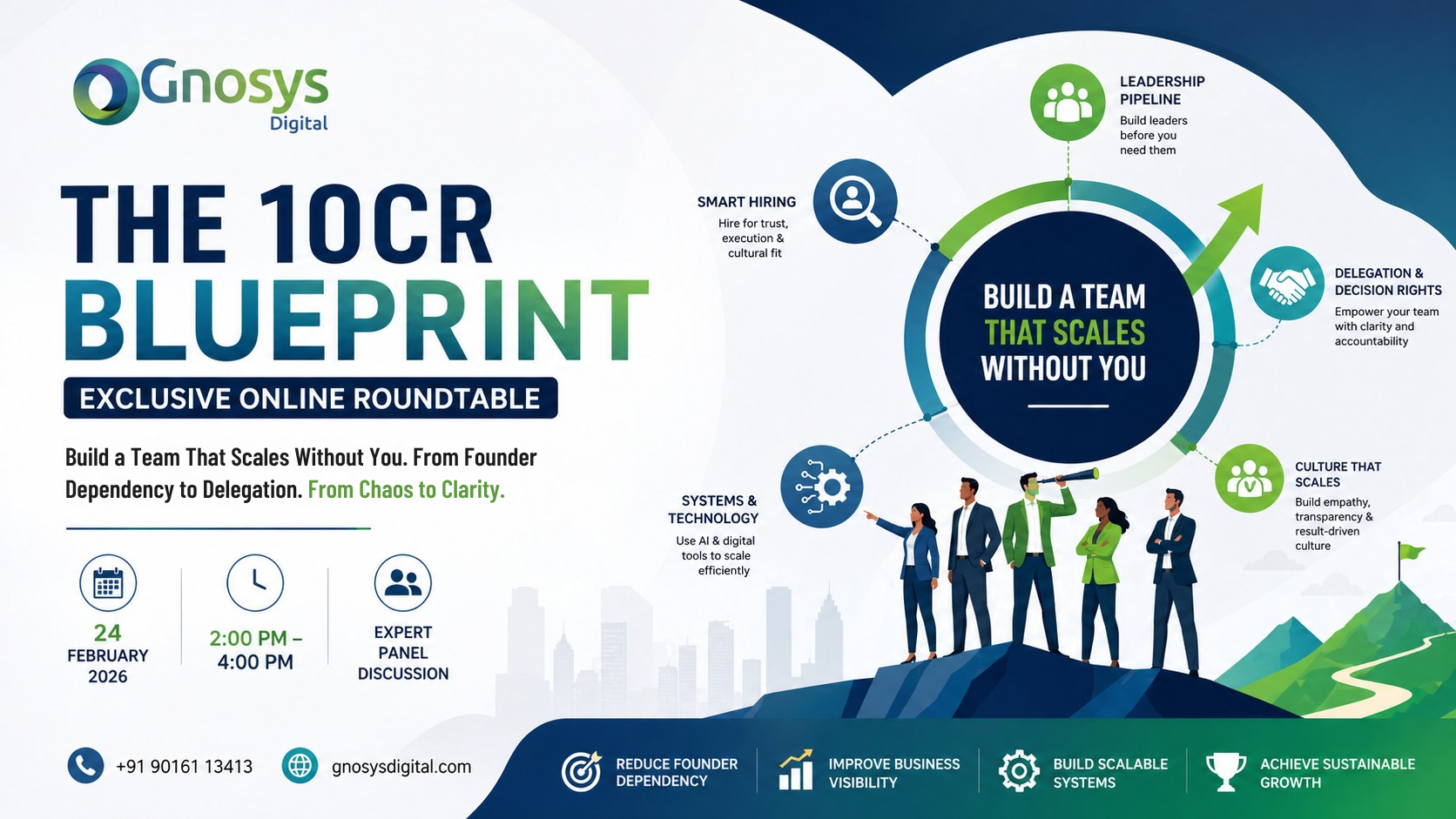
An exclusive roundtable discussion featuring CA Purva Mittal, Dr. Venkat Kumaresan, CA Sangeeta Gandhi, and CA Mukesh Solanki, moderated by CA Chanakya Shah.
Executive Summary
On April 27, 2026, over 55 founders and business owners gathered for an intensive 2.5-hour roundtable discussion on the 10 CR Blueprint – The Leadership & People Blueprint. This third edition of our flagship series focused on the #1 challenge reported by 130+ founders across previous sessions: scaling the team and people.
The session brought together four experts with decades of combined experience across recruitment, leadership development, soft skills training, HR technology, and business transformation.
The central theme was clear: You cannot scale alone. Your success depends on building a team that works with you, not for you – and eventually, without you.
The discussion covered four critical pillars:
- Hiring the First 10 Employees – Who, when, and how to avoid toxic hires
- Building a Leadership Pipeline – Creating managers from individual contributors before you need them
- Delegation & Decision Rights – Moving from “I approve everything” to trusted autonomy
- Culture That Enables Scale – Values, rituals, and boundaries that don’t break at 50 people
This blog captures the key insights, real-world examples, and actionable takeaways shared by our esteemed panelists.
The Panel
| Speaker | Expertise | Topic |
|---|---|---|
| CA Purva Mittal | Talent Strategy & Leadership Hiring | Hiring the First 10 Employees |
| Dr. Venkat Kumaresan | Startup Mentor & Best-Selling Author (“Father of Your Team”) | Building a Leadership Pipeline |
| CA Sangeeta Gandhi | Soft Skills & Leadership Trainer | Delegation & Decision Rights |
| CA Mukesh Solanki | HR & Technology Integration Expert | Culture That Enables Scale |
| CA Chanakya Shah | Moderator | Finance & Business Coach |
Watch the Session
📺 Full video recording available below.
https://drive.google.com/file/d/1vd5qCLH8TmGqnN-5TDiXzYBm-XtQEbb7/view?ts=69f03c08
Topic 1: Hiring the First 10 Employees
Led by CA Purva Mittal
The Single Biggest Hiring Mistake
Purva opened with a powerful observation based on her decade-plus experience in recruitment, especially in finance roles:
“Most founders make their first hiring mistake within the first 12 months. That mistake costs them about 6 to 12 months of their growth.”
Hire for Trust and Execution, Not Just Fancy Degrees
Purva shared examples from successful Gujarati business houses like AU Bank and Choice International:
“They initially hired people from their own domain – people whom they could trust. Those initial people are still with them. They have grown them. They have made them reach sizable numbers.”
Key Insight: In the early stages, you need executors. Someone who is loyal, trustworthy, and a go-getter is more valuable than someone with a fancy degree who talks about strategy but doesn’t execute.
“You need a person who says, ‘Yes, sir, it will be done.’ Not someone who says, ‘This is not my job.'”
The Power of Referrals and Known Networks
“Initially, hire from people you know – referrals, your own network. These are people you can trust. Even if they’re not very smart, they are loyal and confident.”
Actionable Takeaway: Your first 5-10 employees are your core team. They will teach the next set of people. They must be aligned with your thought process.
How to Attract Talent Without High Salaries
Purva addressed a common pain point:
“Everybody is working for money. We need to take care of their finances. But what else works?”
Key strategies shared:
- Confidence and Support – “I am always there at your back to help you in any situation.” Employees stay when they know you have their back.
- Variable Pay – Make the variable component lucrative. Link it to performance. “If I work harder, I get more.”
- Career Path and Leadership Grooming – “From day one, I am grooming you like a leader. In a Big Four, it will take 5-6 years. Here, from this moment, you are growing.”
- Work-Life Balance – Acknowledge that employees have families, pressures, and need time. Be empathetic.
The Red Flags in Interviews (What Most Founders Miss)
Purva shared a practical example:
“I interviewed a person from a Big Four. He started calculating: ‘There I work 5 days a week. Here I have to work 6 days. That’s one extra day per week.'”
“I said no to him. Why? At a leadership position, you should be discussing how you will bring work, how you will grow the practice – not how many leaves you get.”
Other red flags:
- Candidates who ask only about policies, leaves, and benefits – not about growth or contribution
- Candidates who want recognition and status without wanting to do the work
- Candidates who say “I am fed up” with their current role, without a clear vision for the future
The Homegrown Leader Example
Purva shared a personal story:
“I have a team lead who is my replica. If I’m not there, she can take charge on my behalf. She was homegrown – I took her, I groomed her, I gave her confidence. She has gone on maternity leave, taken many leaves – I have always taken care of her.”
“She says, ‘Boss, this is your company, not mine. We both have made this company, and we will take it to the top.'”
Key Takeaway: Your team is your family. Treat them well. In a service industry, your team speaks for you.
Topic 2: Building a Leadership Pipeline
Led by Dr. Venkat Kumaresan
The Story of the Lion and the Cubs
Dr. Venkat opened with a powerful story:
“There was a dense tropical forest. A mighty lion was excellent at hunting and feeding his cubs. The cubs grew up physically strong. The lion assumed they would automatically know how to hunt.”
“One day, the lion grew old. A group of jackals attacked him. The cubs watched, not knowing how to protect their father. The lion died – not because he lacked strength, but because he lacked successors.”
The lesson for founders:
“When leaders do not groom successors, nature fills the vacuum with competitors. Leaders who try to shine all alone will burn out. Those who light others create a lasting fire.”
What Is a Leadership Pipeline?
Dr. Venkat broke down the concept using the metaphor of a pipeline:
| Pipeline Characteristic | What It Means for Leadership |
|---|---|
| Closes a gap | There is a distance between the leader and the next level. The pipeline bridges that gap. |
| Creates convenience | Leaders can think strategically and network widely when they know their team can handle day-to-day operations. |
| Has joints | In MSMEs, different people with complementary skills connect together to form departments. You don’t need one person who can do everything. |
| Can be visible or invisible | Some organizations have visible leadership roles; others have matrix structures where people take on stretch roles. Both work. |
Building a Pipeline Takes Effort, Planning, and Investment
“Building a leadership pipeline requires time to build, time to plan, and investment. Mentoring a team when the founder is busy may require intervention from an organizational development coach.”
The common mistake: “Buying a dog and barking yourself.” You identify someone as a manager, but you still end up telling them what to do because they were promoted for being good at their previous role – not for their leadership capability.
How to Identify Who Has Leadership Potential
Dr. Venkat shared a practical framework using Belbin Team Roles. There are nine team roles:
| Role | Strength |
|---|---|
| Plant | Creative, innovative, likes to work alone |
| Shaper | Extrovert, positive, thrives under pressure, enjoys challenges |
| Implementer | Takes abstract ideas and converts them into action |
| Completer Finisher | Diligent, introverted, focuses on finer details, never makes mistakes |
| Coordinator | Aligns people and gets things done |
| Team Worker | Absorbs the workload of the rest of the team because they love their team |
| Monitor Evaluator | Strategic, objective, good at analyzing options |
| Resource Investigator | Outgoing, enthusiastic, explores opportunities |
| Specialist | Deep expertise in a specific area |
“Identify what category your staff fits into. One person can fit into multiple categories. For example, someone can be both an implementer and a plant.”
Leadership Potential by Level
| Level | Required Belbin Roles |
|---|---|
| Supervisor / Emerging Leader | Team Worker + Implementer (just get it done) |
| Middle Leadership | Coordinator + Shaper (work across teams, positive mindset) |
| Senior Leadership (reporting to the founder) | Coordinator + Plant + Completer Finisher (innovation + execution + attention to detail) |
Step-by-Step Process to Build a Leadership Pipeline
- Conduct a 360° survey – Even for small teams. Discover rough edges before they become problems.
- Take your next-level people to networking events – Don’t let them become frogs in a well. Let them see how the industry works.
- Teach them cognitive bias – No person is perfectly rational in decision-making. Help them recognize judgmental errors.
- Teach solution generation techniques – Use tools like SCAMPER (Substitute, Combine, Adapt, Modify, Put to another use, Eliminate, Reverse). Innovation is a developed skill, not just a native one.
- Use the 21 Irrefutable Laws of Leadership by John C. Maxwell – Have team members take turns discussing one law and how it applies to their role.
How to Create a Leadership Pipeline in a Team of 5
“In a team of 5, even one person with a mindset issue creates a 20% impact. So be very careful.”
Actionable steps:
- Get them attracted to the vision
- Provide enriched roles
- Give recognition and visibility
Common Mistakes When Promoting the First Manager
| Mistake | Why It’s a Problem |
|---|---|
| Assuming good individual contributors will be good leaders | Different skill sets entirely |
| Promoting a “news reporter” | Someone who updates you on everything but can’t handle the situation themselves |
| Halo effect | Assuming someone good at communication will be good at leadership |
| Valuing seniority and hard work only | Hard work alone doesn’t make a leader |
How to Balance Letting Them Lead Without Letting Them Fail Catastrophically
- Have governance reporting – Regular check-ins without micromanagement
- Establish guardrails – “If the average contract value goes below this threshold, handle it for 3 days, then escalate if required.”
The 9-Box Grid for Leadership Succession
Dr. Venkat shared a framework to assess employees based on:
- Current strength (low, medium, high)
- Future potential (low, medium, high)
The combination creates nine boxes, each requiring a different action – from “reward and develop” to “reassign or exit.”
“There are two types of organizations. One where only someone who knows how to read a clock can tell the time. Another is where someone builds a clock so that anyone can read the time. Be a clock builder.”
Topic 3: Delegation & Decision Rights
Led by CA Sangeeta Gandhi
What Are Delegation and Decision Rights?
| Term | Definition |
|---|---|
| Decision Rights | Authority to make decisions |
| Delegation | Transfer of this authority from the superior to the subordinate |
“Just passing on authority doesn’t end the job. Authority plus accountability is what actual delegation is all about.”
Why Delegation Matters
| Benefit | Explanation |
|---|---|
| Focus on strategic priorities | Delegate routine work, focus on what only you can do |
| Faster execution | Decisions don’t wait for you |
| Builds leadership pipeline | Creates successors (as Dr. Venkat explained) |
| Frees managerial bandwidth | You can think, not just react |
| Team development | Skills and career growth for team members |
| Organizational efficiency | The whole system works better |
Why Delegation Fails (Even with Good Intentions)
| Barrier | Solution |
|---|---|
| Fear of loss of control | Start small. Delegate low-risk tasks first. Build trust gradually. |
| Fear that the person won’t do the job well | Trust is built systematically. Give small tasks, see how they fare, then increase. |
| Lack of clarity in roles | Describe clear roles. Communicate authority AND accountability to one person. |
| Poor outcomes | Guide and monitor smartly. It’s a learning process, not a failure. |
The Founder’s Unique Psychological Barriers
| Barrier | What It Means |
|---|---|
| Identity attachment | “I built this, so I must only control it.” |
| Perfectionism | “No one can do it as well as I can.” |
| Fear of loss of relevance | “If they start doing things independently, what will be my role?” |
| Trust deficit (not always rational) | Past mistakes lead to overgeneralized mistrust |
| Control equals comfort | Chaos of scaling feels risky without control |
“Delegation is not a skill problem. It’s a mindset shift from doer to builder.”
How to Trust Your Team When You’re Used to Controlling Everything
- Build trust through first small wins – Low-risk delegation first
- Ensure transparency – Shared dashboards, regular updates
- Define metrics – What does success look like?
- Consistency over time – Trust is built, not given
“The shift is from ‘Do I trust them?’ to ‘Have I set them up to succeed?’ Their success is the company’s success.”
What to Delegate (and What Not To)
| Delegate | Do Not Delegate |
|---|---|
| Repetitive, process-driven decisions | Strategy |
| Routine approvals | Vision |
| Follow-ups | Critical high-risk calls |
| Operational coordination | Core direction |
| Basic client communication (status updates, scheduling, follow-ups) | Strategic client communication (pricing, negotiations, escalations, key relationships) |
“The rule is: if the task is repeatable, low-risk, and documentable, it should not sit with the founder.”
Delegating Task vs. Delegating Ownership
| Delegating Task | Delegating Ownership |
|---|---|
| About activities | About accountability |
| “Do this, do that” | Includes decision rights |
| Short-term | Long-term |
| Includes instructions and supervision | Includes motivation and empowerment |
“You scale not when you delegate tasks, but when you delegate ownership.”
The Skill vs. Will Matrix (Who to Delegate To)
| Lavel | Low Will | High Will |
|---|---|---|
| High Skill | Motivate (carrot and stick) | Ready for delegation – give ownership |
| Low Skill | Supervise closely | Train and develop |
For low will + low skill: Supervision. Push and follow up.
For high will + low skill: Training. Give them the comfort that they will learn.
For low will + high skill: Motivation. Find what works – positive (carrot: reward on accomplishment) or negative (stick: consequences for non-performance).
For high will + high skill: Ready for delegation. Give them ownership.
The RACI Framework for Delegation
| Letter | Meaning | Role |
|---|---|---|
| R | Responsible | Does the work |
| A | Accountable | One person per task – the point of contact |
| C | Consulted | Subject matter experts whose input is needed |
| I | Informed | Kept updated on progress (supervisor level) |
Decision Rights by Level (For Small Teams)
| Level | Who Decides |
|---|---|
| Level 1 | Founder decides (strategic, high-risk decisions) |
| Level 2 | Team decides with consultation (escalate for approval) |
| Level 3 | Team decides independently (routine, low-risk) |
“When you hand over a task, tell them: ‘These are the things you can decide. These you need to consult me on. These I will take care of.'”
What to Do When Delegation Goes Wrong
“Bad delegation is not a failure. It’s feedback that something went wrong in the system.”
Fix it in three steps:
- Pause – Don’t blame immediately
- Diagnose – Was it clarity, capability, or commitment?
- Reset – Redelégate with better structure. Add clear outcomes, checkpoints (not control), and feedback loops.
Success Stories
Infosys (Narayana Murthy): In the 1990s, he created a professional management structure. He gave business unit heads autonomy over client decisions, delivery models, and operational strategies. He established clear governance frameworks – not micromanagement.
HDFC Bank (Aditya Puri): He gave branch managers authority to approve loans up to a certain limit. Regional heads could design strategies for local markets. Teams were trusted to act fast without head office approvals. Result? Faster loan processing, higher customer retention, and employee ownership.
Failure Story
Kingfisher Airlines (Vijay Mallya): All decision rights were held at the top. Delayed and inconsistent decisions. No accountability structure. Result? Operational shutdown, massive financial losses, loss of trust.
Topic 4: Culture That Enables Scale
Led by CA Mukesh Solanki
What Is Culture? (A Different Perspective)
Mukesh started by asking the audience to put their understanding of culture in the chat box. Then he flipped it:
“You can have all the policies in place. You can follow everything by the book. But culture is how you handle the exception.”
The Hotel Refund Story
Mukesh shared a powerful story:
“Two customers call a hotel for a refund on a non-refundable booking. One customer service agent says, ‘Sorry, it’s not in our policy. I cannot help you.’ The other says, ‘Let me see what I can do. Though it’s not in our policy, I will talk to my senior and see if we can help. I will update you by evening.”
“Evening comes. The second agent calls back: ‘I’m really sorry. No refund is possible.”
“In both situations, the customer did not get a refund. But which customer will come back? Which customer will recommend the hotel to others?”
Key Insight: The result was the same. The second customer was retained because of the culture of empathy and transparency.
Culture Is How You Treat Your Customer When Things Go Wrong
“Your junior staff sitting on the customer service desk is as important as your highest-level person. How they speak to your customers defines your brand. If your customer talks about your company, they will say: ‘Wow, what a culture this company.'”
Two Sets of People in Every Organization
| Type | What They Need |
|---|---|
| Arjun (highly skilled, self-directed) | Direction on WHAT to do, not HOW. No micromanagement. |
| Less skilled/junior | Clear instructions – steps 1 to 10. Supervision. Clear roadmap. |
“If you have an Arjun in your team and you micromanage them, you will kill their motivation. If you have a junior person and you don’t give clear instructions, they will fail.”
Key Insight: Culture is knowing which is which and managing accordingly – all while keeping the customer at the center.
Two Major Changes in the Last 12-24 Months
| Change | Implication |
|---|---|
| Gen Z and millennial mix in the workforce | Different mindset. They value mental health, flexibility, and purpose – not just salary. |
| AI and technology | You can now hire AI agents as “co-workers” alongside humans. |
Remove the Culture of Time Sheets
“Remove the culture of managing time sheets in your organization. Don’t track when someone comes to the office. Track results.”
“Tell the person: ‘This is the result I want in 7 days. Whether you work 2 hours or 20 hours, whether you work from home, from the mountains, from Goa – I don’t care. Show me the result on day 7.'”
Actionable tools: Use project management tools like Zoho Projects, Office 365 Planner, or to-do lists rather than Excel sheets.
The Scoreboard Metaphor
“Imagine watching a cricket match with no scoreboard. You don’t know how many runs, how many balls, how many wickets. Can that happen in your organization – that someone says ‘I’m giving my best,’ but you have no scoreboard?”
“You need daily, weekly, monthly, and quarterly scoreboards. Not just at the end of the month.”
AI Agents: Your New Team Members
“You can now hire 10 AI agents for less than ₹25,000 per month – the salary of one junior person. These agents work 24×7, not 5 days a week or 8 hours a day.”
Use cases shared by Mukesh and Aditya Shah:
| Use Case | How AI Helps |
|---|---|
| Voucher checking | Upload vouchers and accounting entries – AI matches them |
| GST reconciliation | Upload both files – AI does the matching |
| Draft responses to client queries | AI gives first cut, senior reviews |
| Meeting minutes to tasks | Record meeting → transcript → ChatGPT converts to actionable tasks with deadlines |
| Task assignment | AI creates tasks in project management tools and emails team members |
| Purchase automation | AI negotiates with vendors, gets quotes, compares, and recommends a purchase |
| Customer interface | AI agent answers queries, monitors books based on customer data |
“You don’t need to be a technical expert. Just keep your eyes and ears open. Within the next 6 months, most of these tools will be available for free or at very low cost.”
Hiring Fast, Firing Fast
“Is hiring ever going to be perfect? Never. I am in recruitment. I have never seen hiring being perfect.”
“You need a clear policy: hire fast, fire fast. Do you want a protective culture, or do you want a sympathy culture for employees who are not performing?”
Key Insight: One non-performing employee in a team of 10 spreads negativity faster than 9 performing employees can spread positivity.
“If someone has a genuine emergency, take a leave for 7 days, 15 days, 1 month, 2 months. I don’t care. Come back when you’re ready. But if I keep you in the team and you are performing at 50%, negativity spreads faster than positivity.”
The Incentive Culture
“First give, then expect. Out of 10 things, 3 will fail, 7 will succeed. That’s fine. Build a culture of rewarding talent, skill, discipline, productivity, and efficiency.”
A Contrarian View: Hiring Relatives
Mukesh offered a perspective that differed from Purva’s earlier point:
“In this generation, I do not believe in hiring relatives. Not at all.”
Reasons:
- You can now monitor performance with tools. You don’t need “trust” in the old sense.
- Relatives may not have the same passion as you.
- If a relative doesn’t perform, removing them is difficult – it spoils relationships and creates social pressure.
- It creates talent vs. bias issues.
“Have the culture of rewarding talent and skill, not rewarding relatives.”
(Purva respectfully disagreed, noting that many successful organizations were built with family members. Healthy debate followed, acknowledging that different businesses have different needs and contexts.)
Summary of Mukesh’s Key Points on Culture
| Do | Don’t |
|---|---|
| Build a culture of empathy and transparency | Follow rules by the book without human touch |
| Measure results, not time | Insist on time sheets |
| Use technology and AI agents | Rely only on manual processes |
| Build scoreboards for performance | Wait until the month-end to review |
| Hire fast, fire fast | Keep non-performers out of sympathy |
| Reward talent and skill | Reward bias or relationships |
| Hire Arjuns for senior roles | Hire only junior people and become a training institute |
Q&A Highlights
Q: What’s the biggest red flag in an interview that most founders miss? (To Purva)
Purva: “The kind of questions they ask. If someone asks about leaves and policies before asking how they can grow with you – that’s a red flag. Their attitude and where they take the conversation tells you everything.”
Q: How do you delegate when you’ve tried before, and it failed? (To Sangeeta)
Sangeeta: “Start somewhere. Don’t generalize one failure to everything. First, hire right. Second, delegate right – identify what to delegate and to whom. Third, understand that Gen Z has a different mindset – they value mental health and work-life balance. That’s not wrong. It’s different. Start trusting. Give accountability, not just tasks.”
Q: At what point should I hire a CEO or second-in-command? (To Venkat)
Venkat: “It depends on the founder’s skill and bandwidth. If the founder has less than 30-40% of time to spend on all business activities, and that phase prolongs for 3-4 months, that’s the time to hire a CEO.”
Q: What are practical use cases of AI agents for small businesses? (To Mukesh)
Mukesh shared multiple examples: Voucher checking, GST reconciliation, draft responses to client queries, meeting minutes, task assignment, and purchase automation. “Most of these tools will be free or low-cost within 6 months. Keep your eyes and ears open.”
Q: How do you build a strong business development and sales team? (To Mukesh)
Mukesh: “First, build your brand and content strategy using technology. Leads should come to you. Second, never hire a junior person for sales as your first hire – you cannot afford to lose prospective leads. Hire an experienced sales executive first, and build the team under them. Third, sales is a different skill set from knowing the product. Give sales to salespeople.”
Q: Can known people (relatives, friends) become core team members while still being neutrally managed? (To Purva)
Purva: “Why not? You have policies and procedures applicable to everyone. Bring professionalism. The same rules apply to the founder and to the relative. If you’re not comfortable saying ‘no’ to someone, your hiring is wrong – whether they are a relative or not.”
Key Takeaways for Founders
| Area | Action Item |
|---|---|
| Hiring | Hire for trust and execution first. Fancy degrees come later. Use referrals. Spot red flags in interviews. |
| Leadership Pipeline | Identify who has leadership potential using Belbin roles. Use the 9-box grid. Take your team to networking events. |
| Delegation | Delegate ownership, not just tasks. Use the Skill vs. Will matrix. Define decision rights by level (founder decides/decides with consultation, / decide independently). |
| Culture | Build empathy and transparency. Remove time sheets. Use AI agents. Measure results. Hire fast, fire fast. Reward talent. |
| AI & Technology | AI agents can do voucher checking, GST reconciliation, draft responses, task assignment, and purchase negotiation. Most will be free or low-cost soon. |
Closing Thoughts from Speakers
CA Purva Mittal
“Your initial people are your core strength. They will teach the next set of people. They must be aligned with your thought process. Treat them like family, and they will take your company to the top.”
Dr. Venkat Kumaresan
“There are two types of organizations. One where only someone who knows how to read a clock can tell the time. Another is where someone builds a clock so that anyone can read the time. Be a clock builder.”
CA Sangeeta Gandhi
“Delegation is not about doing less. It’s about enabling your team to do more. The goal is to move from ‘I approve everything’ to ‘I trust you to decide.'”
CA Mukesh Solanki
“Culture is not about how you celebrate festivals in your company. Culture is about how you grow together with your team – providing them space, responsibility, accountability, incentives, and motivation to reach the next level.”
CA Chanakya Shah (Moderator)
“My mission is to help founders work less and earn more. Building a team that scales without you is the only way to achieve that.”
To connect with any of our panelists or learn more about scaling your business, reach out to us atconnect@gnosysdigital.com.
About Gnosys Digital
Gnosys Digital helps growing businesses move from manual, disconnected operations to integrated, system-driven execution. We work with business owners to bring visibility across sales, operations, and finance, reduce founder dependency, and implement scalable business systems using ERP frameworks.
Did you attend the session? Share your key takeaways in the comments below!
