
Why Most Businesses Don’t Fail at ERP. They Fail at Implementation.
Many businesses finally start looking for an ERP when they can no longer answer basic questions.
What is our exact cash position today?
Which products or services are actually profitable?
Why do inventory numbers never match sales commitments?
At this stage, spreadsheets, emails, and disconnected tools create more confusion than clarity. Leadership spends more time reconciling data than making decisions. Growth feels harder than it should.
This is the breaking point.
ERPNext can solve these problems, but only when it is implemented the right way. The difference between success and failure is not the software itself. It is the implementation approach behind it.
What ERPNext Implementation Really Means
ERPNext implementation is not about installing software on a server.
A proper implementation connects your finance, sales, inventory, operations, and people into a single system that reflects how your business actually works, not how a generic ERP template assumes it should.
When ERPNext is implemented correctly, it becomes the operating system of your business. Decisions are based on real data, teams work from a single source of truth, and leadership gains clear visibility across the organization.
At Gnosys Digital, ERPNext implementation means:
Understanding your business before configuring the system
We start by mapping your real workflows, decision points, and bottlenecks. The software is configured only after we understand how value flows through your business.
Designing workflows that reduce friction and manual work
Automation is applied where it creates impact. Approvals, reporting, inventory movements, and accounting processes are streamlined to remove delays and duplication.
Ensuring your team trusts and adopts the platform.
An ERP only succeeds when people use it. We focus on clarity, training, and usability so your team relies on ERPNext instead of bypassing it.
Delivering clarity, control, and confidence in your numbers
From cash flow to inventory valuation to profitability, leadership gets accurate, real-time data they can trust.
This is the difference between having an ERP system and running your business on ERPNext.
Common Problems Businesses Face Before ERPNext
Most organizations come to us when they face persistent operational challenges that slow growth and cloud decision-making:
- Accounting is scattered across spreadsheets or disconnected tools
Multiple versions of the truth create reconciliation headaches and increase the risk of errors. - Inventory mismatches across sales, stores, and warehouses
Stock levels are inconsistent, leading to lost sales, overstocking, and frustrated customers. - Manual invoicing, approvals, and follow-ups
Teams spend hours on repetitive tasks instead of strategic work, delaying cash flow and operations. - Delayed or unreliable management reports
Decision-makers are forced to piece together data from multiple sources, creating uncertainty and reactive planning. - No real-time visibility into profitability or cash flow
Leaders cannot make informed decisions quickly, limiting growth opportunities.
These are not software problems; they are system design problems.
ERPNext can solve them, but only when implemented with planning, structured workflows, and proper adoption.
Our ERPNext Implementation Approach
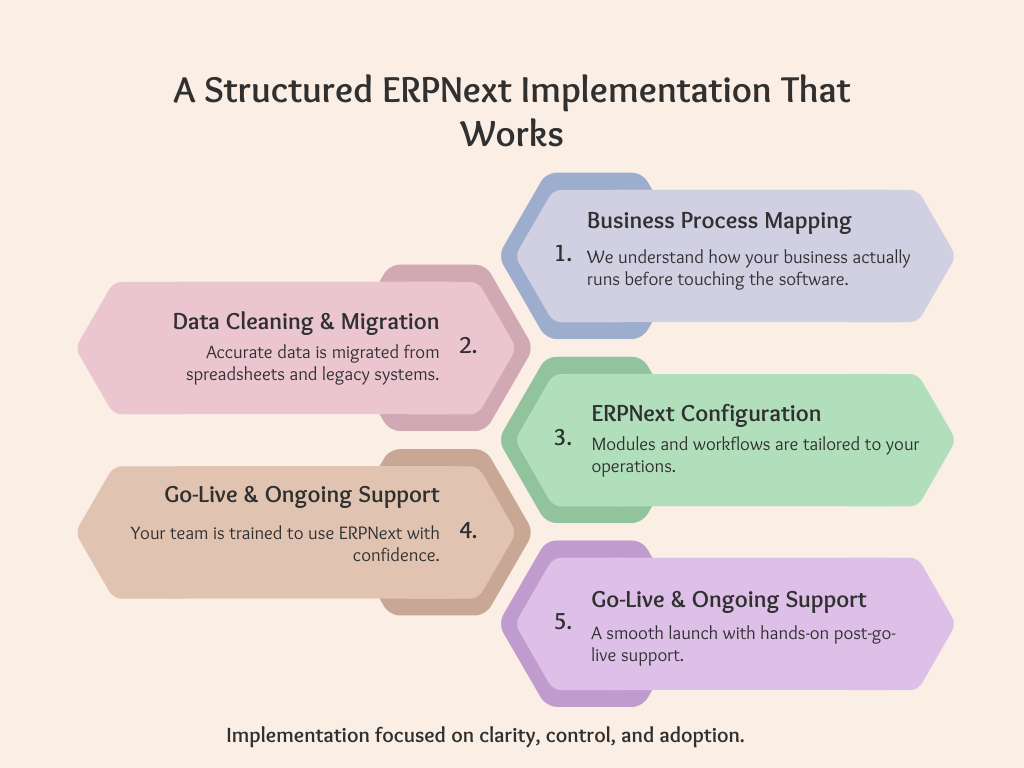
🔍 Step 1: We Map Your Business (Before We Touch Software)
We begin by understanding how your business truly operates.
This includes:
- Sales to invoice workflows
- Purchase and inventory cycles
- Manufacturing or service delivery processes
- Approval hierarchies and internal controls
Why this matters:
This prevents forcing your business into a generic ERP structure and ensures ERPNext works for you, not the other way around.
🧹 Step 2: Clean and Structured Data Migration
Migrating from spreadsheets or legacy tools is an opportunity to fix long-standing data issues.
We focus on:
- Accurate opening balances
- Clean customer and vendor master data
- Correct inventory valuation
- A logical, scalable chart of accounts
Why this matters:
Poor data destroys trust in an ERP system. Clean data builds confidence from day one.
🧩 Step 3: Phased, Module-Wise ERPNext Setup
We implement ERPNext in phases, not all at once.
Most businesses start with:
- Accounting
- Inventory
- Sales and CRM
As operations mature, we expand into:
- Manufacturing
- HR and Payroll
- Projects and Timesheets
Why this matters:
A phased rollout improves adoption, reduces overwhelm, and keeps the system usable.
🎓 Step 4: User Training and Real Adoption
ERP systems fail when teams do not understand or trust them.
We provide:
- Role-based training
- Real business scenarios, not generic demos
- Simple dashboards for leadership
Why this matters:
Adoption turns ERPNext from software into a daily decision-making tool.
🚀 Step 5: Go-Live Support and Continuous Optimization
Implementation does not end on launch day.
We support you with:
- Post-go-live handholding
- Workflow refinements
- Reporting and dashboard improvements
- Ongoing optimization as your business evolves
Why this matters:
Your ERP should continually improve over time, rather than becoming outdated or ignored.
ERPNext Implementation Use Cases We Handle
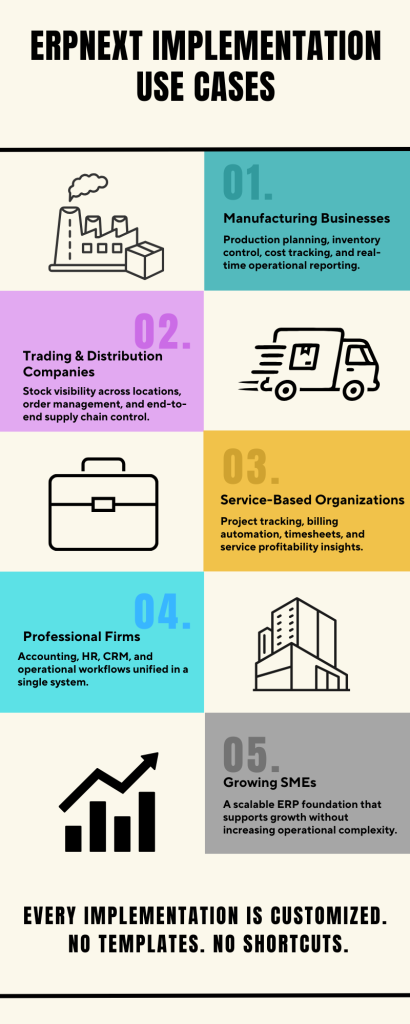
At Gnosys Digital, we implement ERPNext for a wide range of businesses, tailoring every solution to meet the unique needs of each organization:
- Manufacturing Businesses
Streamline production planning, inventory tracking, and cost control to improve efficiency and profitability. - Trading and Distribution Companies
Gain real-time visibility into stock levels, order fulfillment, and supply chain performance. - Service-Based Organizations
Automate project tracking, timesheets, billing, and client reporting to save time and reduce errors. - Professional Firms
Manage accounting, HR, projects, and client interactions from a single platform for better control and insight. - Growing SMEs Planning to Scale
Build a scalable ERP foundation that grows with your business, reducing operational chaos as complexity increases.
Every implementation is fully customized, no templates, no shortcuts. The focus is on aligning ERPNext with your actual business processes to deliver clarity, control, and measurable impact.
The Transformation: Before & After ERPNext
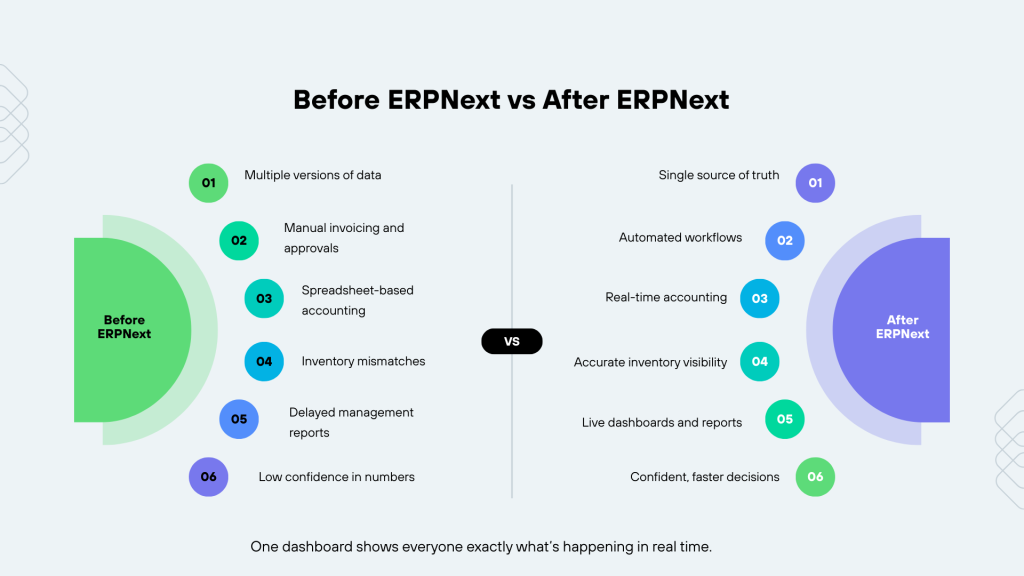
Visual Impact at a Glance
| 📊 BEFORE ERPNext | 🚀 AFTER ERPNext |
|---|---|
| 📁 Data scattered across spreadsheets | 🔗 Single source of truth |
| ⏳ Weekly manual report compilation | 📈 Real-time dashboards |
| 📦 Inventory mismatches and stockout | 📊 Accurate, visible stock levels |
| 💰 Uncertain cash flow position | 💡 Confident, real-time financial clarity |
In Their Own Words
“Before: We had three different versions of ‘the truth’ across finance, sales, and warehouse.
After: One dashboard shows everyone exactly what’s happening in real time.”
— Manufacturing Client, Pune
What This Means for Your Business
This simple change transforms operations: from managing software to managing your business with clarity and confidence. With ERPNext implemented the right way, your team no longer struggles with fragmented data or manual reconciliations. Decisions are faster, reports are reliable, and your business runs as a cohesive, transparent system.
ERPNext vs DIY or Low-Cost Implementations
Because ERPNext is open-source, many businesses attempt DIY setups or opt for low-cost implementation services.
What usually happens in these cases:
- Poorly designed workflows
Processes are forced into generic templates that don’t match how the business actually operates. - Partial or incorrect system usage
Critical features are left unused or misconfigured, limiting ERPNext’s potential. - Continued reliance on spreadsheets outside ERP
Teams revert to old habits, reducing efficiency and introducing errors. - Leadership loses trust in reports.
Inconsistent or inaccurate data erodes confidence in decision-making.
The real cost is not just the money spent.
It’s lost time, lost visibility, and lost confidence.
A well-implemented ERPNext becomes a long-term business asset, providing clarity and control.
A poorly implemented ERPNext becomes shelfware, expensive, underused, and ineffective.
The difference is not the software. It’s the implementation strategy.
Is ERPNext the Right Fit for Your Business?
ERPNext is an excellent solution for businesses that:
- Use multiple disconnected systems across finance, sales, inventory, or operations
- Spend hours each week on manual reconciliation and data entry
- Lacks real-time visibility into cash flow, inventory, or profitability
- Plan to scale without adding software chaos or complexity
- Want full ownership of their data without recurring license constraints
If three or more of these points resonate, ERPNext is likely a strong fit for your organization.
Taking the first step toward a structured ERPNext implementation can transform your operations, improve decision-making, and prepare your business for scalable growth.
What to Expect: The Gnosys Digital ERPNext Implementation Roadmap
To reduce disruption and uncertainty, we follow a proven ERPNext implementation roadmap designed to deliver results quickly without cutting corners. Our approach balances speed with structure, ensuring ERPNext is not just implemented, but adopted and trusted.
Most standard ERPNext implementations are completed within 4–6 weeks, depending on scope and complexity.
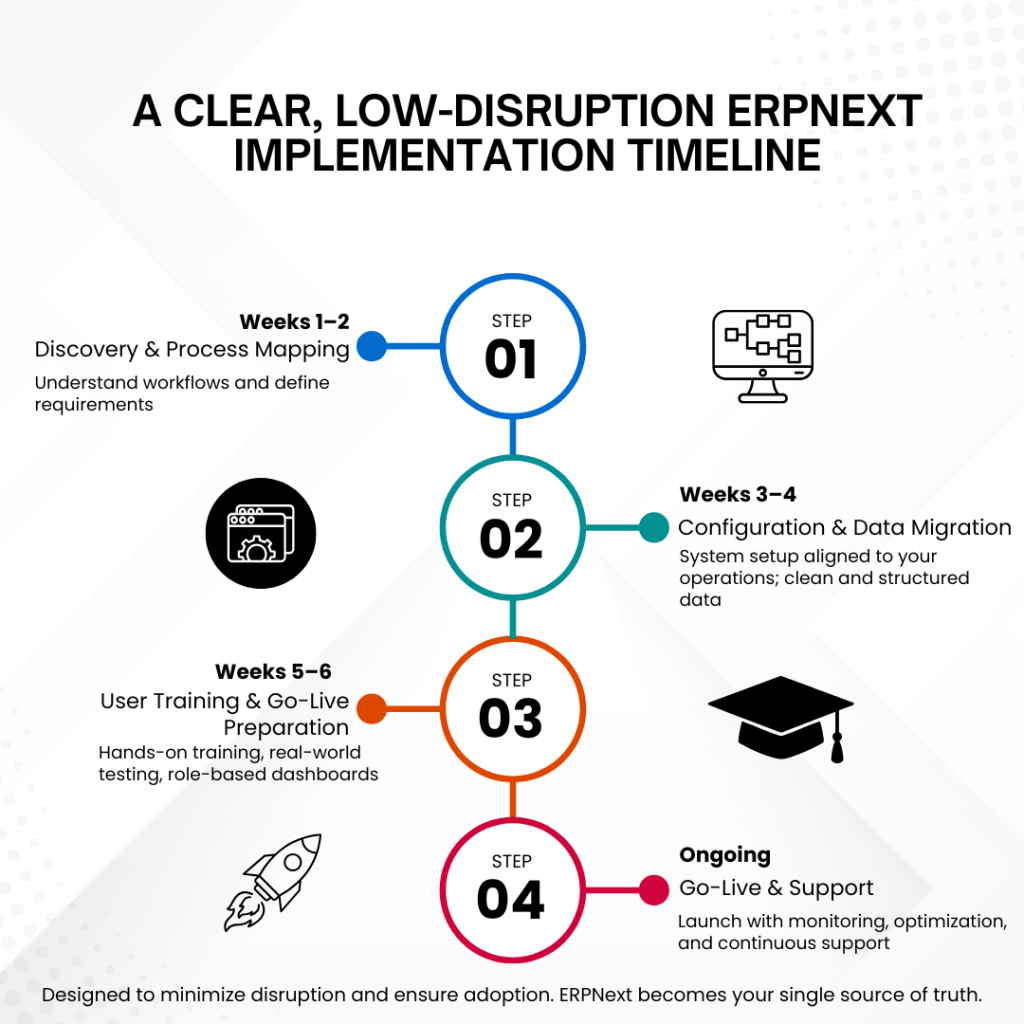
Phase 1: Discovery & Process Mapping (Weeks 1–2)
We begin by understanding how your business actually operates before configuring any software.
This phase includes:
- Mapping end-to-end workflows across finance, sales, inventory, and operations
- Identifying bottlenecks, manual dependencies, and reporting gaps
- Defining success metrics and decision-making requirements
Why this matters:
This step ensures ERPNext reflects your real-world operations, not a generic ERP template. It prevents rework, confusion, and poor adoption later.
Phase 2: Configuration & Data Migration (Weeks 3–4)
Once workflows are clearly defined, we configure ERPNext to match your processes.
This phase covers:
- Module-wise configuration aligned to mapped workflows
- Role-based permissions and approval structures
- Cleaning, migrating, and validating core business data
- Ensuring accurate opening balances and inventory valuation
Why this matters:
Clean configuration and reliable data build trust in the system from day one. Leadership can rely on reports without second-guessing the numbers.
Phase 3: Training, Testing & Go-Live (Weeks 5–6)
In the final phase, we focus on adoption and confidence.
This includes:
- Role-specific user training using real business scenarios
- End-to-end testing of transactions and reports
- A guided go-live with hands-on support and monitoring
Why this matters:
ERP systems fail when teams are unprepared. This phase ensures your team is confident, supported, and ready to use ERPNext as their primary system.
Post Go-Live: Stabilization & Optimization
Implementation does not stop at launch.
After go-live, we continue to:
- Fine-tune workflows based on real usage
- Improve dashboards and management reports
- Support optimization as your business evolves
Outcome:
A stable, scalable ERPNext system that continues to improve with your business.
At a Glance: ERPNext Implementation Timeline
- Weeks 1–2: Discovery & Process Mapping
- Weeks 3–4: Configuration & Data Migration
- Weeks 5–6: Training, Testing & Go-Live
- Ongoing: Optimization & Support
Typical delivery: 4–6 weeks | Implementation starting at ₹50,000
Why This Roadmap Works
This structured approach minimizes downtime, avoids surprises, and ensures ERPNext becomes a trusted operating system for your business, not just another tool.
It replaces guesswork with clarity, manual effort with automation, and disconnected data with a single source of truth.
Why Choose Gnosys Digital for ERPNext Implementation
At Gnosys Digital, we don’t just install software; we solve real business problems. Our approach ensures ERPNext delivers measurable impact, not just a functioning system.
Here’s what sets us apart:
- We Solve Business Problems, Not Just Configure ERP
Every configuration decision ties directly to operational efficiency, visibility, and growth goals. - We Design for Usability, Not Over-Engineering
Workflows are simple, intuitive, and aligned with how your team actually works, so adoption is seamless. - We Provide Transparent Scopes and Timelines
From discovery to go-live, you know exactly what to expect. No surprises, no hidden complexity. - We Are Your Long-Term Partner
Your success after implementation matters as much as the launch itself. We provide ongoing support, optimization, and guidance to ensure ERPNext continues to deliver value as your business grows.
Choosing the right implementation partner is as important as choosing the ERP itself. At Gnosys Digital, we ensure your investment in ERPNext translates into real business outcomes.
Take the First Step With Confidence
Stop guessing. Start planning.
The gap between operational chaos and clarity isn’t a mystery; it’s a method. And it starts with the right plan.
Book a free 30-minute ERPNext Strategy Session with our lead consultant. You will leave with:
A clear assessment of whether ERPNext fits your business
Your top three operational bottlenecks have been identified
A high-level roadmap and investment estimate
