
In many manufacturing units, the day doesn’t begin with clarity it begins with confusion. Production managers are constantly chasing updates, teams are unsure about priorities, and unexpected delays become part of the routine. What should be a streamlined process often turns into daily firefighting, where decisions are reactive instead of planned.
A major reason behind this chaos is the reliance on manual processes. Spreadsheets, disconnected systems, and verbal communication create gaps that lead to stock mismatches, missed deadlines, and inefficient resource usage. When data is scattered and not updated in real time, even small issues quickly snowball into costly disruptions across the production line.
This is where ERP systems step in as a turning point. Instead of operating in uncertainty, manufacturers gain a centralized system that connects every part of the process from raw materials to final output. The shift is clear: from chaos to control, and ultimately to predictable, consistent production outcomes.
The Reality of Manufacturing SMEs in India
Across India, many small and mid-sized manufacturers still operate on spreadsheets, manual registers, or disconnected tools. While these methods may work in the early stages, they quickly become limiting as operations grow. Teams spend more time updating data than actually using it to make decisions, which slows down the entire production cycle.
One of the biggest challenges is the lack of real-time visibility. Inventory, production status, and procurement updates often sit in different files or departments, making it difficult to get a clear picture of what’s actually happening on the shop floor. This gap leads to delayed decisions and reactive management instead of proactive planning.
This is exactly why the demand for Manufacturing ERP India solutions is rising. Businesses are realizing that without a connected system, scaling operations while maintaining efficiency becomes nearly impossible.
Common Production Problems
In day-to-day operations, most manufacturing issues are not complex they are repetitive and predictable, yet still unresolved. The absence of structured systems leads to constant inefficiencies that impact delivery timelines and profitability.
Production planning is often either missing or done loosely, which creates confusion about what needs to be produced and when. Raw material shortages become a frequent issue because inventory is not tracked accurately or updated in real time. At the same time, poor communication between departments results in misalignment, where procurement, production, and sales are not on the same page.
These problems may seem small individually, but together they create a cycle of delays, rework, and lost opportunities.
Why Traditional Methods Fail
Traditional methods fail not because they are completely ineffective, but because they cannot keep up with the speed and complexity of modern manufacturing. Manual tracking increases the chances of human error, and even a small mistake in data entry can disrupt the entire production schedule.
Without a centralized system, decision-making becomes slow and unreliable. Managers often rely on outdated or incomplete information, which leads to poor planning and missed deadlines. Instead of having a single source of truth, businesses operate on fragmented insights.
As the business grows, these limitations become more visible. Scaling operations without proper systems only multiplies inefficiencies, making it harder to maintain consistency, quality, and control.
How ERPNext Solves These Challenges
ERPNext provides a unified platform that connects every aspect of manufacturing into a single system. Instead of juggling between spreadsheets and disconnected tools, businesses can manage production, inventory, procurement, and sales in one place. This integration removes data silos and ensures that every department works with the same real-time information.
With built-in automation and live tracking, ERPNext reduces manual effort and improves accuracy across operations. Tasks like updating stock, creating work orders, or tracking production progress happen seamlessly within the system, allowing teams to focus more on execution rather than administration.
As a powerful production planning software, ERPNext helps businesses move from guesswork to data-driven decisions, ensuring smoother workflows and better control over production processes.
Key Features That Fix Production Chaos
ERPNext brings structure to manufacturing operations through features designed to eliminate confusion and improve efficiency. These tools ensure that every stage of production is clearly defined, tracked, and optimized.
- BOM (Bill of Materials) Management – Defines all raw materials, components, and processes required for production, ensuring accuracy and consistency
- Work Orders – Tracks execution at every stage, helping teams monitor progress and avoid delays
- Production Planning – Enables proper scheduling of resources, materials, and timelines for smooth operations
Real Business Benefits After ERP Implementation
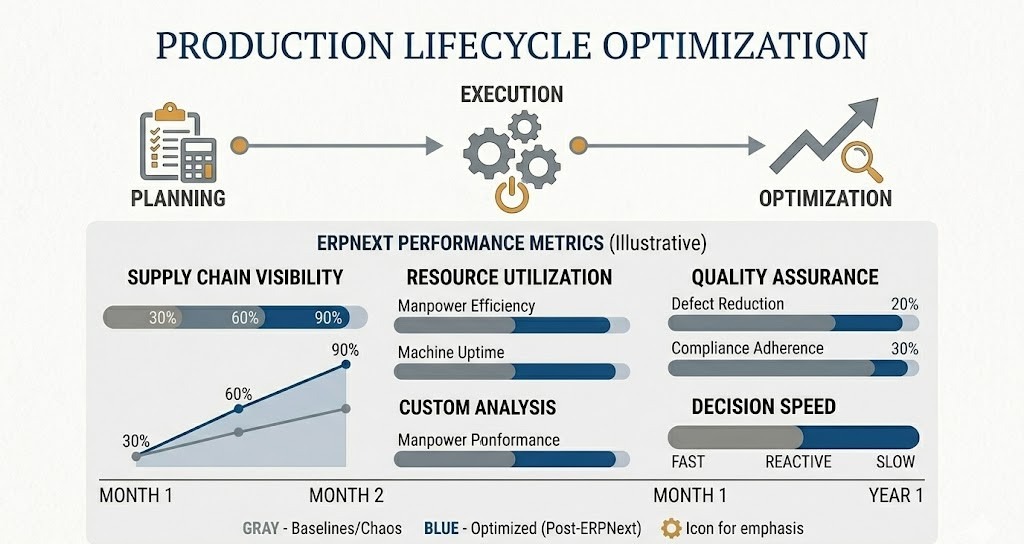
Once an ERP system like ERPNext is in place, the impact on operations becomes immediately visible. Businesses experience fewer disruptions because production is planned and executed with clarity. Downtime reduces significantly, and teams spend less time resolving issues and more time improving output.
Forecasting becomes more accurate as real-time data provides better insights into demand and production capacity. This allows businesses to plan ahead confidently, rather than reacting to last-minute changes or shortages.
Inventory control also improves, as stock levels are continuously updated and aligned with production needs. This not only reduces waste but also ensures that resources are used efficiently, directly improving overall profitability.
Conclusion
Manufacturing doesn’t have to be chaotic. With the right system in place, businesses can move from unstructured operations to a streamlined, predictable production environment. The journey from confusion to clarity is not just about technology it’s about gaining control over every aspect of the business.
For SMEs, adopting an ERP system is no longer optional if they want to stay competitive. Efficiency, accuracy, and scalability are key to long-term growth, and manual processes simply cannot deliver at that level.
If you’re looking to transform your manufacturing operations and scale with confidence, now is the time to adopt ERPNext and build a system that supports consistent, predictable success.
Schedule a Consultation:
https://gnosysdigital.com/custom-manufacturing-operations-control-software-development/
