
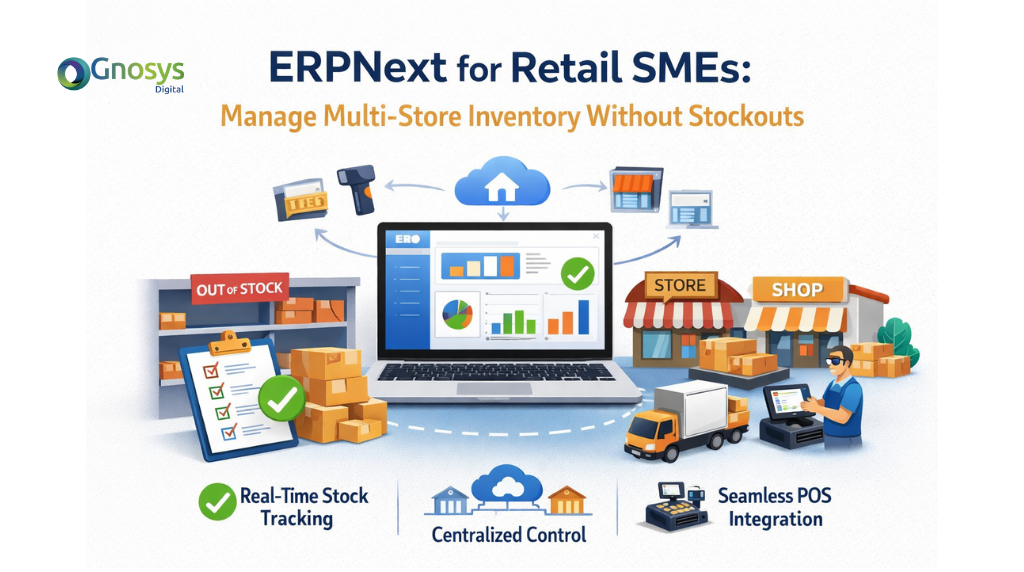
Running a retail business with multiple stores often feels like juggling too many moving parts at once. One day you’re dealing with stockouts on fast-moving items, and the next day your shelves are filled with products that simply aren’t selling. This constant imbalance not only impacts revenue but also damages customer trust, especially when they can’t find what they need.
For many retail SMEs, the root of the problem lies in manual processes and disconnected systems. Billing delays at the counter, lack of real-time inventory visibility, and dependency on spreadsheets create confusion across stores. When each location operates in isolation, business owners lose control over what’s happening on the ground.This is where an ERP system like ERPNext steps in to bring structure and clarity. By centralizing inventory, automating billing, and synchronizing data across all stores, it transforms retail operations from chaotic to controlled. Instead of reacting to problems, retailers can finally operate with confidence and foresight.
Common Retail Challenges
Retail SMEs often operate in a constant state of firefighting, where daily issues consume more time than actual business growth. One of the most common problems is frequent stockouts, especially for fast-moving items. When customers walk in and can’t find what they need, it directly translates into lost sales and, over time, lost loyalty.
Billing inefficiencies add another layer of frustration to the customer experience. Slow or manual billing processes lead to long queues, especially during peak hours, which can push customers away. In today’s fast-paced retail environment, even a few extra minutes at checkout can make a significant difference in customer satisfaction and repeat business.
Key retail challenges include:
- Frequent stockouts leading to lost sales opportunities
- Billing delays causing long queues and poor experience
- Lack of central control across multiple stores
- Manual tracking resulting in errors and mismanagement
Why Traditional Systems Fail
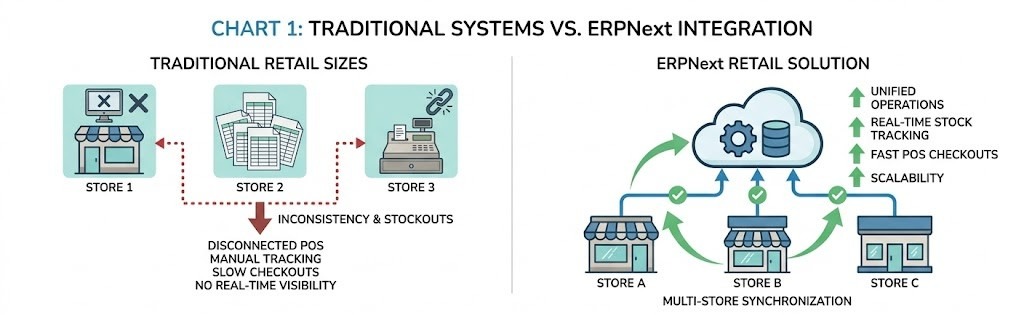
Many retail SMEs start their journey with tools like Excel sheets or standalone POS systems because they are easy to adopt and low in cost. However, as the business grows, these systems fail to keep up with increasing complexity. Since they don’t sync with each other, each store ends up maintaining its own version of data, creating silos instead of a unified system.
The absence of real-time visibility becomes a critical issue in day-to-day operations. Business owners cannot accurately track stock levels, sales performance, or cash flow across stores at any given moment. Decisions are often based on outdated or incomplete information, which leads to poor planning and missed opportunities.
Scaling such systems to manage multiple stores becomes extremely difficult over time. Data duplication, inconsistencies, and manual updates increase exponentially, making operations inefficient and error-prone. Instead of supporting growth, traditional systems start becoming a bottleneck that holds the business back.
How ERPNext Solves Retail Problems
Modern retail challenges require more than patchwork solutions, and this is where ERPNext provides a complete transformation. Instead of using disconnected tools for billing, inventory, and reporting, ERPNext brings everything into a single unified system. This means every transaction, stock update, and sales record is automatically reflected across the entire business without manual intervention.
One of the biggest advantages is real-time stock tracking across all stores. Whether a product is sold in one outlet or transferred between locations, the system updates instantly, giving business owners complete visibility at any moment. This eliminates guesswork and ensures that decisions around purchasing, replenishment, and sales are based on accurate, up-to-date data.
ERPNext also introduces centralized control through cloud access, allowing retailers to manage multiple stores from a single dashboard. Owners and managers can monitor performance, track inventory, and review reports from anywhere, without being physically present at each location. This level of control not only simplifies operations but also makes it much easier to scale the business efficiently.
ERPNext POS + Inventory Management
A smooth checkout experience is critical in retail, and this is where ERPNext POS makes a noticeable difference. The system is designed for speed and efficiency, allowing store staff to complete transactions quickly even during peak hours. With a clean interface and minimal steps, billing becomes faster, reducing queues and improving the overall customer experience.
What makes it even more powerful is the seamless connection between POS and inventory. Every time a sale is made, stock is automatically deducted in real time without any manual updates. This ensures that inventory levels are always accurate across all stores, helping retailers avoid both stockouts and overstocking situations.
The system also supports barcode scanning, making product identification instant and error-free during billing. Additionally, handling returns and exchanges becomes straightforward, as the system can quickly reference previous transactions and update stock accordingly. This level of automation not only saves time but also brings consistency and reliability to everyday retail operations.
Multi-Store Synchronization
Managing multiple retail outlets becomes significantly easier with ERPNext, as it brings all store operations into a single unified dashboard. Instead of switching between systems or relying on store-level reports, business owners can monitor sales, stock, and performance of every outlet from one place. This centralized visibility helps in making faster and more informed decisions.
Stock transfer between stores is another major advantage that eliminates unnecessary purchasing and delays. If one outlet runs low on a product while another has excess stock, items can be easily transferred within the system. Every transfer is tracked and recorded, ensuring transparency and maintaining accurate inventory levels across all locations.
Real-time updates ensure that every store stays in sync at all times, whether it’s a sale, return, or stock movement. With central warehouse integration, retailers can manage bulk inventory efficiently and distribute it across outlets as needed. This creates a smooth flow of goods, reduces wastage, and ensures that products are always available where customers need them.
Smart Reporting & Business Insights
Data becomes truly valuable only when it helps you make better decisions, and this is where ERPNext stands out. The system provides detailed sales reports that can be filtered by store, product, or specific time periods, giving retailers a clear understanding of what is performing well and what needs attention. Instead of relying on assumptions, business owners can base their strategies on actual performance data.
Inventory insights go beyond just knowing stock levels, as ERPNext helps identify stock aging and fast-moving items with precision. Retailers can quickly spot products that are sitting unsold for too long and take action through discounts or promotions. At the same time, high-demand products can be restocked proactively, ensuring that sales opportunities are never missed.
| Insight Type | What You See | Business Impact |
| Sales Reports | Store/Product/Time-wise performance | Identify top-performing areas |
| Stock Aging | Dead or slow-moving inventory | Reduce losses with better planning |
| Fast-Moving Items | High-demand products | Ensure continuous availability |
| Profitability | Margin by product/store | Focus on high-profit segments |
Conclusion
In a competitive retail environment, having control over your operations is no longer optional it’s essential. ERPNext brings together inventory, billing, reporting, and multi-store management into one seamless system, giving retailers complete visibility and operational efficiency. Instead of dealing with daily chaos, businesses can run on structured processes that support growth.
For retail SMEs looking to scale, the right system makes all the difference. ERPNext eliminates the common barriers of manual work, disconnected data, and lack of control, allowing businesses to expand confidently without increasing complexity. Whether you’re managing two stores or twenty, the system grows with you while keeping operations smooth and predictable.
If you’re ready to move beyond spreadsheets and outdated systems, now is the time to take the next step. Start your journey with ERPNext and experience a smarter way to manage your retail business. Book a demo today and see how you can transform your operations with the right technology in place.
Schedule a Consultation:
https://gnosysdigital.com/erpnext-implementation/erpnext-for-retail-smes/
