

Operational chaos in healthcare doesn’t just waste resources; it can put patient safety and care quality at risk
Hospitals, clinics, and diagnostic centers operate under constant pressure. Clinical excellence must coexist with regulatory compliance, financial accuracy, data security, and operational efficiency. When systems are fragmented, even the most capable medical teams struggle to deliver consistent outcomes.
ERPNext provides a unified healthcare ERP framework that brings structure, control, and visibility across clinical and administrative operations, without interfering with patient-focused care.
This article explains how ERPNext enables healthcare organizations to replace operational chaos with coordinated, accountable systems.
The Core Challenge in Healthcare Operations
Operational inefficiencies in healthcare don’t just slow processes; they can directly affect patient care, compliance, and organizational performance.
Most healthcare institutions face similar structural bottlenecks, regardless of size or specialty:
- Fragmented patient information: Clinical records, billing data, pharmacy usage, and inventory details often exist in silos, forcing teams to rely on manual reconciliation and repeated data entry.
- Disjointed departmental workflows: Coordination between clinical teams, billing staff, pharmacy operations, and inventory managers is heavily dependent on human intervention, increasing the risk of delays, errors, and miscommunication.
- Billing and insurance delays: Charges may be generated late, claims can be held up, and financial reconciliation becomes a time-consuming administrative task rather than a controlled process.
- Limited leadership visibility: Without a unified system, executives and compliance teams depend on static reports and manual summaries, restricting their ability to respond to operational or regulatory issues in real time.
Hospitals often spend 20–30% of administrative time reconciling fragmented data across departments, which diverts attention and resources away from patient care.
These challenges are not caused by inadequate clinical expertise. They stem from fragmented operational systems that fail to support the complexity of modern healthcare delivery.
Unified Patient Records and Clinical Flow
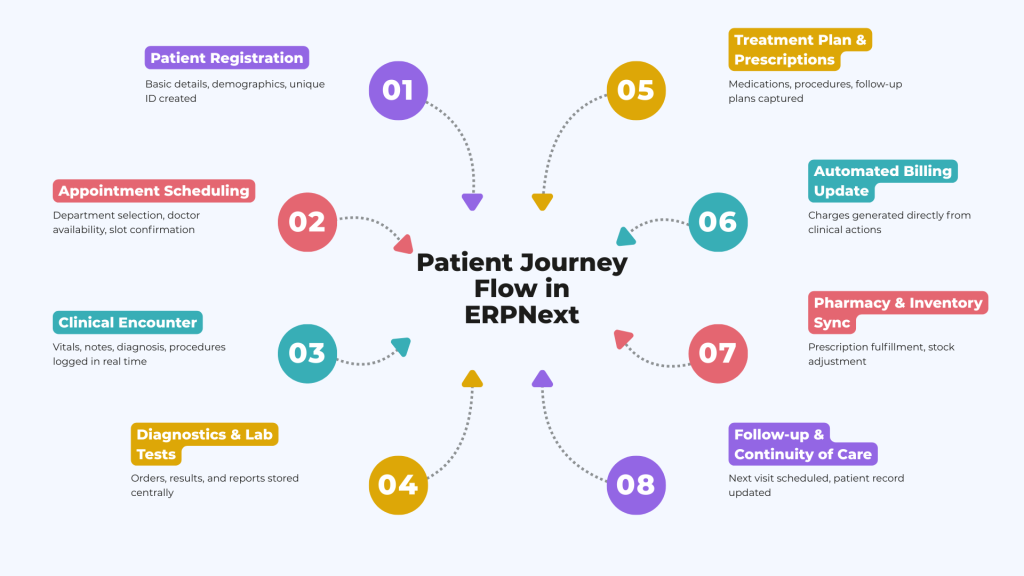
Healthcare teams often work with disconnected systems that slow down decisions and introduce errors. ERPNext centralizes the entire patient journey into one structured workflow.
Core Components Managed in ERPNext:
- Patient Registration
Demographic details are captured once and updated system-wide. - Appointment & Visit History
Complete scheduling lifecycle stored in a single timeline. - Clinical Encounters & Diagnostics
Consult notes, vitals, lab tests, and treatment plans recorded in real time. - Practitioner Roles & Availability
Centralized view of doctors, schedules, and departmental responsibilities.
Impact:
Teams work with the same live data, reducing manual handoffs, eliminating duplicates, and improving clinical accuracy.
Streamlined Appointment and Resource Management
ERPNext organizes appointments and resources in one place, preventing conflicts, reducing delays, and improving patient flow.
What ERPNext Enables
Centralized Scheduling
All appointments across departments and locations are managed in one place, improving visibility and coordination.
Practitioner Availability
The system tracks individual practitioner schedules, workloads, and availability so slots are assigned accurately.
Real-Time Capacity Tracking
Department and facility capacity is visible at all times, helping teams avoid overbooking and manage patient flow effectively.
Automated Patient Notifications
Patients receive automated reminders, confirmations, and follow-ups, reducing no-shows and improving communication.
Operational Impact
By consolidating schedules and resources into a single platform, ERPNext minimizes delays, balances clinical workloads, and improves overall efficiency. Patients experience shorter wait times, and staff operate with clarity and predictability.
Billing, Insurance, and Financial Control
ERPNext links clinical actions directly to billing and insurance, reducing errors, speeding up claims, and providing clear financial visibility.
What ERPNext Enables
Automated Billing
Charges are generated directly from recorded treatments and services, reducing errors and speeding up the billing process.
Insurance and Payer Tracking
Insurance details are linked to patient encounters, ensuring proper claim submission and faster approvals.
Real-Time Financial Visibility
Teams can monitor revenue, receivables, and outstanding balances without relying on manual reconciliation.
Accurate Tax and GST Compliance
The system calculates taxes precisely and provides structured reporting for regulatory requirements.
Operational Impact
By aligning clinical actions with financial events, ERPNext reduces revenue leakage, shortens billing cycles, and supports consistent financial discipline. Clinicians remain focused on patient care, while administrative teams gain predictable and transparent financial control.
Pharmacy and Medical Inventory Management
ERPNext prevents shortages, expired stock, and tracking errors by unifying pharmacy and medical inventory in one system, directly tied to prescriptions and billing.
Core Functions
1. Real-time stock status
Accurate, up-to-date visibility of all medicines and consumables, helping teams plan and respond without delays.
2. Batch and expiry monitoring
Every item is tracked by batch and expiry date to maintain compliance and protect patient safety.
3. Usage-based replenishment
The system analyses actual consumption patterns and triggers timely purchase requirements to avoid both shortages and excess stock.
4. Direct clinical and billing linkage
Inventory updates automatically whenever prescriptions are issued or services are billed, keeping clinical, pharmacy, and finance operations aligned.
Why It Matters
ERPNext strengthens supply chain reliability, reduces wastage, and keeps procurement costs under control. With inventory connected to clinical and financial workflows, healthcare teams can deliver uninterrupted care without facing material shortages or operational inefficiencies.
Compliance, Audit, and Data Security
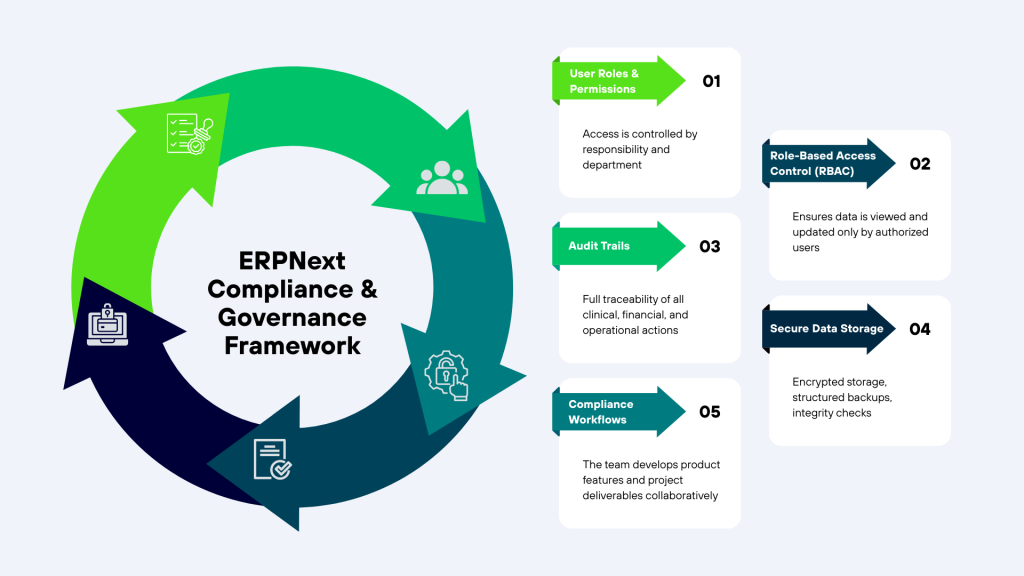
Healthcare organizations operate under strict regulatory, privacy, and data protection requirements. Failing to maintain control over access, data integrity, and reporting can expose institutions to significant legal, financial, and operational risk.
ERPNext simplifies compliance with clear audit trails, role-based access, and secure data storage, making audits predictable and less disruptive.
Key compliance capabilities include:
- Role-based access control to ensure users access only the data relevant to their responsibilities
- Complete audit trails for clinical and financial records, enabling full transparency and traceability
- Secure, auditable data storage that supports regulatory reporting and protects data integrity
- Configurable workflows aligned with internal and external compliance requirements, ensuring consistent adherence to standards
With these controls in place, audits become structured, predictable, and far less disruptive. Healthcare organizations can reduce compliance risk, ensure data integrity, and lower administrative effort, all while maintaining operational efficiency and patient safety.
Management Dashboards and Decision Intelligence
ERPNext dashboards give leaders live insights into patient flow, finances, and inventory, enabling faster decisions and better resource management.
What the Dashboards Deliver
1. Patient flow insights
Live visibility into patient volumes, appointment trends, and service utilization across departments.
2. Department performance metrics
Operational and clinical efficiency indicators to identify gaps, bottlenecks, and improvement opportunities.
3. Real-time financial overview
Cash flow status, receivables, collections progress, and revenue movement are available in a single consolidated view.
4. Inventory and cost intelligence
Consumption trends, cost patterns, stock turnover insights, and procurement impact on budgets.
Why It Matters
These dashboards transform ERPNext into a decision-support engine. Leaders gain the ability to act on live data, increase accountability, and strengthen strategic planning. The result is faster operational response, better resource allocation, and a more controlled, insight-driven healthcare environment.
Scalable for Growing Healthcare Institutions
Healthcare organizations are constantly evolving, adding new services, expanding locations, and increasing patient volume. Systems that cannot scale efficiently create operational bottlenecks, higher costs, and disruptions in patient care.
ERPNext scales as your healthcare organization grows, supporting new services, locations, and patient volumes without disrupting operations.
Key features include:
- Modular architecture that allows new capabilities to be added as organizational needs evolve
- Configurable workflows that adapt to real-world operations without heavy or costly customization
- Multi-location and multi-department support to unify operations across clinics, hospitals, and specialty centers
With ERPNext, healthcare organizations can expand services, open new locations, and increase operational capacity while maintaining continuity of care, operational efficiency, and long-term stability.
Why ERPNext Is a Strategic Fit for Healthcare
Healthcare organizations need an ERP system designed for real-world clinical and administrative workflows, not one adapted as an afterthought. ERPNext delivers a purpose-built, flexible framework that supports the complex operations of modern healthcare institutions.
Key advantages include:
- Open and transparent architecture, providing adaptability and control over all operational processes
- No vendor lock-in, enabling organizations to customize, scale, and innovate without dependency constraints
- Cost-effective implementation, reducing the total cost of ownership compared to legacy healthcare ERP systems
- Long-term operational stability, supporting hospitals, clinics, and multi-location healthcare networks
Most importantly, ERPNext aligns technology with patient care. Instead of creating friction between operations and clinical teams, it enhances workflow efficiency, ensures data accuracy, and strengthens compliance, allowing healthcare professionals to focus on what matters most: delivering safe, effective patient care.
Healthcare Operations: Traditional Systems vs ERPNext
| Area | Traditional Healthcare Systems | ERPNext for Healthcare |
|---|---|---|
| Patient Records | Fragmented across multiple systems | Unified, centralized patient data |
| Clinical & Billing Integration | Manual coordination required | Automatic linkage between care and billing |
| Pharmacy & Inventory | Separate systems, delayed updates | Real-time inventory linked to prescriptions |
| Billing Accuracy | High risk of errors and delays | Billing is generated directly from clinical actions |
| Insurance Processing | Manual tracking and reconciliation | Structured payer and claims tracking |
| Reporting & Visibility | Static, delayed reports | Real-time dashboards and insights |
| Compliance & Audits | Manual, disruptive audits | Built-in audit trails and access control |
| Scalability | Costly and complex expansions | Modular and scalable architecture |
| Total Cost of Ownership | High licensing and customization costs | Cost-effective, no vendor lock-in |
Ready to Transform Your Healthcare Operations?
If your clinic, hospital, or medical center is struggling with fragmented systems, manual processes, or delayed reporting, a tailored ERPNext implementation can make the difference.
At Gnosys Digital, we specialize in applying ERPNext specifically for healthcare workflows, from patient management and billing to pharmacy inventory and compliance reporting. Our team handles implementation, customization, data migration, and staff training so your organization gains clarity and efficiency without disrupting patient care.
Take the next step toward operational excellence:
👉 Book a Free Healthcare ERP Discovery Call
Start with a no-obligation consultation and receive a personalized roadmap for your healthcare ERP transformation.
